
Question 221 markMCQEasy
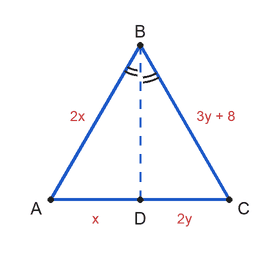
From the given figure, if ∠A = ∠C, we get :
Confirming your payment
Sign up now and get 250 free tokens.
Isosceles Triangles · Question 22 of 58
From the given figure, if ∠A = ∠C, we get :
(A) ,
(B) ,
(C) ,
(D) ,
Answer: (D) ,
Concept: Sides opposite equal angles of a triangle are equal. Two triangles are congruent by S.S.S., S.A.S., A.S.A. (or A.A.S.) or R.H.S., and then their corresponding parts are equal (C.P.C.T.C.).
Step 1 — Use ∠A = ∠C.
In ΔABC, ∠A = ∠C, so the sides opposite them are equal: BC = BA. From the figure this gives the first equation.
Step 2 — Use the bisector BD.
The figure marks BD as the bisector of ∠B. In ΔABD and ΔCBD: AB = CB (Step 1), ∠ABD = ∠CBD, and BD is common. So ΔABD ≅ ΔCBD (S.A.S.), and AD = CD.
Step 3 — Solve.
Put x = 2y into the first equation.
Then x is twice 8, so x = 16.
Step 4 — Check.
AB = 2 × 16, which is 32.
BC = 3 × 8 + 8, which is 32.
AD = 16 and DC = 2 × 8, which is 16. Both pairs are equal.
Watch out: Two equations are needed for two unknowns; use both pairs of equal sides.
Why the other options are wrong:
Therefore, x = 16 and y = 8, option (D).