
Question 303 marksMedium
If the bisector of an angle of a triangle bisects the opposite side, prove that the triangle is isosceles.
Confirming your payment
Sign up now and get 250 free tokens.
Isosceles Triangles · Question 30 of 58
If the bisector of an angle of a triangle bisects the opposite side, prove that the triangle is isosceles.
Solution:
Concept: Two triangles are congruent by S.S.S., S.A.S., A.S.A. (or A.A.S.) or R.H.S., and then their corresponding parts are equal (C.P.C.T.C.). Sides opposite equal angles of a triangle are equal.
Given: The bisector of ∠A of ΔABC meets BC at D, and BD = DC.
Step 1 — Set up and construct.
In ΔABC let AD bisect ∠A, with D on BC and BD = DC.
Produce AD to E so that DE = AD, and join EC.
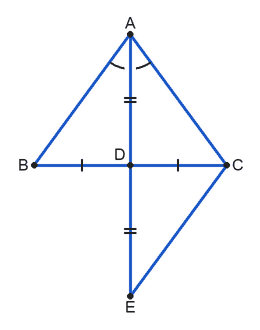
Step 2 — ΔABD ≅ ΔECD.
BD = CD (given)
∠ADB = ∠EDC (vertically opposite angles)
AD = ED (construction)
So ΔABD ≅ ΔECD (S.A.S.). Hence AB = EC and ∠BAD = ∠CED (C.P.C.T.C.).
Step 3 — ΔACE is isosceles.
∠BAD = ∠CAD (AD bisects ∠A), and ∠BAD = ∠CED, so ∠CED = ∠CAD. In ΔACE these are the angles at E and at A, so the sides opposite them are equal: AC = EC.
Step 4 — Conclude.
AB = EC and AC = EC, so AB = AC and ΔABC is isosceles.
Watch out: Doubling the median (DE = AD) is the key construction; without it there is no pair of congruent triangles.
Therefore, the triangle is isosceles (AB = AC). Hence proved.