
Question 293 marksMedium
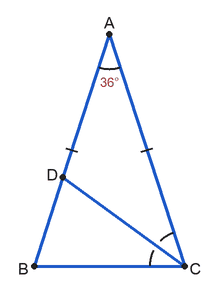
In a triangle ABC, AB = AC and ∠A = 36°. If the internal bisector of ∠C meets AB at point D, prove that AD = BC.
Confirming your payment
Sign up now and get 250 free tokens.
Isosceles Triangles · Question 29 of 58
In a triangle ABC, AB = AC and ∠A = 36°. If the internal bisector of ∠C meets AB at point D, prove that AD = BC.
Solution:
Concept: Angles opposite equal sides of a triangle are equal. Sides opposite equal angles of a triangle are equal.
Given: AB = AC, ∠A = 36°, and the bisector of ∠C meets AB at D.
Step 1 — Base angles.
AB = AC, so ∠B = ∠ACB.
They share what is left of 180° after ∠A = 36°.
Step 2 — Halve ∠C.
CD bisects ∠ACB, so ∠ACD and ∠BCD are each half of 72°.
Step 3 — ΔADC is isosceles.
In ΔADC, ∠A = 36° and ∠ACD = 36°, so these angles are equal. The sides opposite them, CD and AD, are equal.
Step 4 — ΔBCD is isosceles.
In ΔBCD the angle at D is the third angle.
So ∠BDC = ∠B, and the sides opposite them, BC and CD, are equal.
Step 5 — Join the results.
AD = CD and CD = BC, so AD = BC.
Watch out: CD is the link: it equals AD in one triangle and BC in the other.
Therefore, AD = BC. Hence proved.