
Question 201 markMCQEasy
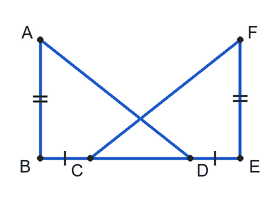
In the given figure, AB ⊥ BE, EF ⊥ BE, AB = EF and BC = DE, then :
Confirming your payment
Sign up now and get 250 free tokens.
Isosceles Triangles · Question 20 of 58
In the given figure, AB ⊥ BE, EF ⊥ BE, AB = EF and BC = DE, then :
(A) ΔABD ≅ ΔEFC
(B) ΔABD ≅ ΔFEC
(C) ΔABD ≅ ΔECF
(D) ΔABD ≅ ΔCEF
Answer: (B) ΔABD ≅ ΔFEC
Concept: Two triangles are congruent by S.S.S., S.A.S., A.S.A. (or A.A.S.) or R.H.S., and then their corresponding parts are equal (C.P.C.T.C.). The letters must be written in matching order.
Step 1 — Make BD equal to EC.
BC = DE.
Adding the common part CD to both gives BC + CD = DE + CD, that is BD = EC.
Step 2 — Find the congruence.
AB = FE (given)
∠ABD = ∠FEC, since both are 90° (AB ⊥ BE and EF ⊥ BE)
BD = EC (Step 1)
So the triangles are congruent by S.A.S.
Step 3 — Match the vertices in order.
The right angles match, so B ↔ E. The equal sides AB and FE then give A ↔ F, and BD, EC give D ↔ C. So ΔABD ≅ ΔFEC.
Watch out: A correct congruence statement lists matching vertices in the same positions.
Why the other options are wrong:
Therefore, ΔABD ≅ ΔFEC, option (B).