
Question 433 marksMedium
Equal sides AB and AC of an isosceles triangle ABC are produced. The bisectors of the exterior angles so formed meet at D.
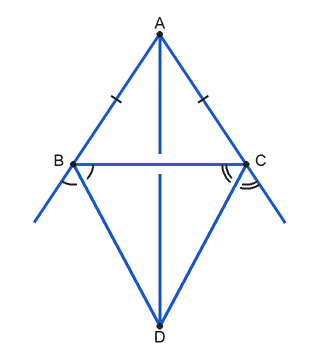
Prove that AD bisects angle A.
Confirming your payment
Sign up now and get 250 free tokens.
Isosceles Triangles · Question 43 of 58
Equal sides AB and AC of an isosceles triangle ABC are produced. The bisectors of the exterior angles so formed meet at D.
Prove that AD bisects angle A.
Solution:
Concept: Angles opposite equal sides of a triangle are equal. Sides opposite equal angles of a triangle are equal. Two triangles are congruent by S.S.S., S.A.S., A.S.A. (or A.A.S.) or R.H.S., and then their corresponding parts are equal (C.P.C.T.C.).
Given: AB = AC; AB and AC are produced; the bisectors of the exterior angles meet at D.
Step 1 — Equal exterior angles.
AB = AC, so ∠ABC = ∠ACB. Each exterior angle (at B and at C) is 180° minus one of these, so the exterior angles are equal.
Step 2 — ΔDBC is isosceles.
BD and CD bisect the equal exterior angles, so ∠DBC = ∠DCB.
The sides opposite them are equal:
DB = DC.
Step 3 — ΔABD ≅ ΔACD.
AB = AC (given)
DB = DC (Step 2)
AD is common to both triangles.
So ΔABD ≅ ΔACD (S.S.S.), and ∠BAD = ∠CAD (C.P.C.T.C.).
Watch out: ∠DBC is half the EXTERIOR angle at B, not half of ∠ABC.
Therefore, AD bisects ∠A. Hence proved.