
Question 263 marksMedium
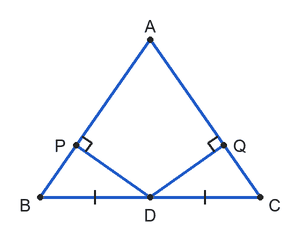
In the given figure, AB = AC. Prove that:
(i) DP = DQ
(ii) AP = AQ
(iii) AD bisects angle A
Confirming your payment
Sign up now and get 250 free tokens.
Isosceles Triangles · Question 26 of 58
In the given figure, AB = AC. Prove that:
(i) DP = DQ
(ii) AP = AQ
(iii) AD bisects angle A
Solution:
Concept: Angles opposite equal sides of a triangle are equal. Two triangles are congruent by S.S.S., S.A.S., A.S.A. (or A.A.S.) or R.H.S., and then their corresponding parts are equal (C.P.C.T.C.).
Given: AB = AC, BD = CD, DP ⊥ AB and DQ ⊥ AC (figure).
Step 1 — Read the figure.
The figure marks BD = CD (D is the mid-point of BC), DP ⊥ AB and DQ ⊥ AC. AB = AC, so ∠B = ∠C.
Step 2 — Part (i): ΔDPB and ΔDQC.
∠DPB = ∠DQC, since both are 90°
∠PBD = ∠QCD (the base angles B and C)
BD = CD (marked)
So ΔDPB ≅ ΔDQC (A.A.S.). Hence DP = DQ, and also BP = CQ (C.P.C.T.C.).
Step 3 — Part (ii): AP and AQ.
Take the equal pieces BP and CQ away from the equal sides AB and AC.
Since AB = AC and BP = CQ, we get AP = AQ.
Step 4 — Part (iii): AD bisects ∠A.
In ΔAPD and ΔAQD: AP = AQ, DP = DQ, and AD is common. So ΔAPD ≅ ΔAQD (S.S.S.), and ∠PAD = ∠QAD. So AD bisects ∠A.
Watch out: Part (ii) needs the extra equal parts BP = CQ from the congruence of part (i).
Therefore, (i) DP = DQ, (ii) AP = AQ and (iii) AD bisects ∠A. Hence proved.