
Question 383 marksMedium
In an equilateral triangle ABC; points P, Q and R are taken on the sides AB, BC and CA respectively such that AP = BQ = CR.
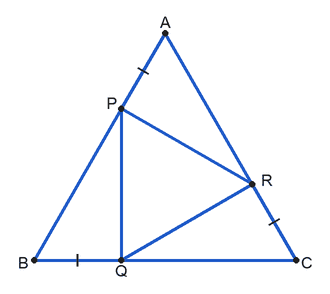
Prove that triangle PQR is equilateral.
Confirming your payment
Sign up now and get 250 free tokens.
Isosceles Triangles · Question 38 of 58
In an equilateral triangle ABC; points P, Q and R are taken on the sides AB, BC and CA respectively such that AP = BQ = CR.
Prove that triangle PQR is equilateral.
Solution:
Concept: Each angle of an equilateral triangle is 60°. Two triangles are congruent by S.S.S., S.A.S., A.S.A. (or A.A.S.) or R.H.S., and then their corresponding parts are equal (C.P.C.T.C.).
Given: ABC is equilateral; P, Q, R lie on AB, BC, CA, and AP, BQ, CR are equal.
Step 1 — The remaining parts are equal.
The sides AB, BC, CA are equal, and the pieces AP, BQ, CR are equal. Taking the equal pieces from the equal sides leaves equal pieces:
So PB, QC and RA are equal.
Step 2 — Three congruent triangles.
Look at ΔAPR, ΔBQP and ΔCRQ at the three corners.
AP, BQ and CR are equal (given).
∠A, ∠B and ∠C are each 60°.
AR, BP and CQ are equal (Step 1).
So ΔAPR ≅ ΔBQP ≅ ΔCRQ (S.A.S.).
Step 3 — Conclude.
The third sides PR, QP and RQ are corresponding sides, so they are equal (C.P.C.T.C.). ΔPQR has three equal sides.
Watch out: In each corner triangle the angle (60°) must lie between the two sides you use.
Therefore, ΔPQR is equilateral. Hence proved.