
Opening your dashboard
Class 12 Physics Chapter 15: Refraction of Light at Plane Surfaces Solutions
80 textbook questions with step-by-step answers, free to read, for ISC 2026-27.
Get talked through Ch 15, not just shown the answer
Reading a finished solution is not the same as being able to do it. The AI tutor takes one question at a time and works it with you, in your own words, until you can.
- Ask it out loud, in your own words
- It gives you the next step, not the answer
- Stuck on part (ii)? Start there
80 questions with solutions
1–5 marks · Mixed difficulty
The first 33 solutions are on this page. This chapter is a long one, so the rest open on their own page to keep this one quick to load.
- 11 mark
Question 1
To an observer on the Earth, the stars appear to twinkle. This can be ascribed to
Solve with AIAnswer
(A) The fact that stars do not emit light continuously
(B) Frequent absorption of starlight by their own atmosphere
(C) Frequent absorption of starlight by the Earth's atmosphere
- Correct
(D) The refractive index fluctuations in the Earth's atmosphere
Answer: (D) The refractive index fluctuations in the Earth's atmosphere
Key idea: Light bends (refracts) wherever the refractive index of the medium changes. The refractive index of air depends on its density, and so on its temperature.
Step 1 — Describe the air the starlight passes through.
Starlight crosses many kilometres of the Earth's atmosphere. Moving pockets of warmer and cooler air have slightly different densities, so the refractive index along the path keeps changing from moment to moment.
Step 2 — See what this does to the light from a star.
A star is so far away that it acts as a point source. The changing refraction shifts the direction of its thin beam of light and changes the amount of light entering the eye, many times a second.
Step 3 — Connect this to twinkling.
The star therefore seems to flicker in brightness and to jump slightly in position, which we call twinkling. A planet looks like a small disc, so the flickers from different points of the disc average out, and planets twinkle much less.
Why the other options are wrong:
- (A) is wrong: Stars send out light steadily; the flicker is produced in our atmosphere, which is why stars seen from a spacecraft above the atmosphere do not twinkle.
- (B) is wrong: Absorption in a star's own atmosphere removes certain wavelengths steadily (it causes dark lines in the star's spectrum); it does not change many times a second, so it cannot cause twinkling.
- (C) is wrong: Absorption in the Earth's atmosphere dims starlight fairly steadily, more near the horizon; the rapid flicker comes from changing refraction, not from absorption.
Therefore, stars twinkle because of fluctuations in the refractive index of the Earth's atmosphere: option (D).
- 21 mark
Question 2
When light travels from one medium to the other of which the refractive index is different, then which of the following will change?
Solve with AIAnswer
(A) Frequency, wavelength and velocity
(B) Frequency and wavelength
(C) Frequency and velocity
- Correct
(D) Wavelength and velocity
Answer: (D) Wavelength and velocity
Key idea: The speed of light in a medium of refractive index is . The speed, frequency and wavelength of a wave are linked by .
Step 1 — Decide whether the frequency changes.
The frequency is set by the source. Every wave crest arriving at the surface produces one crest in the second medium, so the number of crests per second is the same on both sides. The frequency does not change.
Step 2 — Decide whether the speed changes.
The speed in a medium is , so a medium with a different refractive index gives a different speed. The velocity changes.
Step 3 — Decide whether the wavelength changes.
With the frequency fixed, the wavelength is the speed divided by the frequency, so it changes in the same proportion as the speed.
Why the other options are wrong:
- (A) is wrong: It includes frequency, which stays the same; only the wavelength and the velocity change.
- (B) is wrong: It includes frequency, which does not change, and it leaves out velocity, which does change.
- (C) is wrong: It includes frequency, which does not change, and it leaves out wavelength, which changes along with the speed.
Therefore, the wavelength and the velocity change, while the frequency stays the same: option (D).
- 31 mark
Question 3
A light wave has a frequency of Hz and a wavelength of metres in a medium. The refractive index of the medium is
Solve with AIAnswer
- Correct
(A) 1.5
(B) 1.33
(C) 1.0
(D) 0.66
Answer: (A) 1.5
Key idea: The speed of a wave is .
The refractive index of a medium is , where is the speed of light in vacuum, .
Step 1 — Find the speed of light in the medium.
We multiply the frequency by the wavelength in the medium.
Step 2 — Find the refractive index.
We divide the speed in vacuum by the speed in the medium.
Why the other options are wrong:
- (B) is wrong: This is the refractive index of water; it would need a speed of about and so a wavelength of about m, not the given m.
- (C) is wrong: A refractive index of 1.0 would mean light travels at in the medium, so the wavelength would be m.
- (D) is wrong: This is the speed ratio , two-thirds cut to two decimal places; it is the reciprocal of the refractive index, and the refractive index of a material medium for light is greater than 1.
Therefore, the refractive index of the medium is 1.5: option (A).
- 41 mark
Question 4
White light is incident normally on a glass slab. Inside the glass slab
Solve with AIAnswer
- Correct
(A) Red light travels faster than other colours.
(B) Violet light travels faster than other colours.
(C) Yellow light travels faster than other colours.
(D) All colours travel at the same speed.
Answer: (A) Red light travels faster than other colours.
Key idea: Glass is a dispersive medium: its refractive index is slightly different for each colour, least for red and greatest for violet. The speed of each colour in glass is .
Step 1 — Compare the refractive indices of glass for the colours.
For ordinary crown glass the refractive index is about 1.51 for red light and about 1.53 for violet light, with the other colours in between.
Step 2 — Compare the speeds.
The speed is divided by the refractive index, so the colour with the smallest refractive index travels fastest. Red is fastest and violet is slowest.
Step 3 — See why normal incidence does not matter.
At normal incidence the colours are not bent apart, but inside the glass they still travel at their own speeds.
Why the other options are wrong:
- (B) is wrong: Violet has the largest refractive index in glass, so it is the slowest colour, not the fastest.
- (C) is wrong: Yellow has a refractive index between those of red and violet, so it is slower than red.
- (D) is wrong: Only in vacuum (and very nearly in air) do all colours share one speed; glass is dispersive, so their speeds differ.
Therefore, inside the glass slab red light travels faster than the other colours: option (A).
- 51 mark
Question 5
When light wave suffer reflection at the interface between air and glass, the change of phase of reflected wave is equal to
Solve with AIAnswer
(A) Zero
(B)
- Correct
(C)
(D)
Answer: (C)
Key idea: When a light wave is reflected at the surface of an optically denser medium, the reflected wave is inverted, which is a phase change of . Reflection at the surface of an optically rarer medium causes no phase change.
Step 1 — Decide which side the light comes from.
As usual, the light travels in air and is reflected at the surface of the glass. Glass is optically denser than air.
Step 2 — Apply the rule for reflection at a denser medium.
Reflection at the surface of a denser medium inverts the wave, so the phase changes by . This is equivalent to an extra path of half a wavelength.
Why the other options are wrong:
- (A) is wrong: Reflection with no phase change happens when light travelling inside the glass is reflected at the glass–air surface (reflection at a rarer medium), not for light reflected from the air side.
- (B) is wrong: For ordinary (not total) reflection at a transparent surface, the phase change is either zero or ; a change of does not occur.
- (D) is wrong: A phase change of brings the wave back to the same phase, so it is the same as no change; it does not describe the inversion at a denser medium.
Note: The key assumes the light is incident from the air side, as is usual. For light reflected inside the glass at the glass–air surface, the phase change would be zero.
Therefore, the change of phase of the reflected wave is π: option (C).
- 61 mark
Question 6
Monochromatic light is refracted from air into the glass of refractive index . The ratio of the wavelength of incident and refracted waves is
Solve with AIAnswer
(A)
(B)
- Correct
(C)
(D)
Answer: (C)
Key idea: The frequency of light does not change on refraction. Since , the wavelength is proportional to the speed, and the refractive index of glass is .
Step 1 — Write each wavelength in terms of the speed.
In air the light travels at , and in glass at ; the frequency is the same in both.
Step 2 — Divide the two wavelengths.
The frequency cancels, leaving the ratio of the speeds, which is the refractive index.
So the ratio of the incident wavelength to the refracted wavelength is .
Why the other options are wrong:
- (A) is wrong: It gives the ratio the wrong way round: is the refracted wavelength compared with the incident one.
- (B) is wrong: The wavelength changes by the same factor as the speed, , not ; this option is also the wrong way round, since the incident wavelength in air is the longer one.
- (D) is wrong: A ratio of holds for the frequencies, which do not change, not for the wavelengths.
Therefore, the ratio of the incident to the refracted wavelength is μ : 1: option (C).
- 71 mark
Question 7
A beam of monochromatic blue light of wavelength 4200 Å in air travels in water of refractive index . Its wavelength in water will be
Solve with AIAnswer
(A) 4200 Å
(B) 5800 Å
(C) 4150 Å
- Correct
(D) 3150 Å
Answer: (D) 3150 Å
Key idea: The frequency of light does not change when it enters water, but its speed falls by the factor . So the wavelength also falls by the factor : .
Step 1 — Write down the data.
The wavelength in air is 4200 Å, and the refractive index of water is .
Step 2 — Divide the wavelength in air by the refractive index.
Dividing by is the same as multiplying by .
Why the other options are wrong:
- (A) is wrong: This is the wavelength in air; in water the light slows down, so its wavelength becomes shorter.
- (B) is wrong: This is longer than the wavelength in air, but light in water has a shorter wavelength; even multiplying by by mistake gives 5600 Å, so this option matches no single slip.
- (C) is wrong: A fall of only 50 Å would need a refractive index of about 1.01 (4200 divided by 4150), far below the value for water.
Therefore, the wavelength of the blue light in water is 3150 Å: option (D).
- 81 mark
Question 8
A and B are two parallel sided transparent slabs of refractive indices and respectively. A ray is incident at an angle on the surface of separation of A and B and after refraction from B into air grazes the surface of B. Then
Solve with AIAnswer
(A)
- Correct
(B)
(C)
(D)
Answer: (B)
Key idea: At every boundary Snell's law says that has the same value on both sides. For a slab with parallel faces, the angle of refraction at one face equals the angle of incidence at the other face.
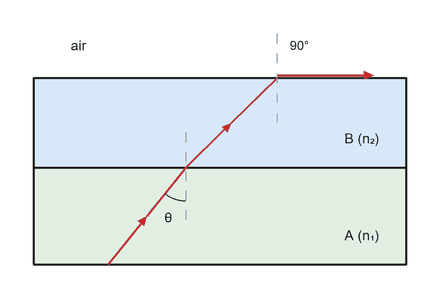
Step 1 — Apply Snell's law at the surface between A and B.
Let be the angle of refraction in slab B.
Step 2 — Apply Snell's law at the top face of B.
The faces of B are parallel, so the ray meets the top face of B at the angle . It grazes the surface on leaving, so its angle of refraction in air is .
Step 3 — Combine the two results.
Both equations contain , so we can put the first one equal to 1.
The refractive index drops out: slab B only carries the ray across, and the grazing condition depends on and air alone.
Why the other options are wrong:
- (A) is wrong: The value is , the angle of incidence at the top face of B, not the angle in slab A.
- (C) is wrong: The condition is the critical condition at the A–B surface itself; the ray would then graze along that surface and never reach the air.
- (D) is wrong: Snell's law at the A–B surface gives the ratio as ; setting itself equal to this ratio of two sines mixes up the two angles.
Therefore, sin θ = 1/n₁: option (B).
- 91 mark
Question 9
A vessel of depth cm is half filled with a liquid of refractive index and the upper half with a liquid of refractive index . The apparent depth of the vessel seen perpendicularly is
Solve with AIAnswer
(A)
- Correct
(B)
(C)
(D)
Answer: (B)
Key idea: Seen along the normal, a layer of liquid of real depth and refractive index appears to be only deep. When light from the bottom crosses several layers, the apparent depths of the layers add.
Step 1 — Find the apparent depth of the lower layer.
The lower half of the vessel holds liquid of refractive index to a depth .
Step 2 — Find the apparent depth of the upper layer.
The upper half holds liquid of refractive index , also to a depth .
Step 3 — Add the two apparent depths.
The bottom of the vessel appears at the sum of the two apparent depths below the top surface.
Why the other options are wrong:
- (A) is wrong: As printed, the fraction equals 1, so this option is just , the real depth of one layer, with refraction ignored.
- (C) is wrong: It takes for each layer, but each layer is only deep, so it is twice the correct value.
- (D) is wrong: It divides the whole depth by the product , but each layer reduces only its own depth, and the two apparent depths add.
Therefore, the apparent depth of the vessel is d[1/μ₁ + 1/μ₂]: option (B).
- 101 mark
Question 10
A wave has velocity in medium P and velocity in medium Q. If the wave is incident in medium P at an angle of , then the angle of refraction will be
Solve with AIAnswer
(A)
(B)
(C)
- Correct
(D)
Answer: (D)
Key idea: Snell's law can be written with speeds: , where and are the speeds of the wave in the two media.
Step 1 — Write Snell's law for this wave.
The wave goes from P, where its speed is , into Q, where its speed is .
Step 2 — Make the subject and put in the values.
We multiply both sides by and by .
Step 3 — Find the angle of refraction.
The angle whose sine is 1 is a right angle.
The critical angle for the wave going from P to Q is , because its sine equals the speed ratio . The wave is incident exactly at the critical angle, so the refracted wave grazes along the surface.
Why the other options are wrong:
- (A) is wrong: An angle of refraction equal to the angle of incidence would need equal speeds in P and Q, but the speed doubles.
- (B) is wrong: An angle of would need to be 0.707, so the speed in Q would have to be only times the speed in P, not 2 times.
- (C) is wrong: An angle of would need to be 0.866, so the speed in Q would have to be times the speed in P, not 2 times.
Therefore, the angle of refraction is 90°: option (D).
- 111 mark
Question 11
Light travels through a glass plate of thickness and having refractive index . If is the velocity of light in vacuum, the time taken by the light to travel this thickness of glass is
Solve with AIAnswer
(A)
(B)
- Correct
(C)
(D)
Answer: (C)
Key idea: Light travels more slowly in glass: its speed there is . The time to cross a distance is the distance divided by the speed.
Step 1 — Find the speed of light in the glass.
The refractive index is the ratio of the speed in vacuum to the speed in glass.
Step 2 — Find the time to cross the thickness.
We call the time , so that it is not confused with the thickness , and divide the thickness by the speed.
Why the other options are wrong:
- (A) is wrong: It comes from taking the speed in glass as , faster than light in vacuum; light is slower in glass, so the speed is .
- (B) is wrong: It has the unit metre times metre per second, , so it cannot be a time.
- (D) is wrong: It multiplies the thickness by the speed instead of dividing by it, so its unit is , not a time.
Therefore, the time taken by light to cross the glass is nt/c: option (C).
- 121 mark
Question 12
When a light wave goes from air into water, the quantity that remains unchanged is its
Solve with AIAnswer
(A) Speed
(B) Amplitude
- Correct
(C) Frequency
(D) Wavelength
Answer: (C) Frequency
Key idea: The frequency of a wave is set by its source. The speed of light depends on the medium, .
Step 1 — Decide whether the frequency changes.
Every wave crest that reaches the water surface produces one crest in the water, so the number of crests per second stays the same. The frequency is unchanged.
Step 2 — Check the other quantities.
The speed falls in water, and since the wavelength is the speed divided by the frequency, the wavelength falls as well. Part of the light is reflected at the surface, so the amplitude of the wave that goes into the water is also different.
Why the other options are wrong:
- (A) is wrong: The speed falls from about in air to in water, about for a refractive index of .
- (B) is wrong: Part of the light is reflected at the water surface, so the transmitted wave has a different amplitude from the incident wave.
- (D) is wrong: The wavelength falls in water, because the speed falls while the frequency stays fixed.
Therefore, the quantity that remains unchanged is the frequency: option (C).
- 131 mark
Question 13
A cut diamond sparkles because of its
Solve with AIAnswer
(A) Hardness
- Correct
(B) High refractive index
(C) Emission of light by the diamond
(D) Absorption of light by the diamond
Answer: (B) High refractive index
Key idea: The critical angle of a material is given by . A high refractive index gives a small critical angle, so total internal reflection happens for a wide range of directions.
Step 1 — Find the critical angle of diamond.
The refractive index of diamond is about 2.42.
Step 2 — Explain what happens inside a cut diamond.
The faces of a diamond are cut so that most light entering through the top meets the back faces at more than . This light is totally reflected several times inside the stone and comes out through a few top faces in bright flashes, so the diamond sparkles. The high dispersion of diamond also spreads white light into colours (its "fire").
Why the other options are wrong:
- (A) is wrong: A diamond's hardness lets it keep sharp, polished faces, but it does not change the path of light inside the stone; the sparkle comes from refraction and total internal reflection.
- (C) is wrong: A diamond does not produce light of its own; it only redirects the light falling on it.
- (D) is wrong: Absorbing light would make the stone darker and duller, not sparkling; a good diamond absorbs very little visible light.
Therefore, a cut diamond sparkles because of its high refractive index: option (B).
- 141 mark
Question 14
Critical angle of light passing from glass to air is minimum for
Solve with AIAnswer
(A) Red
(B) Green
(C) Yellow
- Correct
(D) Violet
Answer: (D) Violet
Key idea: The critical angle for light going from glass to air is given by . A larger refractive index gives a smaller , and so a smaller critical angle.
Step 1 — Compare the refractive index of glass for the colours.
Glass is dispersive: its refractive index rises steadily from red, through yellow and green, to violet.
Step 2 — Compare the critical angles.
Violet has the largest refractive index, so it has the smallest value of . Its critical angle is therefore the smallest.
Why the other options are wrong:
- (A) is wrong: Red has the smallest refractive index in glass, so it has the largest critical angle.
- (B) is wrong: Its refractive index is smaller than that of violet, so green light has a larger critical angle than violet light.
- (C) is wrong: Its refractive index is smaller than those of green and violet, so yellow light has a larger critical angle still.
Therefore, the critical angle from glass to air is minimum for violet light: option (D).
- 151 mark
Question 15
If the critical angle for total internal reflection from a medium to vacuum is , the velocity of light in the medium is
Solve with AIAnswer
(A) m/s
- Correct
(B) m/s
(C) m/s
(D) m/s
Answer: (B) m/s
Key idea: The critical angle from a medium to vacuum is given by .
The speed of light in the medium is .
Step 1 — Find the refractive index from the critical angle.
We take the reciprocal of .
Step 2 — Find the speed of light in the medium.
We divide the speed of light in vacuum by the refractive index.
Why the other options are wrong:
- (A) is wrong: This is the speed of light in vacuum; a medium with a critical angle has a refractive index greater than 1, so light is slower in it.
- (C) is wrong: It multiplies by the refractive index instead of dividing; with the light in the medium is slower than in vacuum, not faster.
- (D) is wrong: This speed would need a refractive index of , which gives a critical angle of about , not .
Therefore, the velocity of light in the medium is 1.5 × 10⁸ m/s: option (B).
- 161 mark
Question 16
Which of the following is not due to total internal reflection?
Solve with AIAnswer
(A) Brilliance of diamond
(B) Working of optical fibre
- Correct
(C) Difference between apparent and real depth of a pond
(D) Mirage on hot summer days
Answer: (C) Difference between apparent and real depth of a pond
Key idea: Total internal reflection happens only when light in a denser medium meets a rarer medium at an angle of incidence greater than the critical angle. The apparent depth of a pond is caused by ordinary refraction.
Step 1 — Explain why a pond looks shallower.
Light from the bottom of the pond is refracted at the water surface into the air and bends away from the normal. The eye traces the rays back in straight lines, so the bottom appears raised. The light that forms this image leaves the water, so no total internal reflection is involved.
Step 2 — Check the other three effects.
Each of the other three effects depends on light being totally reflected inside a denser medium, as the bullets below show.
Why the other options are wrong:
- (A) is wrong: The brilliance of a cut diamond is due to total internal reflection: light is totally reflected many times inside the stone, whose critical angle is only about .
- (B) is wrong: An optical fibre works by total internal reflection: light is totally reflected again and again at the boundary between the core and the cladding of lower refractive index.
- (D) is wrong: A mirage is due to total internal reflection: light from a distant object bends gradually in the hot, rarer layers of air near the ground and is finally totally reflected upwards, so an inverted image is seen.
Therefore, the difference between the apparent and real depth of a pond is not due to total internal reflection: option (C).
- 171 mark
Question 17
A transparent solid cylindrical rod has a refractive index of . It is surrounded by air. A light ray is incident at the mid-point of one end of the rod as shown in the figure. The incident angle for which the light ray graze along the wall of the rod is
 Solve with AI
Answer
(A)
(B)
(C)
- Correct
(D)
Answer: (D)
Key idea: The ray grazes along the wall of the rod when it meets the wall at exactly the critical angle , where . The end face of the rod is perpendicular to its wall.
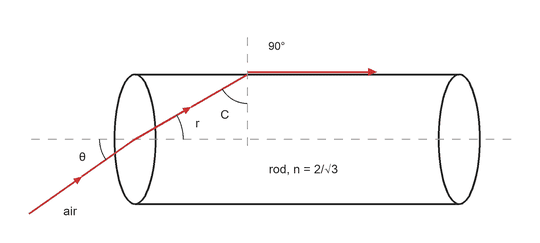
Step 1 — Find the critical angle at the wall.
We take the reciprocal of the refractive index .
Step 2 — Find the angle of refraction at the end face.
The normal to the end face (the rod's axis) is perpendicular to the normal to the wall. So the angle that the ray makes with the axis and the angle it makes with the wall's normal add up to .
Step 3 — Apply Snell's law at the end face.
The ray goes from air, of refractive index 1, into the rod.
This is about . For smaller values of the ray meets the wall at more than and is totally reflected, so it stays inside the rod.
Why the other options are wrong:
- (A) is wrong: The angle is , the angle of refraction inside the rod, not the angle in air.
- (B) is wrong: The angle is , the critical angle at the wall, not the angle of incidence on the end face.
- (C) is wrong: It takes equal to the refractive index itself; the number is about 1.155, and a sine can never exceed 1, so no such angle exists.
Therefore, the ray grazes along the wall when θ = sin⁻¹(1/√3): option (D).
- 181 mark
Question 18
What is refraction?
Solve with AIWritten solution
Solution:
Key idea: Light travels at different speeds in different media. In a medium of refractive index its speed is .
Step 1 — Describe what happens at the boundary.
When light passes at a slant from one transparent medium into another, for example from air into glass, its speed changes at the surface. Because of this change of speed, the ray changes its direction at the surface.
Step 2 — State the definition.
This change of direction is called refraction. A ray entering a denser medium bends towards the normal, and a ray entering a rarer medium bends away from it.
Note: At normal incidence the speed and the wavelength still change, but the ray goes straight on without bending.
Therefore, refraction is the bending of light rays at the surface of separation of two transparent media as light passes from one medium into the other, because its speed is different in the two media.
- 191 mark
Question 19
Can the absolute refractive index of a medium be less than unity?
Solve with AIWritten solution
Solution:
Key idea: The absolute refractive index of a medium is the ratio of the speed of light in vacuum, , to its speed in the medium.
Step 1 — Compare the speed of light in a medium with its speed in vacuum.
Light travels fastest in vacuum. In glass, water, air or any other ordinary medium, light travels more slowly, so is less than .
Step 2 — Decide the size of the refractive index.
Since is less than , the fraction is greater than 1. It equals 1 only for vacuum itself.
Note: For X-rays, and in some special media such as plasmas, the phase speed of the wave can be slightly greater than , giving a refractive index just below 1. This does not break relativity, because no energy or signal travels faster than . For light in ordinary media the refractive index is always greater than 1.
Therefore, no: for light in any ordinary medium the absolute refractive index cannot be less than 1, because light travels fastest in vacuum.
- 201 mark
Question 20
State Snell's law of refraction of light.
Solve with AIWritten solution
Solution:
Key idea: Refraction obeys two laws. The second law, which links the angle of incidence and the angle of refraction (both measured from the normal), is Snell's law.
Step 1 — Name the angles involved.
A ray in medium 1 meets the surface at an angle of incidence with the normal, and the refracted ray in medium 2 makes an angle of refraction with the normal.
Step 2 — State the law.
For a given pair of media and a given colour (wavelength) of light, the ratio of the sine of the angle of incidence to the sine of the angle of refraction is a constant.
The constant is the refractive index of medium 2 with respect to medium 1. In terms of absolute refractive indices, the law reads .
Note: The first law of refraction states that the incident ray, the refracted ray and the normal at the point of incidence all lie in one plane.
Therefore, Snell's law states that sin i / sin r is a constant, the refractive index of the second medium with respect to the first, for a given pair of media and a given colour of light.
- 211 mark
Question 21
Is the ratio of frequencies of ultraviolet rays and infrared rays in glass more than, less than or equal to one?
Solve with AIWritten solution
Solution:
Key idea: The frequency of a wave is fixed by its source and does not change when the wave enters another medium such as glass.
Step 1 — Compare the frequencies of ultraviolet and infrared rays.
Ultraviolet rays have frequencies above those of violet light (above about Hz). Infrared rays have frequencies below those of red light (below about Hz). So an ultraviolet ray always has a higher frequency than an infrared ray.
Step 2 — Carry the comparison into glass.
Neither frequency changes when the rays enter glass, so in glass the ultraviolet frequency is still the higher one.
Note: The book's printed answer is "one". That is the ratio of the frequency of either ray in glass to its frequency in air, since frequency does not change on refraction. As printed, the question compares ultraviolet with infrared, so the ratio is more than one.
Therefore, the ratio of the frequency of ultraviolet rays to that of infrared rays in glass is more than one.
- 221 mark
Question 22
Define critical angle for total internal reflection.
Solve with AIWritten solution
Solution:
Key idea: When light passes from a denser medium into a rarer one, it bends away from the normal, so the angle of refraction is always larger than the angle of incidence.
Step 1 — See what happens as the angle of incidence grows.
As the angle of incidence in the denser medium is increased, the angle of refraction in the rarer medium increases faster. At one particular angle of incidence the refracted ray grazes along the surface, making with the normal. For larger angles of incidence there is no refracted ray, and the light is totally reflected.
Step 2 — State the definition.
That particular angle of incidence is called the critical angle for the pair of media. For a medium of refractive index and air, it is given by .
Therefore, the critical angle is the angle of incidence in the denser medium for which the angle of refraction in the rarer medium is 90°.
- 231 mark
Question 23
A substance has critical angle of for yellow light. What is its refractive index?
Solve with AIWritten solution
Solution:
Key idea: The critical angle of a substance (to air) and its refractive index are linked by .
Step 1 — Make the refractive index the subject.
We take the reciprocal of both sides.
Step 2 — Put in the critical angle.
The critical angle is , and is .
Note: The question names yellow light because the refractive index, and so the critical angle, is slightly different for each colour.
Therefore, the refractive index of the substance for yellow light is √2, about 1.414.
- 241 mark
Question 24
Give the ratio of velocities of two light waves travelling in vacuum and having wavelength 4000 Å and 8000 Å.
Solve with AIWritten solution
Solution:
Key idea: In vacuum, light of every wavelength travels with the same speed, .
Step 1 — Find the speed of each wave in vacuum.
The speed of light in vacuum does not depend on the wavelength, so the 4000 Å wave and the 8000 Å wave both travel at .
Step 2 — Find the ratio of the speeds.
We divide one speed by the other.
The two waves differ in frequency instead: since the frequency is , the 4000 Å wave has twice the frequency of the 8000 Å wave.
Therefore, the ratio of the velocities of the two light waves in vacuum is 1 : 1.
- 251 mark
Question 25
Write the condition for total internal reflection to take place.
Solve with AIWritten solution
Solution:
Key idea: Light passing from a denser medium into a rarer medium bends away from the normal. Beyond a certain angle of incidence (the critical angle) there is no refracted ray at all, and all the light is reflected.
Step 1 — State the condition on the direction of travel.
The light must travel from an optically denser medium towards an optically rarer medium, for example from glass to air. Going from a rarer to a denser medium, a refracted ray always exists, so total internal reflection cannot occur.
Step 2 — State the condition on the angle of incidence.
The angle of incidence in the denser medium must be greater than the critical angle for that pair of media. For a medium of refractive index and air, .
Therefore, for total internal reflection (i) the light must travel from an optically denser medium to a rarer medium, and (ii) the angle of incidence in the denser medium must be greater than the critical angle.
- 261 mark
Question 26
State the principle of optical fibres.
Solve with AIWritten solution
Solution:
Key idea: Total internal reflection happens when light inside a denser medium meets a rarer medium at an angle of incidence greater than the critical angle.
Step 1 — Describe the structure of an optical fibre.
An optical fibre has a very thin core of glass or plastic, surrounded by a layer called the cladding, whose refractive index is slightly lower than that of the core.
Step 2 — Explain how light is guided.
Light entering one end at a small angle to the axis strikes the core–cladding boundary at an angle of incidence greater than the critical angle. It is totally reflected, and this happens again and again, so the light travels along the fibre, even round gentle bends, with very little loss.
Therefore, an optical fibre works on the principle of total internal reflection.
- 271 mark
Question 27
The Sun is seen a little before rises and for a short while after it sets. Explain why?
Solve with AIWritten solution
Solution:
Key idea: The density, and so the refractive index, of the Earth's atmosphere increases towards the ground. Light crossing it at a slant is refracted and bends gradually towards the Earth (atmospheric refraction).
Step 1 — Follow the sunlight near the horizon.
When the Sun is just below the horizon, its light enters the atmosphere at a slant and passes from rarer into denser layers of air. It bends towards the normal again and again, so it follows a curved path that bends down towards the Earth and reaches the observer.
Step 2 — See where the Sun appears.
The eye sees the Sun along the direction in which the light finally arrives, so the Sun appears higher than it really is. Near the horizon this lift is about (34 minutes of arc), a little more than the Sun's own diameter.
Step 3 — Find the effect on sunrise and sunset.
Because of this lift, the Sun is seen above the horizon about 2 minutes before it actually rises and for about 2 minutes after it actually sets (longer at high latitudes).
Therefore, the Sun is seen a little before sunrise and a little after sunset because of atmospheric refraction, which makes it appear above the horizon while it is still just below it.
- 281 mark
Question 28
Calculate the speed of light in a medium whose critical angle is .
Solve with AIWritten solution
Solution:
Key idea: The critical angle of a medium (to air) gives its refractive index through .
The speed of light in the medium is then .
Step 1 — Find the refractive index from the critical angle.
We take the reciprocal of .
Step 2 — Find the speed of light in the medium.
We divide the speed of light in vacuum by the refractive index, using .
Note: The book prints . Dividing (or ) by gives to three figures, so the printed value is a misprint.
Therefore, the speed of light in the medium is about 2.12 × 10⁸ m s⁻¹.
- 291 mark
Question 29
Why is the diamond brilliant? Is it a source of light also?
Solve with AIWritten solution
Solution:
Key idea: A material of refractive index has a critical angle given by . A large refractive index gives a small critical angle, so light inside is easily totally reflected.
Step 1 — Find the critical angle of diamond.
The refractive index of diamond is 2.417.
Step 2 — Explain the brilliance.
The critical angle is small, so most light entering a cut diamond meets the inner faces at more than and is totally reflected several times. The faces are cut so that the light finally comes out through a few top faces in bright flashes, and the diamond looks brilliant.
Step 3 — Decide whether a diamond is a source of light.
A diamond does not produce any light of its own; it only redirects the light falling on it. In a completely dark room it does not shine.
Note: The book rounds the critical angle to ; to three figures it is .
Therefore, a diamond is brilliant because of total internal reflection (its critical angle is only about 24.4°), and it is not a source of light.
- 301 mark
Question 30
For the same angle of incidence, the angles of refraction in media , and are , , respectively. In which medium will the velocity of light be minimum?
Solve with AIWritten solution
Solution:
Key idea: For light entering each medium from the same first medium (air) at the same angle of incidence , the refractive index is , and Snell's law gives .
Step 1 — Link the speed to the angle of refraction.
We put the two expressions for equal and make the subject.
The angle of incidence and are the same for all three media, so the speed is proportional to .
Step 2 — Compare the angles of refraction.
The sine increases with the angle between and , so the smallest angle of refraction gives the smallest speed. The angles are in , in and in , so the smallest angle is in .
Therefore, the velocity of light is minimum in medium R.
- 311 mark
Question 31
Why does the rising Sun appear bigger?
Solve with AIWritten solution
Solution:
Key idea: Near the horizon, sunlight crosses a long path through layers of air whose refractive index increases towards the ground, so it is bent downwards (atmospheric refraction). This lifts the image of the Sun, and it lifts the lower edge more than the upper edge.
Step 1 — Find the effect of refraction on the Sun's shape.
When the lower edge of the Sun is on the horizon, refraction lifts it by about 34 minutes of arc, but the upper edge, which is higher, is lifted only by about 29 minutes of arc. So the vertical diameter appears about one-sixth shorter (about 27 instead of 32 minutes of arc). The horizontal diameter is hardly changed. Refraction therefore makes the rising Sun look slightly oval, not larger.
Step 2 — Explain why the rising Sun seems bigger.
The angle that the rising Sun covers is no larger than at noon (about half a degree across). It looks bigger mainly because of a visual illusion: near the horizon the brain compares the Sun with distant trees and buildings, judges it to be far away, and so sees it as larger. The rising Moon looks bigger for the same reason.
Note: The book says that atmospheric refraction makes the vertical diameter appear shorter and the horizontal diameter appear longer. Refraction does shorten the vertical diameter, but it does not lengthen the horizontal one; the apparent enlargement is an illusion.
Therefore, the rising Sun is not really magnified: atmospheric refraction only flattens it into a slightly oval shape, and it appears bigger mainly because of a visual illusion near the horizon.
- 321 mark
Question 32
Which of the following does not change when light goes from one medium to the other; Frequency, wavelength, speed and intensity?
Solve with AIWritten solution
Solution:
Key idea: The frequency of light is fixed by its source. The speed of light depends on the medium, .
Step 1 — Check the frequency.
Every wave crest reaching the surface produces one crest in the second medium, so the number of crests per second does not change. The frequency stays the same.
Step 2 — Check the other three quantities.
The speed changes, because the refractive index is different in the new medium. The wavelength changes too, because it is the speed divided by the unchanged frequency. The intensity changes, because part of the light is reflected at the surface and some may be absorbed in the new medium.
Therefore, the frequency does not change when light goes from one medium to another.
- 331 mark
Question 33
Can total internal reflection occur when light travels from a rarer to denser medium?
Solve with AIWritten solution
Solution:
Key idea: Total internal reflection can happen only when light travelling in an optically denser medium meets the boundary with an optically rarer medium at an angle of incidence greater than the critical angle.
Step 1 — Find how the ray bends on entering a denser medium.
Let the light go from a rarer medium of refractive index into a denser medium of refractive index , where . Snell's law links the angle of incidence and the angle of refraction .
Since is less than , is always smaller than , so the ray bends towards the normal and is less than .
Step 2 — Check whether the angle of refraction can ever reach 90°.
Even for grazing incidence (), equals , which is less than . So never reaches and a refracted ray always exists. There is no critical angle for this direction of travel, and only a small part of the light is partially reflected.
Therefore, no: total internal reflection cannot occur when light goes from a rarer to a denser medium; it needs light travelling from a denser to a rarer medium.
- 341 mark
Question 34
Does critical angle depend on colour of light?
- 351 mark
Question 35
What causes brilliance of diamond?
- 361 mark
Question 36
In which direction relative to the normal does a ray of light bend when it enters obliquely into a medium in which its speed is increased?
- 371 mark
Question 37
Determine refractive index of substance if critical angle is .
- 381 mark
Question 38
When light undergoes refraction at the surface of separation of two media, what happens to its wavelength?
- 391 mark
Question 39
For the same angle of incidence, the angles of refraction in media , and are , , respectively. In which medium will the velocity of light be minimum?
- 401 mark
Question 40
Which of blue and red light is deviated more by prism? Give reason.
- 411 mark
Question 41
Why does the sky appear blue? What will it look on the moon?
- 422 marks
Question 42
At what angle should a light ray strike the surface of separation of two media in order that the light ray do not bend?
- 432 marks
Question 43
State the laws of refraction.
- 442 marks
Question 44
Define refractive index.
- 452 marks
Question 45
What is the angle of deviation when a light ray passes from (i) a rarer medium into a denser medium and (ii) a denser medium into a rarer medium?
- 462 marks
Question 46
State and explain the principle of reversibility of light.
- 472 marks
Question 47
Obtain the relation connecting wavelength and refractive index.
- 482 marks
Question 48
Draw a ray diagram to show the path of light ray through a parallel sided glass slab.
- 492 marks
Question 49
A light undergoes refraction through three different media of refractive indices , and . Obtain a relation connecting the three refractive indices.
- 502 marks
Question 50
A point object is placed in a denser medium and viewed from a rarer medium. Obtain the relation connecting real depth, apparent depth and refractive index of the medium.
- 512 marks
Question 51
Write a note on mirage.
- 522 marks
Question 52
A ray of light passes from a denser medium into a rarer medium. Draw a ray diagram to show the path of the light ray when the angle of incidence is (i) equal to the critical angle, (ii) less than the critical angle and (iii) greater than the critical angle.
- 532 marks
Question 53
How is critical angle and refractive index related?
- 542 marks
Question 54
What are total reflecting prisms?
- 552 marks
Question 55
Draw a ray diagram to show how a total reflecting prism turns a light ray through (i) and (ii) .
- 562 marks
Question 56
What is the principle of working of a bicycle reflector?
- 572 marks
Question 57
How can an inverted image be made erect (i) with deviation and (ii) without deviation?
- 582 marks
Question 58
Give the advantages of total reflecting prisms over plane mirror.
- 592 marks
Question 59
Explain the cause of brilliance of diamonds.
- 602 marks
Question 60
Explain the principle of working of an optical fibre.
- 612 marks
Question 61
Describe the construction of an optical fibre.
- 622 marks
Question 62
Mention a few applications of optical fibre.
- 632 marks
Question 63
A ray of light while travelling from a denser to a rarer medium undergoes total reflection. Derive the expression for the critical angle in terms of the speed of light in the respective media.
- 642 marks
Question 64
A ray of light goes from medium 1 to medium 2. Velocities of light in the two media are and respectively. For an angle of incidence in medium 1, the corresponding angle of refraction in medium 2 is .
(i) Which of the two media is optically denser and why?
(ii) Establish the relationship between , and .
- 652 marks
Question 65
Show that no ray can pass through a prism whose refracting angle is greater than twice the critical angle for the material of the prism.
- 663 marks
Question 66
(a) Distinguish between optically denser and optically rarer medium.
(b) Write down the relation connecting refractive index and velocity of light.
(c) Explain principle of reversibility of light.
- 673 marks
Question 67
(a) Obtain the relation connecting apparent depth, real depth and refractive index.
(b) What is mirage? How is it formed?
(c) Define critical angle. How is it related to refractive index?
- 683 marks
Question 68
(a) Mention the advantages of total reflecting prisms.
(b) Draw a diagram to show how an inverted image can be made erect using a total deflecting prism.
(c) What are the advantages of fibre optics communication systems?
- 695 marks
Question 69
(a) State the laws of refraction of light. Define refractive index.
(b) Derive the relation connecting real depth, apparent depth and refractive index when the object is placed (i) in a denser medium and (ii) in rarer medium.
- 705 marks
Question 70
(a) What is total internal reflection? What are the necessary conditions?
(b) What are total reflecting prisms? Mention their uses.
(c) Explain the working of optical fibre. Give its applications.
- 713 marks
Question 71
The wavelength of red helium–neon laser light in air is 632.8 nm. A beam of red light strikes the surface of a transparent material at an angle of incidence 30°. If the angle of refraction is 20°, find the refractive index of the material. What is the wavelength of light in the material?
- 723 marks
Question 72
Find the angle of incidence of a ray of light on a smooth surface of flint glass of refractive index 1.66 so that the angle of refraction is 37°.
- 733 marks
Question 73
A light ray passes from a medium of refractive index 1.49 into another transparent medium of refractive index 1.544. If the angle of incidence in the first medium is 25°, what is the angle of refraction?
- 743 marks
Question 74
A light ray is incident on a plane surface of a transparent material at an angle of 40° with the normal. If the refracted ray makes an angle of 26° with the normal, find the speed of light in the material. The velocity of light in vacuum is m/s.
- 753 marks
Question 75
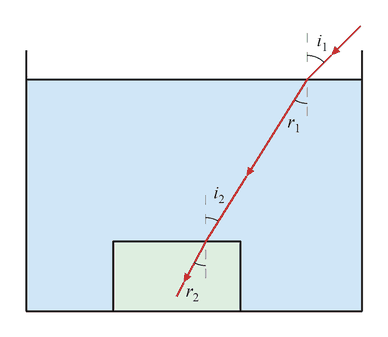
A rectangular glass slab is kept at the bottom of a trough containing water. A light ray is incident on water surface at an angle of 45° and it passes through water into glass. If the refractive index of water is 4/3 and that for glass is 3/2, find the angle of refraction in glass.
- 763 marks
Question 76
In a tank water is filled to a depth of 1.33 m. By how much does the bottom of the tank appear to be raised if of water is 1.33?
- 773 marks
Question 77
A glass slab of thickness 3 cm is placed on a mark. When the dot is seen through the slab it appears to be raised through 1 cm. If the velocity of light in air is m/s, what is the velocity of light in glass?
- 783 marks
Question 78
A beaker is partly filled with water of refractive index upto a height and then coconut oil of refractive index upto a height , what is the apparent shift in the position of a mark at the bottom of the beaker when viewed vertically from the top of the beaker?
- 793 marks
Question 79
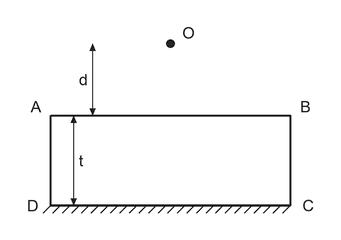
The given figure shows a thick glass mirror of thickness . The refractive index of glass is . At a distance from the surface , a point object is kept. What is the distance between the object and its image?
- 803 marks
Question 80
Calculate the critical angle for a glass–air surface if a ray of light which is incident in air on the surface is deviated through 15° when its angle of incidence is 40°.
What Class 12 Physics Ch 15 covers
The sections of the chapter, in the order the book takes them. Every question above comes from one of these.
- 01Refraction and Laws of Refraction
- 02Refractive Index
- 03Principle of Reversibility and Refractive Index Relations
- 04Refraction through a Parallel Slab and Apparent Depth
- 05Total Internal Reflection and Critical Angle
- 06Atmospheric Refraction
More ways to study this chapter
The same chapter asked three other ways. Practise it, revise it, and see what the board has set on Ch 15 before.
- Competency-Based Questions (CBQ)Case study questions: a situation, and the part of the chapter that answers it.43questionsOpen
- Previous Year QuestionsQuestions that have actually appeared in board papers, each tagged with its year.5questionsOpen
- Practice QuestionsExtra questions per chapter, for when one attempt at a method is not enough.94questionsOpen
Ch 15 in past ISC papers
The same chapter as the board has actually asked it. These are worded differently from the textbook exercise, which is the point of reading them.
- 11 mark
Board paper question 1
A fish which is at a depth of in water () is viewed by an observer on the bank of a lake. Its apparent depth as observed by the observer is:
Solve with AIAnswer
(A)
- Correct
(B)
(C)
(D)
Answer: (B)
Key idea: An object under water looks nearer the surface than it really is, because light from it bends away from the normal as it passes from water into air. For viewing from nearly straight above, the apparent depth is the real depth divided by the refractive index of the water: apparent depth .
Step 1 — Write the data.
The real depth of the fish is , and the refractive index of water is .
Step 2 — Find the apparent depth.
We divide the real depth by the refractive index.
The fish appears to be raised by .
Note: The formula holds for rays leaving the water nearly along the normal. An observer on the bank sees the fish along a slanting line, and then the fish looks even shallower; the options are built on the simple near-normal formula used above.
Why the others are wrong:
- (A) The value is , the apparent rise of the fish (the normal shift), not its apparent depth.
- (C) The value is the real depth; it would be seen only if light did not bend at the surface ().
- (D) The value comes from multiplying by instead of dividing; it would make the fish look deeper, which is the opposite of what refraction into air does.
Therefore, the apparent depth of the fish is 9 cm, option (B).
- 21 mark
Board paper question 2
Name the principle on the basis of which optical fibres work.
Solve with AIWritten solution
Solution:
Key idea: When light inside a denser medium meets the boundary with a rarer medium at an angle of incidence greater than the critical angle, none of it is refracted out; all of it is reflected back. This is total internal reflection.
Step 1 — Describe the fibre.
An optical fibre has a thin core of glass of higher refractive index, surrounded by a cladding of lower refractive index.
Step 2 — Say how light is kept inside.
Light entering the core strikes the core–cladding boundary at angles greater than the critical angle, so it is totally reflected. It zig-zags along the core by repeated total internal reflections, with very little loss, even when the fibre bends gently.
Therefore, optical fibres work on the principle of total internal reflection.
- 32 marks
Board paper question 3
Find critical angle for glass and water pair, given refractive index of glass is and that of water is .
Solve with AIWritten solution
Solution:
Key idea: The critical angle for light going from a denser medium (refractive index ) to a rarer medium () is the angle of incidence for which the angle of refraction is . Snell's law, , gives .
Step 1 — Identify the denser medium.
Glass, with , is optically denser than water, with , so total internal reflection can happen for light going from glass into water. The critical angle is measured inside the glass.
Step 2 — Find sin C.
We put the two refractive indices into , with water as the rarer medium.
Step 3 — Find the angle.
We take the inverse sine.
The figure below shows a ray in the glass meeting the boundary at this angle; the refracted ray just grazes along the boundary.
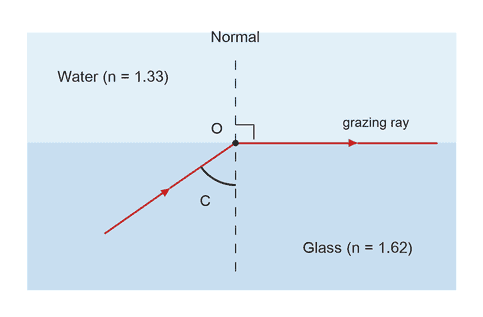
Therefore, the critical angle for the glass–water pair is about 55.2° (for light going from glass towards water).
- 41 mark
Board paper question 4
Define the critical angle for the given medium.
Solve with AIWritten solution
Solution:
Key idea: When light passes from a denser medium into a rarer one, it bends away from the normal, so the angle of refraction is larger than the angle of incidence. As the angle of incidence grows, the refracted ray gets closer to the boundary.
Step 1 — Picture the limiting case.
At one particular angle of incidence the refracted ray just grazes along the boundary, so the angle of refraction is . For any larger angle of incidence the light is totally reflected back into the denser medium.
Step 2 — State the definition.
The critical angle of a medium is the angle of incidence in that (denser) medium for which the angle of refraction in the rarer medium (usually air) is . For a medium of refractive index with respect to air, .
Therefore, the critical angle is the angle of incidence in the denser medium for which the angle of refraction in the rarer medium is 90°.
- 51 mark
Board paper question 5
Name the physical principle on the basis of which optical fibers work
Solve with AIWritten solution
Solution:
Key idea: Light inside a denser medium that meets the boundary with a rarer medium at more than the critical angle is reflected back completely; this is total internal reflection.
Step 1 — Describe the fibre.
An optical fibre has a glass core of higher refractive index inside a cladding of lower refractive index.
Step 2 — Say how the light travels.
Light inside the core meets the core–cladding boundary at angles of incidence greater than the critical angle. Each time, it is totally reflected back into the core, so it travels along the fibre by repeated total internal reflections with very little loss of energy.
Therefore, optical fibres work on the principle of total internal reflection.
Class 12 Physics Ch 15 questions students ask
How many questions are there in Class 12 Physics Ch 15?
80 questions. Every one is solved step by step on this page.
Are these Class 12 Physics solutions free?
Yes. Every question and its full working is free to read, with no account needed.
Can I download the Class 12 Physics Ch 15 solutions as a PDF?
There is no PDF to download. Every solution is on this page instead, which means it is searchable, always the current syllabus, and readable on a phone. Use your browser's print option if you want it on paper.