Opening your dashboard
Class 12 Physics Chapter 15 Refraction of Light at Plane Surfaces: Practice Questions
94 questions on Chapter 15, each worked through on its own page with the AI tutor. Class 12 Physics, ICSE 2026-27.
94 questions
1–3 marks · Mixed difficulty
- 11 mark
Question 1
A ray of monochromatic light passes obliquely from medium X into medium Y. The angle of refraction is found to be greater than the angle of incidence. Which conclusion is correct?
- 22 marks
Question 2
A narrow beam of light falls on the flat surface of a liquid in a dish at an angle of incidence of . A student notices that the reflected ray and the refracted ray are exactly perpendicular to each other.
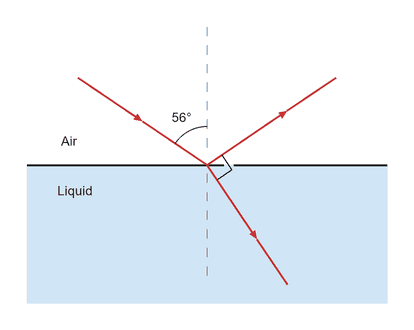
(i) Find the angle of refraction.
(ii) Find the refractive index of the liquid.
- 31 mark
Question 3
A ray of light in air strikes the plane surface of a glass block of refractive index at an angle of incidence of . Through what angle is the ray deviated from its original direction on entering the glass?
- 43 marks
Question 4
In a laboratory, a ray of light is sent from air into a glass block. For an angle of incidence of , the angle of refraction is measured as .
(i) Find the refractive index of the glass.
(ii) Predict the angle of refraction when the angle of incidence is .
(iii) A student claims that doubling the angle of incidence doubles the angle of refraction. Use your answer to (ii) to test this claim, and state which quantity really stays constant.
- 52 marks
Question 5
(i) When light passes from air into water, state what happens to its speed, its wavelength and its frequency.
(ii) A diver under water looks at a green lamp whose light has a wavelength of in air. Find the wavelength of this light in water. Light of this wavelength in air would look violet. What colour does the diver see? Give a reason.
(Refractive index of water .)
- 63 marks
Question 6
A laser beam in air strikes the still water surface of a tank at an angle of incidence of , as shown. The water is deep. is the point on the bottom vertically below the point where the beam enters the water, and the beam makes a bright spot on the bottom.

(i) Find the angle of refraction in the water.
(ii) Find the distance .
(iii) If the tank were empty, how far from would the spot be? By how much does the water move the spot, and in which direction?
(Refractive index of water ; take and .)
- 72 marks
Question 7
A short pulse of light takes longer to travel along a long tube filled with a clear liquid than it takes to travel the same length in vacuum. (Hypothetical data.)
(i) Find the refractive index of the liquid.
(ii) Find the speed of light in the liquid.
(Take , and take the pulse to travel at the speed in the liquid.)
- 81 mark
Question 8
The refractive indices of water and diamond are and respectively. The ratio is
- 92 marks
Question 9
For a sample of crown glass, the refractive index is for red light and for violet light. A short pulse of white light enters a thick block of this glass normally.
(i) Find the speeds of red and violet light in the glass.
(ii) Which colour leaves the block first, and by how much time does it lead the other?
(Take , and take each colour to travel at the speed in the glass.)
- 101 mark
Question 10
Two identical beakers are filled with water to the same height, one at and the other at . A coin lies at the bottom of each. Viewed from directly above,
- 113 marks
Question 11
Two light signals leave a source at the same instant. Signal 1 travels through a long column of water (refractive index ). Signal 2 travels through a long glass rod (refractive index ). Both then reach the detectors after the same path in air.
(i) Define optical path.
(ii) Find the optical path of each signal in its medium.
(iii) Which signal reaches first, and by how much time?
(Take , and take each signal to travel at the speed in its medium.)
- 121 mark
Question 12
A clean glass rod is dipped into a beaker of a certain clear oil and becomes almost invisible inside the oil. The best explanation is that
- 131 mark
Question 13
For three media 1, 2 and 3, the refractive index of medium 2 with respect to medium 1 is , and the refractive index of medium 3 with respect to medium 2 is . The refractive index of medium 1 with respect to medium 3, , is
- 143 marks
Question 14
A ray of light travelling in medium A strikes the plane boundary with medium B at an angle of incidence of . The angle of refraction in B is .
(i) Find the refractive index of B with respect to A.
(ii) Which medium is optically denser? Find the ratio of the speeds of light in the two media.
(iii) Another ray travelling in B strikes the same boundary at an angle of incidence of . Without further calculation, state its angle of refraction in A and name the principle used.
- 153 marks
Question 15
Monochromatic light has a wavelength of in water. It passes from the water into glass and then into air.
(i) Find its wavelength in the glass and in air.
(ii) Find its frequency and its speed in the glass.
(Refractive indices: water , glass ; take .)
- 161 mark
Question 16
A glass plate (refractive index ) lies flat on the bottom of a tank. Water (refractive index ) covers the plate, and a layer of oil (refractive index ) floats on the water, so the three layers have parallel faces. A ray in air strikes the top of the oil at an angle of incidence of . The angle that the ray makes with the normal inside the glass is about
- 171 mark
Question 17
A ray in air is refracted at point on the surface of a glass block and travels along inside the glass. A second ray is now sent inside the glass along , towards . This ray will
- 183 marks
Question 18
Light travels at in a transparent medium X. The refractive index of a second medium Y with respect to X is . Light of wavelength in X passes into Y. (Hypothetical data.)
(i) Find the absolute refractive indices of X and Y.
(ii) Find the speed of light in Y.
(iii) Find the wavelength of this light in Y.
(Take .)
- 191 mark
Question 19
A ray of light passes through a parallel-sided glass slab of thickness placed in air. Which statement about the lateral shift of the ray is correct?
- 201 mark
Question 20
A small beetle is trapped in a piece of amber (refractive index ), below its flat top face. Viewed normally from above, the beetle appears to be at a depth of about
- 213 marks
Question 21
A travelling microscope is used to find the refractive index of a glass slab. Its readings are:
- focused on a cross mark on the table: ;
- glass slab placed on the mark, microscope re-focused on the mark seen through the slab: ;
- microscope focused on a little chalk dust sprinkled on the top face of the slab: .
(i) Find the real thickness and the apparent thickness of the slab, and hence its refractive index.
(ii) Why is chalk dust sprinkled on the top face?
- 223 marks
Question 22
A lamp hangs above the still surface of a pond. A diver is below the surface, vertically below the lamp.
(i) How far away does the lamp appear to the diver?
(ii) How far below the lamp would the diver appear to a camera placed right beside the lamp?
(Refractive index of water ; consider rays close to the vertical.)
- 231 mark
Question 23
A glass slab thick (refractive index ) stands vertically. An ant walks straight towards the slab on the far side, from to from it, while an observer looks at it normally through the slab. During this walk, the shift of the ant's image towards the observer
- 241 mark
Question 24
Light of one frequency has a wavelength of in a transparent medium X and in another transparent medium Y. Total internal reflection can take place at the boundary between X and Y
- 253 marks
Question 25
A student aims a narrow beam of light at a semicircular glass block along a radius, so that the beam always reaches the centre O of the flat face, as shown. The angle of incidence at O is slowly increased. At the light leaving the flat face just grazes along it.
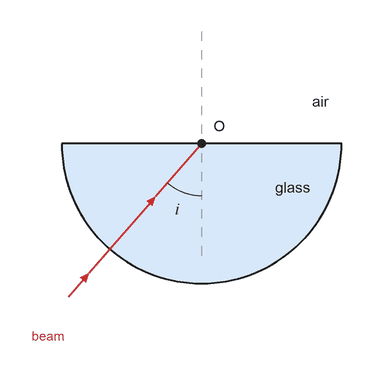
(a) Why does the beam not bend where it enters the curved face?
(b) Find the refractive index of the glass.
(c) What happens at O when and when ? Give the angle of refraction in the first case and the angle between the flat face and the reflected beam in the second.
- 261 mark
Question 26
For a dense flint glass, for red light and for violet light. A narrow beam of white light inside a block of this glass strikes the glass–air surface at an angle of incidence of . What happens at this surface?
- 272 marks
Question 27
The critical angles of two transparent liquids A and B with respect to air are and respectively. The liquids do not mix. (Hypothetical data.)
(a) Which liquid is optically denser? Give a reason.
(b) Find the critical angle at the boundary between A and B, and state the direction in which light must travel there for total internal reflection.
- 283 marks
Question 28
A swimming pool has a flat bottom below the still water surface. A diver's eyes are below the surface. Looking up, the diver sees a bright image of a pebble lying on the bottom, formed by total internal reflection at the water–air surface. (Refractive index of water .)
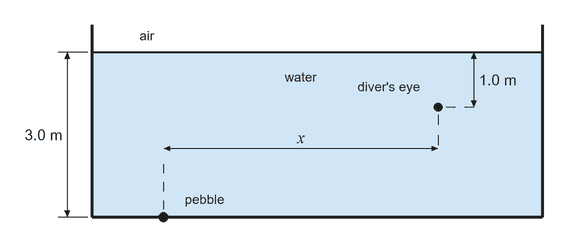
(a) Find the critical angle for water.
(b) Find the least horizontal distance between the diver's eyes and the pebble for which this totally reflected image can be seen.
- 291 mark
Question 29
Diamond has refractive index and cubic zirconia, a cheaper imitation stone, has refractive index . Inside a cut stone, a ray meets a facet at an angle of incidence of . The ray is totally reflected
- 303 marks
Question 30
The light-emitting chip of an LED is made of a semiconductor of refractive index . Light produced inside the chip leaves through its flat top surface.
(a) Find the critical angle at the chip–air surface.
(b) The chip is now covered with clear epoxy of refractive index . Find the critical angle at the chip–epoxy surface.
(c) The epoxy is moulded into a dome with the chip at its centre. Why does this let more light out of the LED?
- 311 mark
Question 31
Turpentine (refractive index , density ) floats on water (refractive index , density ). Which statement about total internal reflection at the turpentine–water boundary is correct?
- 321 mark
Question 32
If the Earth had no atmosphere, the length of the day (from sunrise to sunset) at a place would be
- 333 marks
Question 33
Near the horizon, atmospheric refraction raises the apparent position of the Sun. At the moment when the true position of the Sun's lower edge is exactly on the horizon, take its lower edge to be raised by , and its upper edge (which is higher in the sky) to be raised by only . The Sun's true angular diameter is . (Hypothetical data.)
(a) Why is the lower edge raised more than the upper edge?
(b) Find the apparent vertical angular diameter of the Sun.
(c) Refraction does not change the horizontal diameter. Find the ratio of the apparent vertical diameter to the horizontal diameter and describe the shape of the Sun seen at sunset.
- 341 mark
Question 34
In polar regions, the air just above the sea is much colder than the air higher up. A distant ship seen across such a sea may appear
- 352 marks
Question 35
(a) A star directly overhead shows no shift in its apparent position due to the atmosphere, but a star near the horizon appears higher than it really is. Explain both observations.
(b) Would an astronaut standing on the Moon see a star near the Moon's horizon raised in the same way? Give a reason.
- 361 mark
Question 36
A right-angled isosceles prism of glass of refractive index is used with its hypotenuse face towards the light. A ray in the plane of the prism's cross-section strikes the hypotenuse face at an angle of incidence of .
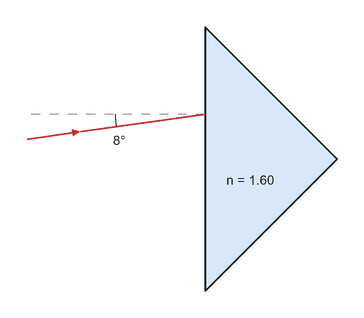
Compared with this incident ray, the light finally leaving the prism
- 373 marks
Question 37
A periscope can turn light twice through using either two plane mirrors or two right-angled isosceles glass prisms. Use these data: the best silvered mirror reflects of the light falling on it; total internal reflection reflects ; an uncoated air–glass face (where light enters or leaves a prism) reflects away of the light, and a face with an anti-reflection coating loses only . Ignore absorption in the glass. (Hypothetical data.)
(a) What fraction of the light gets through the mirror periscope?
(b) What fraction gets through the prism periscope with uncoated faces, and with coated faces?
(c) Use your answers to explain why the faces of total reflecting prisms are coated.
- 381 mark
Question 38
A camera uses a five-sided (penta) prism, rather than a single plane mirror at , to turn the light from the lens through towards the eyepiece. The main reason is that
- 393 marks
Question 39
In an optical fingerprint scanner, light enters face AB of a right-angled isosceles glass prism (refractive index ) normally and meets the hypotenuse face AC, on which a finger is pressed. Light coming back from AC leaves through face BC to a camera. Where a ridge of the skin touches the glass, the glass is in contact with skin of refractive index ; in the valleys between the ridges there is air. (Hypothetical data.)
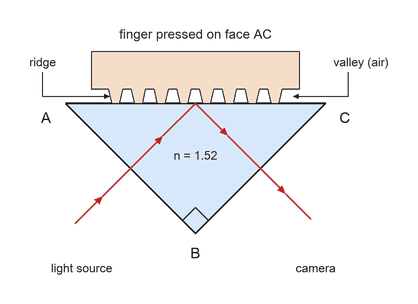
(a) Find the angle of incidence at AC and show that the light is totally reflected under the valleys.
(b) Show that the light is not totally reflected under the ridges. Do the ridges look bright or dark to the camera?
(c) Above what value must the refractive index of the skin lie for the ridges to show up in this way?
- 401 mark
Question 40
Prism binoculars contain two Porro prisms (right-angled isosceles prisms, each turning light through by two total reflections), placed with their reflecting edges at right angles to each other. This arrangement
- 413 marks
Question 41
A communication fibre has a core of refractive index . Its designer wants it to accept light from air within a cone of half-angle about its axis, where (the numerical aperture).
(a) Show that , where is the refractive index of the cladding.
(b) Find the refractive index the cladding must have.
(c) Find and the critical angle at the core–cladding boundary.
- 421 mark
Question 42
By mistake, an optical fibre is made with a cladding of refractive index round a core of refractive index . When light is sent into the core, it will
- 432 marks
Question 43
In a straight optical fibre (core refractive index , cladding ), a ray meets the core–cladding boundary at an angle of incidence of . Where the fibre is bent sharply, the same ray meets the outer wall of the bend at an angle of incidence of .
(a) Find the critical angle at the core–cladding boundary.
(b) What happens to the ray in the straight part and at the bend? Why must such fibres not be bent sharply?
- 443 marks
Question 44
A ray travels along a straight optical fibre whose core has diameter and refractive index ; the cladding has refractive index . The ray meets the core–cladding boundary at an angle of incidence of .
(a) Check that the ray is totally reflected.
(b) How far along the fibre does the ray travel between one reflection and the next?
(c) About how many reflections does the ray undergo in of fibre?
- 451 mark
Question 45
An optical fibre accepts light from air within a cone of half-angle about its axis, where (). If the end of the fibre is dipped in water (refractive index ), the half-angle of the cone of light it accepts from the water becomes
- 461 mark
Question 46
What happens to the frequency when light passes from one medium to another?
- 472 marks
Question 47
A beam of light is converging towards a certain point. A parallel sided glass plate is introduced in the path of the converging beam. How will the point of convergence be shifted?
- 481 mark
Question 48
For normal incidence of a light ray on a glass slab, what is the angle of refraction?
- 492 marks
Question 49
A parallel sided glass slab is placed on a sheet of paper on which marks are put with different colours from blue to red. Will the image of all the marks lie in the same plane?
- 501 mark
Question 50
In Question 4 (a parallel sided glass slab is placed on a sheet of paper on which marks are put with different colours from blue to red), which colour mark will be maximum raised and which will be minimum raised?
- 511 mark
Question 51
To a fish, under water, viewing obliquely a fisherman standing on the bank of a lake, does the man look taller or shorter than what he actually is?
- 522 marks
Question 52
Does the apparent depth of a tank of water change if viewed obliquely? Does the apparent depth increase or decrease?
- 532 marks
Question 53
The refractive index of diamonds is much greater than that of ordinary glass. Is this fact of some use to a diamond cutter?
- 542 marks
Question 54
“An air bubble in a jar of water shines brightly”. Explain why?
- 553 marks
Question 55
A substance has critical angle of 45° for yellow light. What is its refractive index?
- 563 marks
Question 56
A ray of light of frequency Hz is passed through a liquid. The wavelength of light measured inside the liquid is found to be m. Calculate the refractive index of the liquid.
- 573 marks
Question 57
Velocity of light in glass is m/s and in air it is m/s. By how much would an ink dot appears to be raised when covered by a glass plate 6 cm thick?
- 583 marks
Question 58
A thin prism of 2° angle gives a deviation of 1°. What is the value of refractive index of the material of the prism?
- 591 mark
Question 59
Name the physical principle on which the working of optic fibres is based.
- 601 mark
Question 60
Name one advantage of the use of optical fibres.
- 612 marks
Question 61
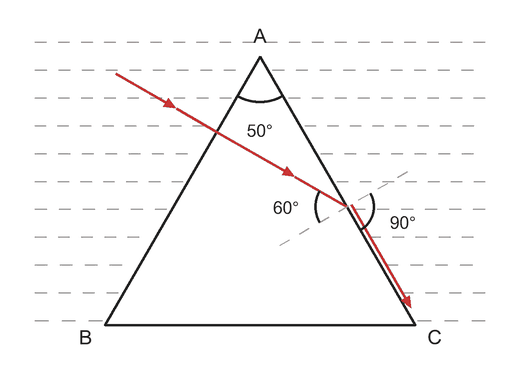
Find the refractive index of liquid if a ray of light strikes surface normally and then comes out from face at grazing emergence .
- 622 marks
Question 62
A ray of light falls on a right-angled prism () and travels as shown in the figure. What is the refractive index of the material of the prism?

- 632 marks
Question 63
A ray of light is normally incident on one face of an equilateral triangle. Trace the course of the ray through the prism emerging from it.

- 642 marks
Question 64
A fish is located at a distance of 10 cm from the wall of a fish pond. The thickness of the glass wall is 2 cm. Find the apparent position of the fish.
- 651 mark
Question 65
In refraction, light waves are bent on passing from one medium to the second medium, because, in the second medium
- 661 mark
Question 66
A green light is incident from the water to the air–water interface at the critical angle (). Select the correct statement.
- 671 mark
Question 67
Which one of the following is not associated with total internal reflection?
- 681 mark
Question 68
'Mirage' is a phenomenon due to
- 691 mark
Question 69
The speed of light in media and is m/s and m/s respectively. A ray of light enters from medium to at an incidence angle . If the ray suffers total internal reflection, the value of is
- 701 mark
Question 70
Pick out the correct statements about optical fibres from the following.
S1: Optical fibres are used for the transmission of optical signals only.
S2: Optical fibres are used for transmitting and receiving electrical signals.
S3: The intensity of light signals sent through optical fibres suffer very small loss.
S4: Optical fibres effectively employ the principle of multiple total internal reflections.
S5: Optical fibres are glass fibres coated with a thin layer of a material with lower refractive index.
- 711 mark
Question 71
A point source of light is kept at a depth of in water of refractive index . The radius of the circle at the surface of water through which light emits is
- 721 mark
Question 72
The velocity of light in a medium is half its velocity in air. If ray of light emerges from such a medium into air, the angle of incidence at which it will be totally internally reflected is
- 731 mark
Question 73
A ray of light propagates from glass (refractive index ) to water (refractive index ). The value of the critical angle is
- 741 mark
Question 74
Relation between critical angles of water and glass is
- 751 mark
Question 75
A point source of light is kept below the surface of water in a pond
- 761 mark
Question 76
The refractive index of water is 1.33. The direction in which a man under water should look to see the setting Sun is
- 771 mark
Question 77
Optical fibres are related with
- 781 mark
Question 78
Brilliance of diamond is due to
- 791 mark
Question 79
A ray of light traveling in water is incident on its surface open to air. The angle of incidence is , which is less than the critical angle. Then there will be
- 801 mark
Question 80
Consider telecommunication through optical fibres. Which of the following statements is not true?
- 811 mark
Question 81
Glass has refractive index with respect to air and the critical angle for a ray of light going from glass to air is . If a ray of light is incident from air on the glass with angle of incidence , the corresponding angle of refraction is
- 821 mark
Question 82
An endoscope is employed by a physician to view the internal parts of a body organ. It is based on the principle of
- 831 mark
Question 83
A fish looking up through the water sees the outside world contained in a circular horizon. If the refractive index of water is and the fish is 12 cm below the surface, the radius of this circle in cm is
- 841 mark
Question 84
A point source of light is placed 4 m below the surface of water of refractive index . The minimum diameter of a disc which should be placed over the source on the surface of water to cut-off all light coming out of water is
- 851 mark
Question 85
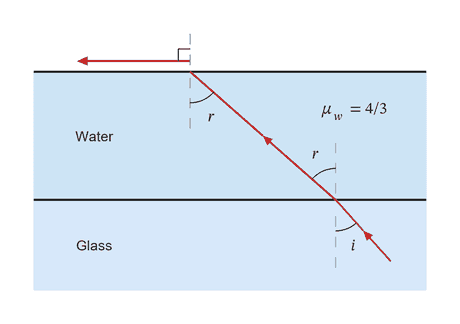
A ray of light is incident at the glass–water interface at an angle . It emerges finally parallel to the surface of water, then the value of would be
- 861 mark
Question 86
The refractive index of the material of the prism and liquid are 1.56 and 1.32 respectively. What will be the value of for the following refraction?
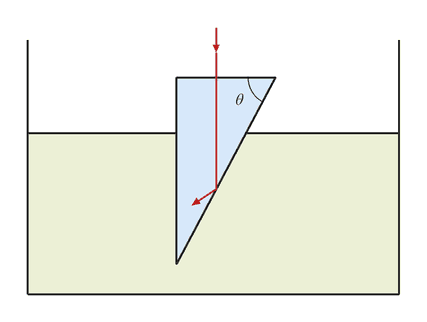
- 871 mark
Question 87
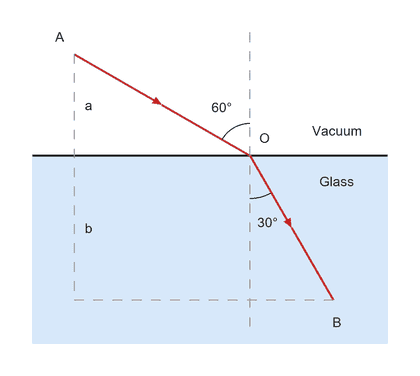
A ray of light in vacuum is incident on a glass slab at angle 60° and refracted at angle 30° along as shown in the figure. The optical path length of light ray from to is
- 881 mark
Question 88
A transparent cube of side , made of a material of refractive index , is immersed in a liquid of refractive index . A ray is incident on the face at an angle . Total internal reflection takes place at point on the face . Then must satisfy

- 891 mark
Question 89
Pick the wrong answer in the context with rainbow.
- 901 mark
Question 90
In total internal reflection, when the angle of incidence is equal to the critical angle for the pair of media in contact, what will be angle of refraction?
- 911 mark
Question 91
The critical angle of a medium for a specific wavelength if the medium has relative permittivity 3 and relative permeability for this wavelength, will be
- 921 mark
Question 92
The relative permittivity of distilled water is 81. The velocity of light in it will be (given )
- 931 mark
Question 93
A glass tumbler having inner depth of 17.5 cm is kept on a table. A student starts pouring water into it while looking at the surface of water from the above. When he feels that the tumbler is half filled, he stops pouring water. Up to what height is the tumbler actually filled?
- 941 mark
Question 94
Find the value of the angle of emergence from the prism. Refractive index of the glass is .