
Question 552 marksEasy
Draw a ray diagram to show how a total reflecting prism turns a light ray through (i) and (ii) .
Confirming your payment
Sign up now and get 250 free tokens.
Refraction of Light at Plane Surfaces · Question 55 of 80
Draw a ray diagram to show how a total reflecting prism turns a light ray through (i) and (ii) .
Solution:
Key idea: In a right-angled isosceles glass prism, light entering a face normally meets another face at , which is more than the critical angle of glass (about ), so it is totally reflected.
Step 1 — Draw the ray diagrams.
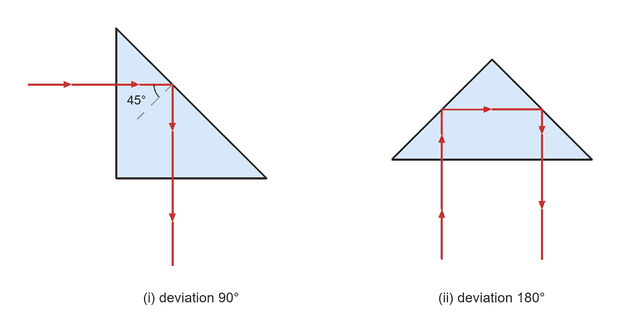
The figure shows (i) the prism turning a ray through and (ii) the prism turning a ray through .
Step 2 — Explain the turn through 90°.
The ray falls normally on one of the faces containing the right angle and goes straight in. It meets the hypotenuse face at an angle of incidence of , more than the critical angle, so it is totally reflected. A reflection at turns the ray through , and it leaves normally through the other short face.
Step 3 — Explain the turn through 180°.
The ray falls normally on the hypotenuse face and goes straight in. It meets one short face at and is totally reflected through towards the other short face. There it again meets the face at and is totally reflected through another . It leaves normally through the hypotenuse face, travelling back parallel to its original path.
Therefore, one total internal reflection at the hypotenuse turns the ray through 90°, and two total internal reflections at the two short faces turn it through 180°.