
Question 652 marksMedium
Show that no ray can pass through a prism whose refracting angle is greater than twice the critical angle for the material of the prism.
Confirming your payment
Sign up now and get 250 free tokens.
Refraction of Light at Plane Surfaces · Question 65 of 80
Show that no ray can pass through a prism whose refracting angle is greater than twice the critical angle for the material of the prism.
Solution:
Key idea: For a ray passing through a prism of angle , the angles of refraction at the two faces satisfy . A ray can leave the second face only if it meets that face at an angle not greater than the critical angle .
Step 1 — Recall the prism geometry.
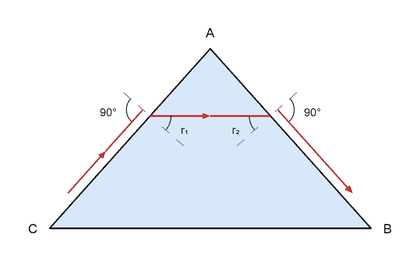
The figure shows a prism with refracting angle . Inside the prism the ray makes angle with the normal at the first face and angle with the normal at the second face , and the geometry of the prism gives their sum.
Step 2 — Find the largest possible value of r₁.
The angle is largest when the angle of incidence on the first face is largest, which happens for grazing incidence ( of ). Snell's law at the first face then gives this largest value.
The sine of the critical angle is also , so this largest equals , and for every other ray is smaller.
Step 3 — Write the condition for the ray to leave the second face.
At the second face the light goes from glass to air. It can emerge only if its angle of incidence is not more than the critical angle; at it just grazes out along face , as drawn in the figure.
Step 4 — Find the largest prism angle that lets a ray through.
Adding the two largest values gives the largest prism angle for which some ray can still emerge.
Step 5 — Show that no ray emerges when A is more than twice the critical angle.
Suppose . For any ray, , and is at most .
So every ray meets face at more than the critical angle and is totally reflected there. For example, for glass with , , so a glass prism with an angle greater than about lets no light out through its second face.
Therefore, no ray can pass through a prism whose refracting angle is greater than twice the critical angle, because every ray then meets the second face at more than the critical angle and is totally reflected.