Solution:
Key idea: For light going from a denser to a rarer medium, the critical angle C is the angle of incidence for which the angle of refraction is 90∘. For glass with μ=1.5, C≈41.8∘.
Step 1 — Draw the three ray diagrams.
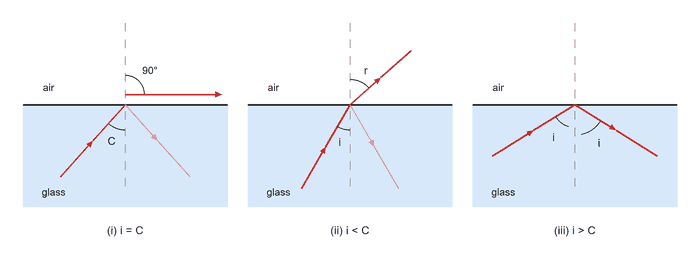
The figure shows light going from glass into air, with a dashed normal at the point of incidence in each panel.
Step 2 — Describe case (i), angle of incidence equal to the critical angle.
When i=C, the refracted ray grazes along the surface of separation, so the angle of refraction is 90∘. A weak reflected ray also returns into the glass.
Step 3 — Describe case (ii), angle of incidence less than the critical angle.
When i is less than C, the ray is refracted into the air and bends away from the normal, so r is greater than i. For example, at i=30∘ in glass the ray leaves at r≈48.6∘. A weak partially reflected ray also returns into the glass.
Step 4 — Describe case (iii), angle of incidence greater than the critical angle.
When i is greater than C, there is no refracted ray at all. All the light is reflected back into the glass, with the angle of reflection equal to the angle of incidence. This is total internal reflection.
Therefore, when the angle of incidence equals the critical angle the refracted ray grazes the surface; when it is less than the critical angle the ray is refracted into air, bending away from the normal, with weak partial reflection; and when it is greater, all the light is totally reflected back into the glass.
