
Question 512 marksEasy
Write a note on mirage.
Confirming your payment
Sign up now and get 250 free tokens.
Refraction of Light at Plane Surfaces · Question 51 of 80
Write a note on mirage.
Solution:
Key idea: The refractive index of air falls slightly as its temperature rises. Light travelling from denser into rarer air bends away from the normal, and it is totally reflected when its angle of incidence exceeds the critical angle.
Step 1 — Describe what a mirage looks like.
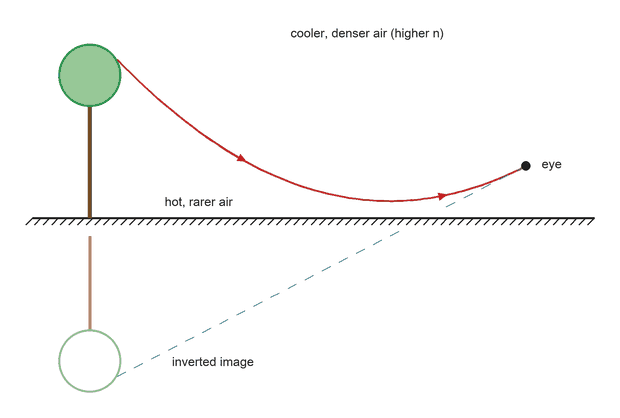
A mirage is an optical illusion seen in deserts and on hot roads. An inverted image of a distant object, such as a tree, is seen below the object, as if it were reflected in a pool of water.
Step 2 — Describe the layers of air on a hot day.
The hot ground heats the air just above it, so the air near the ground is hotter and rarer than the air higher up. The refractive index therefore decreases towards the ground. For example, it is about for air at and about for air at .
Step 3 — Follow a ray from the top of the tree.
A ray from the top of the tree travelling down at a small angle passes from denser into rarer layers. At each layer it bends a little away from the normal, so its angle of incidence on the next layer keeps increasing.
Step 4 — Explain the total reflection near the ground.
At a layer near the ground the angle of incidence becomes greater than the critical angle, and the ray is totally reflected upwards. With the values in Step 2 the critical angle is about , so only rays travelling almost parallel to the ground turn back. This is why a mirage is seen only at a distance and at a low angle.
Step 5 — Explain why the image is inverted.
The eye traces the arriving ray back in a straight line, so it seems to come from a point below the ground. Rays from the top of the tree arrive from lower down than rays from its base, so the image is inverted. The shimmering of the hot air makes it look like a reflection in water.
Note: In reality the ray bends gradually and turns smoothly; the textbook model treats the turning point as total internal reflection at a layer near the ground.
Therefore, a mirage is an inverted image of a distant object, seen as if reflected in water, formed when light going down through ever hotter, rarer air near the ground bends more and more and is finally totally reflected upwards.