Answer: (B) sinθ=n11
Key idea: At every boundary Snell's law says that nsin(angle with the normal) has the same value on both sides. For a slab with parallel faces, the angle of refraction at one face equals the angle of incidence at the other face.
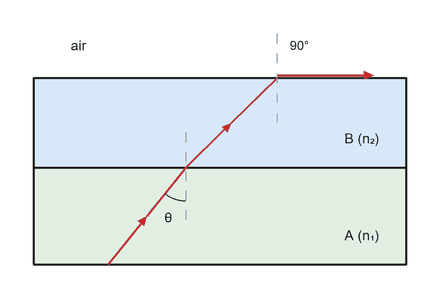
Step 1 — Apply Snell's law at the surface between A and B.
Let ϕ be the angle of refraction in slab B.
n1sinθ=n2sinϕ
Step 2 — Apply Snell's law at the top face of B.
The faces of B are parallel, so the ray meets the top face of B at the angle ϕ. It grazes the surface on leaving, so its angle of refraction in air is 90∘.
n2sinϕ=1×sin90∘
n2sinϕ=1
Step 3 — Combine the two results.
Both equations contain n2sinϕ, so we can put the first one equal to 1.
n1sinθ=1
sinθ=n11
The refractive index n2 drops out: slab B only carries the ray across, and the grazing condition depends on n1 and air alone.
Why the other options are wrong:
- (A) is wrong: The value 1/n2 is sinϕ, the angle of incidence at the top face of B, not the angle θ in slab A.
- (C) is wrong: The condition sinθ=n2/n1 is the critical condition at the A–B surface itself; the ray would then graze along that surface and never reach the air.
- (D) is wrong: Snell's law at the A–B surface gives the ratio sinϕ/sinθ as n1/n2; setting sinθ itself equal to this ratio of two sines mixes up the two angles.
Therefore, sin θ = 1/n₁: option (B).
