
Question 705 marksMedium
(a) What is total internal reflection? What are the necessary conditions?
(b) What are total reflecting prisms? Mention their uses.
(c) Explain the working of optical fibre. Give its applications.
Confirming your payment
Sign up now and get 250 free tokens.
Refraction of Light at Plane Surfaces · Question 70 of 80
(a) What is total internal reflection? What are the necessary conditions?
(b) What are total reflecting prisms? Mention their uses.
(c) Explain the working of optical fibre. Give its applications.
Solution:
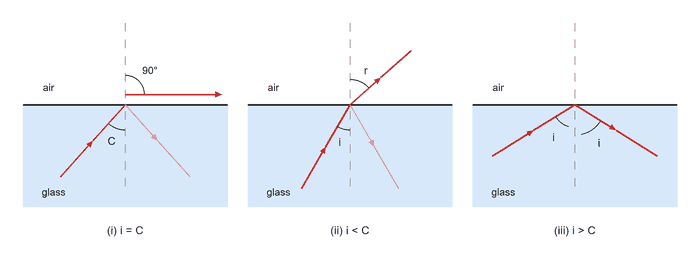
Key idea: When light goes from an optically denser medium into a rarer one, it bends away from the normal. The angle of incidence in the denser medium for which the refracted ray just grazes the boundary (angle of refraction ) is called the critical angle . For a medium of refractive index with air, .
Step 1 — (a) Define total internal reflection.
We look at what happens as the angle of incidence inside the denser medium grows. Below the critical angle, the ray is partly refracted out and partly reflected (panel ii). At the critical angle the refracted ray just grazes the surface (panel i). Above the critical angle no light is refracted at all, and the whole of the light is reflected back into the denser medium (panel iii). This is called total internal reflection.
Step 2 — (a) State the necessary conditions.
Total internal reflection happens only when both of these conditions hold.
For glass () the critical angle is about , and for water () it is about .
Step 3 — (b) Describe a total reflecting prism.
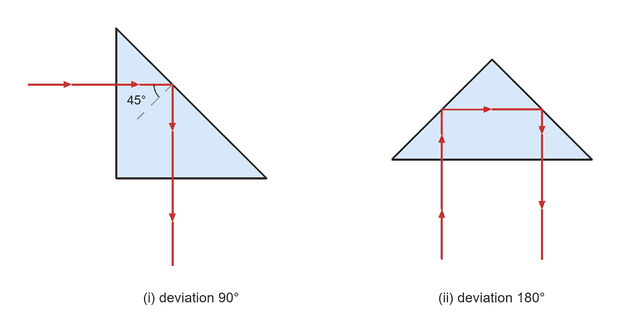
A total reflecting prism is a glass prism whose cross-section is a right-angled isosceles triangle, with angles , and . Light that enters one face normally goes straight in and meets the next face at an angle of incidence of . This is greater than the critical angle of glass (about ), so the light is totally reflected there.
Step 4 — (b) List the uses of total reflecting prisms.
The prism can be turned so that the light is totally reflected once or twice, which gives the following uses.
A prism is better than a plane mirror for these jobs: total internal reflection reflects practically all the light, it gives no faint extra images, and there is no silvering to tarnish.
Step 5 — (c) Explain the working of an optical fibre.
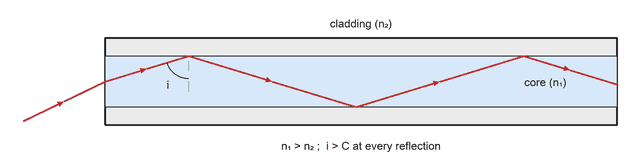
We use total internal reflection again, this time over and over along a thin strand. An optical fibre has a very thin core of glass (or plastic) of refractive index , covered by a cladding of lower refractive index . Light that enters one end within a certain cone of angles (the acceptance cone) meets the core–cladding boundary at an angle of incidence greater than the critical angle, where . So it is totally reflected. The same happens at every later reflection, so the light zigzags along the core, even round gentle bends, with very little loss, and comes out at the far end.
Step 6 — (c) Give the applications of optical fibres.
Because fibres carry light far with little loss and are not affected by outside electrical interference, they are used in the following ways.
Therefore, total internal reflection needs light going from a denser to a rarer medium at more than the critical angle; total reflecting prisms use it to turn light through 90° or 180° or to erect an image; and optical fibres use repeated total internal reflection in a high-index core to carry light for communication and medicine.