
Opening your dashboard
Class 12 Physics Chapter 15 Refraction of Light at Plane Surfaces: Previous Year Questions
5 questions on Chapter 15, each solved step by step. Class 12 Physics, ICSE 2026-27.
5 questions with solutions
1–2 marks · Mixed difficulty
- 11 mark
Question 1
A fish which is at a depth of in water () is viewed by an observer on the bank of a lake. Its apparent depth as observed by the observer is:
Solve with AIAnswer
(A)
- Correct
(B)
(C)
(D)
Answer: (B)
Key idea: An object under water looks nearer the surface than it really is, because light from it bends away from the normal as it passes from water into air. For viewing from nearly straight above, the apparent depth is the real depth divided by the refractive index of the water: apparent depth .
Step 1 — Write the data.
The real depth of the fish is , and the refractive index of water is .
Step 2 — Find the apparent depth.
We divide the real depth by the refractive index.
The fish appears to be raised by .
Note: The formula holds for rays leaving the water nearly along the normal. An observer on the bank sees the fish along a slanting line, and then the fish looks even shallower; the options are built on the simple near-normal formula used above.
Why the others are wrong:
- (A) The value is , the apparent rise of the fish (the normal shift), not its apparent depth.
- (C) The value is the real depth; it would be seen only if light did not bend at the surface ().
- (D) The value comes from multiplying by instead of dividing; it would make the fish look deeper, which is the opposite of what refraction into air does.
Therefore, the apparent depth of the fish is 9 cm, option (B).
- 21 mark
Question 2
Name the principle on the basis of which optical fibres work.
Solve with AIWritten solution
Solution:
Key idea: When light inside a denser medium meets the boundary with a rarer medium at an angle of incidence greater than the critical angle, none of it is refracted out; all of it is reflected back. This is total internal reflection.
Step 1 — Describe the fibre.
An optical fibre has a thin core of glass of higher refractive index, surrounded by a cladding of lower refractive index.
Step 2 — Say how light is kept inside.
Light entering the core strikes the core–cladding boundary at angles greater than the critical angle, so it is totally reflected. It zig-zags along the core by repeated total internal reflections, with very little loss, even when the fibre bends gently.
Therefore, optical fibres work on the principle of total internal reflection.
- 32 marks
Question 3
Find critical angle for glass and water pair, given refractive index of glass is and that of water is .
Solve with AIWritten solution
Solution:
Key idea: The critical angle for light going from a denser medium (refractive index ) to a rarer medium () is the angle of incidence for which the angle of refraction is . Snell's law, , gives .
Step 1 — Identify the denser medium.
Glass, with , is optically denser than water, with , so total internal reflection can happen for light going from glass into water. The critical angle is measured inside the glass.
Step 2 — Find sin C.
We put the two refractive indices into , with water as the rarer medium.
Step 3 — Find the angle.
We take the inverse sine.
The figure below shows a ray in the glass meeting the boundary at this angle; the refracted ray just grazes along the boundary.
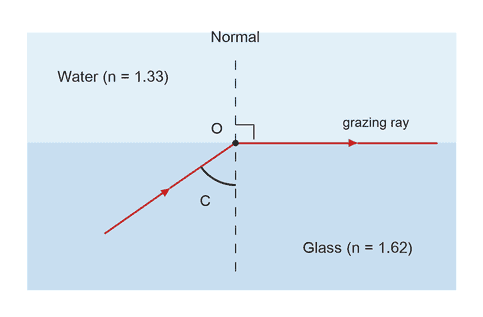
Therefore, the critical angle for the glass–water pair is about 55.2° (for light going from glass towards water).
- 41 mark
Question 4
Define the critical angle for the given medium.
Solve with AIWritten solution
Solution:
Key idea: When light passes from a denser medium into a rarer one, it bends away from the normal, so the angle of refraction is larger than the angle of incidence. As the angle of incidence grows, the refracted ray gets closer to the boundary.
Step 1 — Picture the limiting case.
At one particular angle of incidence the refracted ray just grazes along the boundary, so the angle of refraction is . For any larger angle of incidence the light is totally reflected back into the denser medium.
Step 2 — State the definition.
The critical angle of a medium is the angle of incidence in that (denser) medium for which the angle of refraction in the rarer medium (usually air) is . For a medium of refractive index with respect to air, .
Therefore, the critical angle is the angle of incidence in the denser medium for which the angle of refraction in the rarer medium is 90°.
- 51 mark
Question 5
Name the physical principle on the basis of which optical fibers work
Solve with AIWritten solution
Solution:
Key idea: Light inside a denser medium that meets the boundary with a rarer medium at more than the critical angle is reflected back completely; this is total internal reflection.
Step 1 — Describe the fibre.
An optical fibre has a glass core of higher refractive index inside a cladding of lower refractive index.
Step 2 — Say how the light travels.
Light inside the core meets the core–cladding boundary at angles of incidence greater than the critical angle. Each time, it is totally reflected back into the core, so it travels along the fibre by repeated total internal reflections with very little loss of energy.
Therefore, optical fibres work on the principle of total internal reflection.