
Question 572 marksMedium
How can an inverted image be made erect (i) with deviation and (ii) without deviation?
Confirming your payment
Sign up now and get 250 free tokens.
Refraction of Light at Plane Surfaces · Question 57 of 80
How can an inverted image be made erect (i) with deviation and (ii) without deviation?
Solution:
Key idea: A right-angled isosceles glass prism totally reflects light at a face it meets at (more than the critical angle of glass, about ). Each such reflection turns the beam over in the plane of the figure, so the prism can make an inverted image erect.
Step 1 — Draw the arrangement that erects the image with a deviation of 180°.
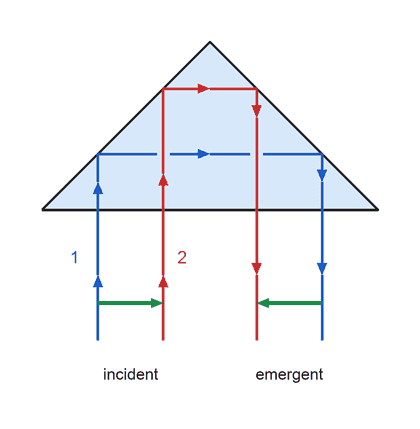
The figure shows two rays, 1 and 2, from the inverted image falling normally on the hypotenuse face of a total reflecting prism.
Step 2 — Explain how the image is made erect with deviation.
Each ray goes straight in, meets one short face at and is totally reflected, then meets the other short face at and is totally reflected again. It comes back out through the hypotenuse face, deviated through . Ray 1, which entered on the left, comes out on the right, and ray 2 changes sides the other way. So the image is turned over, and the inverted image becomes erect.
Step 3 — Draw the arrangement that erects the image without deviation.
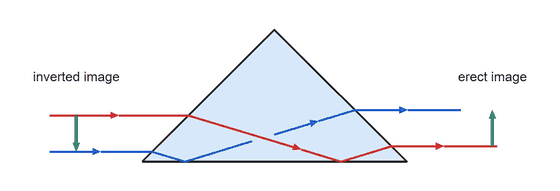
The figure shows rays falling on one short face of the prism, travelling parallel to the hypotenuse face.
Step 4 — Explain how the image is made erect without deviation.
For glass with , a ray meeting the short face at is refracted at about , so inside the prism it slopes down by about . It then meets the hypotenuse face at about , more than the critical angle, and is totally reflected. It leaves through the other short face, where it is refracted back to its original direction. The upper ray comes out lower and the lower ray comes out upper, so the prism turns the image over without changing the direction of the light.
Therefore, an inverted image is made erect with a deviation of 180° by sending the light normally into the hypotenuse face (two total reflections), and without any deviation by sending it parallel to the hypotenuse into a short face (one total reflection at the hypotenuse).