
Question 673 marksMedium
(a) Obtain the relation connecting apparent depth, real depth and refractive index.
(b) What is mirage? How is it formed?
(c) Define critical angle. How is it related to refractive index?
Confirming your payment
Sign up now and get 250 free tokens.
Refraction of Light at Plane Surfaces · Question 67 of 80
(a) Obtain the relation connecting apparent depth, real depth and refractive index.
(b) What is mirage? How is it formed?
(c) Define critical angle. How is it related to refractive index?
Solution:
Key idea: Rays leaving a denser medium bend away from the normal, so an object under water looks raised. If such bending makes a ray meet a boundary at more than the critical angle , it is totally reflected, and .
Step 1 — Draw the rays for an object under water (part a).
In the figure, is an object in water at real depth . The ray along the normal goes straight out. A nearby ray meets the surface at angle of incidence and is refracted away from the normal at angle . Produced back, it meets at , so is the apparent depth.

Step 2 — Apply Snell's law at A.
Since and the normal at are parallel, the angle equals the angle of incidence (alternate angles), and the angle equals the angle of refraction (corresponding angles). For light going from water into air, with the refractive index of water with respect to air, Snell's law gives the following.
Step 3 — Use small angles and the right-angled triangles.
For viewing from nearly overhead both angles are small, so each sine can be replaced by the tangent. In triangle , , and in triangle , .
Step 4 — Say what a mirage is (part b).
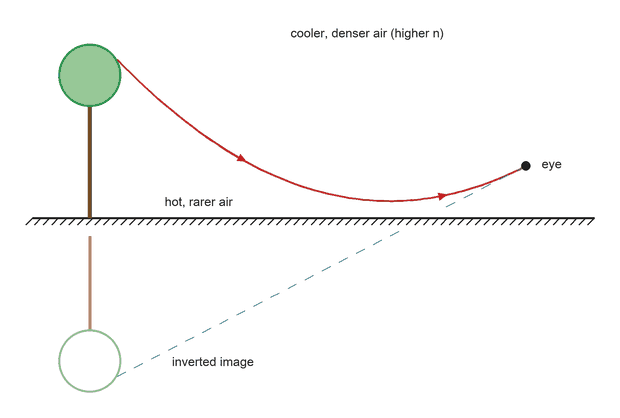
A mirage is an optical illusion seen in deserts and on hot roads, in which an inverted image of a distant object appears below it, as if reflected from a pool of water.
Step 5 — Explain how a mirage is formed.
The air near the hot ground is hotter and rarer than the air above, so its refractive index decreases downwards. A ray from the top of a tree going down passes from denser into rarer layers and bends more and more away from the normal, so its angle of incidence keeps increasing. Near the ground it exceeds the critical angle and the ray is totally reflected upwards. The eye traces the ray back in a straight line, so it sees an inverted image below the ground.
Step 6 — Define the critical angle (part c).
The critical angle is the angle of incidence in the denser medium for which the angle of refraction in the rarer medium is .
Step 7 — Relate the critical angle to the refractive index.
For a medium of refractive index in contact with air, Snell's law at the critical angle gives the relation.
For example, for glass with , the critical angle is about .
Therefore, (a) refractive index = real depth / apparent depth; (b) a mirage is an inverted image formed by refraction and total internal reflection of light in hot, rarer air near the ground; (c) the critical angle is the angle of incidence for which the angle of refraction is 90°, and .