
Question 602 marksEasy
Explain the principle of working of an optical fibre.
Confirming your payment
Sign up now and get 250 free tokens.
Refraction of Light at Plane Surfaces · Question 60 of 80
Explain the principle of working of an optical fibre.
Solution:
Key idea: Light travelling in a medium of higher refractive index is totally reflected at the boundary with a medium of lower refractive index when its angle of incidence exceeds the critical angle.
Step 1 — Describe the structure that the principle uses.
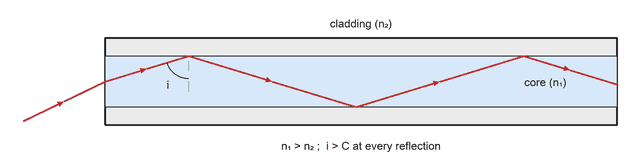
An optical fibre has a central core of refractive index surrounded by a cladding of slightly lower refractive index , as shown in the figure.
Step 2 — Find the critical angle at the core–cladding boundary.
At the boundary the light goes from the core (denser) towards the cladding (rarer), so the critical angle is given by the ratio of the two indices.
For example, with and , the critical angle is about .
Step 3 — Explain what happens to light inside the core.
Light entering the end of the core at a small angle to the axis meets the core–cladding boundary at an angle of incidence greater than . With the values above, any ray within about of the axis does so. It is totally reflected, crosses the core and is totally reflected again at the opposite side.
Step 4 — Explain why the light reaches the far end.
This total reflection repeats at every point where the light meets the boundary, even when the fibre is bent gently. No light escapes through the sides, so it travels the whole length with very little loss and comes out at the other end.
Therefore, an optical fibre works by repeated total internal reflection at the boundary between its core and its lower-index cladding, which guides the light along the fibre with very little loss.