
Question 482 marksEasy
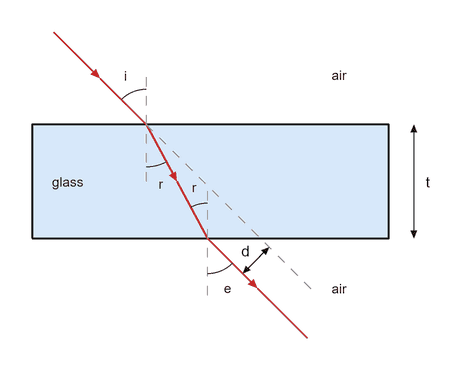
Draw a ray diagram to show the path of light ray through a parallel sided glass slab.
Confirming your payment
Sign up now and get 250 free tokens.
Refraction of Light at Plane Surfaces · Question 48 of 80
Draw a ray diagram to show the path of light ray through a parallel sided glass slab.
Solution:
Key idea: At each face of the slab the ray obeys Snell's law. Because the two faces are parallel, the bending at the second face exactly undoes the bending at the first.
Step 1 — Draw the ray diagram.
The figure shows a ray falling at angle of incidence on the top face of a glass slab of thickness , with dashed normals at both points of incidence.
Step 2 — Describe the refraction at the first face.
Going from air into glass, the ray bends towards the normal and makes an angle of refraction inside the glass, where is the refractive index of glass.
Step 3 — Describe the refraction at the second face.
The normals at the two faces are parallel, so the ray meets the bottom face at the same angle (alternate angles). Going from glass into air, it bends away from the normal and emerges at angle .
Step 4 — Compare the emergent ray with the incident ray.
Both equations equal , so equals and the angle of emergence equals the angle of incidence . The emergent ray is therefore parallel to the incident ray.
Step 5 — Find the sideways shift of the ray.
The path inside the glass has length , and the emergent ray is displaced from the produced incident ray by the perpendicular distance shown in the figure.
For example, a slab cm thick with and gives and a lateral shift of about cm.
Therefore, the ray bends towards the normal on entering the slab and away from it on leaving, so it emerges parallel to the incident ray but shifted sideways by .