Opening your dashboard
Class 12 Physics Chapter 15 Refraction of Light at Plane Surfaces: Competency-Based Questions (CBQ)
43 questions on Chapter 15, each worked through on its own page with the AI tutor. Class 12 Physics, ICSE 2026-27.
43 questions
1–3 marks · Mixed difficulty
- 11 mark
Question 1
Competency: Application
A teacher models refraction with a pair of toy wheels joined by an axle. They roll obliquely from a smooth floor onto a thick carpet, on which they roll more slowly. One wheel reaches the carpet before the other. As the pair crosses the edge of the carpet, its path
- 23 marks
Question 2
Competency: Application
An archerfish shoots a jet of water at insects above the surface. Its eye is below the still water surface. It sees an insect on a leaf above the surface along a line of sight that makes with the vertical inside the water, as shown. (Hypothetical data.) (Refractive index of water . Treat the jet as a straight line over this short distance.)
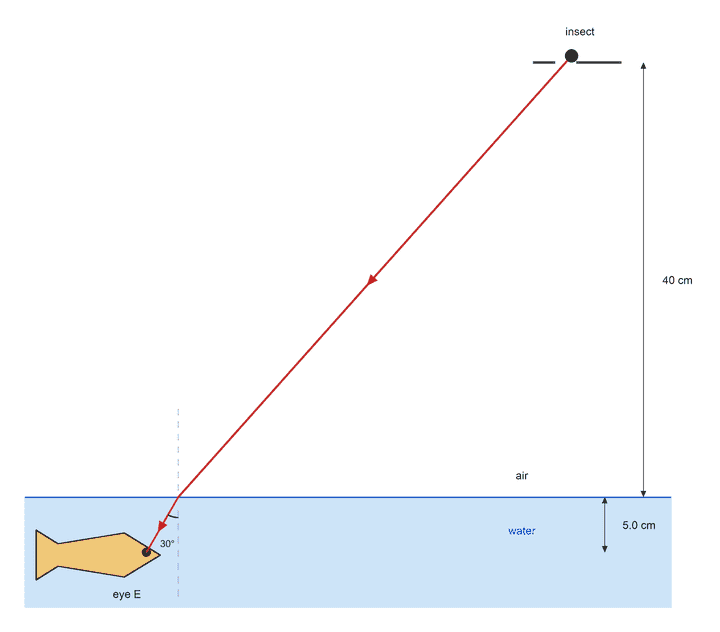
(a) Find the angle that the light from the insect makes with the vertical in air, before it enters the water.
(b) Find the horizontal distance of the insect from the fish's eye.
(c) If the fish shot its jet along its line of sight, would the jet pass nearer to or farther from the fish than the insect does? At what angle to the vertical must it aim to hit the insect?
- 31 mark
Question 3
Competency: Analysis & Evaluation
A parallel beam of light wide in air enters the flat face of a glass block at an angle of incidence of . Its width is measured at right angles to its direction of travel.
Assertion (A): Inside the glass the beam is wider than .
Reason (R): On entering the glass the light bends towards the normal, so the angle it makes with the normal becomes smaller.
- 43 marks
Question 4
Competency: Analysis & Evaluation
Students trace rays through a rectangular perspex block and measure the angle of refraction for six angles of incidence , reading the protractor to the nearest :
(Hypothetical data.)
(a) Calculate for each reading. Which reading is faulty? Give a reason.
(b) Using the other readings, find the refractive index of perspex.
(c) What should the angle of refraction for have been?
- 53 marks
Question 5
Competency: Application
A surveyor's laser rangefinder sends a light pulse to a reflector and times its return. It then calculates the distance as using the speed of light in vacuum, . On the day of the survey the refractive index of the air is . The reflector is exactly away. (Hypothetical data.)
(a) Find the speed of light in the air, and the time the pulse takes to go to the reflector and back.
(b) What distance does the instrument display? Is it too long or too short, and by how much?
(c) On a hotter day the refractive index of the air is . Find the error now, and say why surveyors enter the air temperature into the instrument.
- 61 mark
Question 6
Competency: Application
In a laser timing experiment, a glass plate thick (refractive index ) is placed across the path of the beam, at right angles to it. The plate makes the light arrive later. The same delay would be produced, without the plate, by lengthening the air path by (take the refractive index of air as )
- 71 mark
Question 7
Competency: Analysis & Evaluation
A glass rod in a liquid can almost vanish when lit with yellow light, yet show faint coloured edges when lit with white light.
Assertion (A): Two transparent materials that have the same refractive index for yellow light can have different refractive indices for blue light.
Reason (R): Light of every colour travels in vacuum with the same speed, .
- 83 marks
Question 8
Competency: Application
A forensic laboratory identifies a clear liquid by its refractive index. A thin layer of the liquid covers the flat top face of a glass block of refractive index . A laser beam inside the glass meets the glass–liquid boundary at an angle of incidence of and enters the liquid at an angle of refraction of . (Hypothetical data.) (.)
Liquid water ethanol kerosene glycerol Refractive index (a) Find the refractive index of the liquid with respect to the glass, and its absolute refractive index. Identify the liquid.
(b) Find the speed of light in the liquid.
(c) Above what angle of incidence in the glass would no light enter the liquid?
- 91 mark
Question 9
Competency: Analysis & Evaluation
Assertion (A): A ray of light passing obliquely from glass (refractive index ) into water (refractive index ) bends away from the normal.
Reason (R): Light always bends away from the normal when it passes from a medium of greater mass density into one of smaller mass density.
- 101 mark
Question 10
Competency: Analysis & Evaluation
A straight oar dipped obliquely into still water appears to bend sharply at the water surface. The part under the water looks less steep than it really is. The best explanation is that, to an eye above the water,
- 111 mark
Question 11
Competency: Analysis & Evaluation
A coin lies at the bottom of a beaker and is viewed from directly above. Water (refractive index ) is poured in, first to a depth of and then to .
Assertion (A): The coin appears raised by the same distance in both cases.
Reason (R): An object viewed normally through a layer of thickness and refractive index appears raised by .
- 123 marks
Question 12
Competency: Analysis & Evaluation
To identify an unknown clear liquid, a student pours it into a tall jar with a pin at the bottom. For each depth of liquid the student locates the image of the pin, looking vertically down, and measures its apparent depth below the liquid surface:
(cm) (cm) (Hypothetical data.)
(a) Show that is proportional to and find the refractive index of the liquid.
(b) Which of these could the liquid be: water (), ethanol (), kerosene (), benzene ()?
(c) Predict the apparent depth of the pin when the liquid is deep, and the distance by which the pin then appears raised.
- 133 marks
Question 13
Competency: Application
A sugar mill checks the sugar content of cane juice with a refractometer. A drop of juice is spread on the flat face of a glass prism of refractive index . Light inside the prism strikes the glass–juice boundary; beyond the critical angle it is totally reflected, so the field of view is divided into a bright part and a dark part. The edge between them gives the critical angle, measured as .
For sugar solutions, , where is the percentage of sugar by mass. (Hypothetical data.)
(a) Find the refractive index of the juice.
(b) Find the sugar content of the juice.
(c) Find the critical angle the instrument would show for pure water. Does the critical angle increase or decrease as the juice gets sweeter?
- 143 marks
Question 14
Competency: Application
A thin LED ceiling panel is a flat acrylic sheet (refractive index ) lit by LEDs placed along one edge. The edge is cut at right angles to the two large faces. Light enters through the edge from the air at every possible angle. The panel looks dark except where small white dots are printed on its back face. (Hypothetical data.)
(a) Find the critical angle for acrylic in air.
(b) Show that every ray entering through the edge strikes the large faces at an angle of incidence greater than the critical angle.
(c) Explain why the panel glows only where the white dots are printed.
- 151 mark
Question 15
Competency: Analysis & Evaluation
Inside a glass block (refractive index ), a ray meets the top face at an angle of incidence of . The top face is covered by a thin film of water (refractive index ) with air above it.
Assertion (A): No light from this ray comes out into the air above the water film.
Reason (R): Across parallel boundaries the product has the same value in every layer, so light can reach the air only if in the glass is less than .
- 161 mark
Question 16
Competency: Application
In a science show, a laser beam is sent into a jet of water that curves down from a hole in the side of a bottle. The light follows the curved jet and makes a bright spot where the water lands. The best explanation is that the light
- 173 marks
Question 17
Competency: Analysis & Evaluation
An astronomer models the atmosphere as many thin horizontal layers whose refractive index rises from in space to at the ground. A star's true direction makes an angle with the vertical (its zenith angle); the observer sees it at an apparent zenith angle . (Hypothetical data.)
(a) Using Snell's law at each boundary, show that , whatever the number of layers.
(b) Find, in minutes of arc, how much higher a star with appears.
(c) Find the shift for a star with . Why must a telescope's pointing correction be larger for stars lower in the sky?
- 181 mark
Question 18
Competency: Analysis & Evaluation
On a clear night, a student notices that the bright stars twinkle but the planet Jupiter shines with a steady light.
Assertion (A): Planets twinkle much more than stars because they are much nearer to the Earth.
Reason (R): Twinkling is caused by the random refraction of light from a distant point source in moving layers of air of different temperature and density.
- 191 mark
Question 19
Competency: Application
Looking across the top of a bonfire, a student sees the trees behind it shimmer and waver. The best explanation is that
- 201 mark
Question 20
Competency: Analysis & Evaluation
Large optical telescopes are usually built on high mountain tops. In terms of refraction by the atmosphere, the main advantage is that
- 213 marks
Question 21
Competency: Analysis & Evaluation
A right-angled isosceles glass prism turns light through by total internal reflection at its hypotenuse face . It is to be used in an underwater viewer in which face is in contact with sea water (refractive index ). Light enters face normally, as shown. (Hypothetical data.)

(a) Find the least refractive index the prism must have to work in air.
(b) A prism of crown glass (refractive index ) works in air. Show that it will not work with sea water on face .
(c) Show that a prism of very dense glass (refractive index ) would work with sea water on . Suggest one way to make the crown-glass prism work instead.
- 221 mark
Question 22
Competency: Analysis & Evaluation
A narrow beam of white light enters one face of a right-angled isosceles crown-glass prism normally and is turned through by total internal reflection at the hypotenuse. For crown glass, ranges from about (red) to (violet).
Assertion (A): The light that leaves the prism is still white; the prism does not split it into colours.
Reason (R): The critical angle of glass is the same for light of all colours.
- 233 marks
Question 23
Competency: Application
A video call between two cities can go either through an undersea optical-fibre cable long (core refractive index ) or through a communication satellite, for which the signal travels about up and down at the speed of light in vacuum. (Hypothetical data.) (; ignore delays in the electronics, and take the light in the fibre to travel along its length.)
(a) Find the time the signal takes through the fibre cable.
(b) Find the time through the satellite link.
(c) For a reply to come back, the signal must make the trip twice. Which link gives the shorter wait, and by roughly what factor?
- 241 mark
Question 24
Competency: Analysis & Evaluation
Assertion (A): A bare glass fibre (refractive index ) with no cladding, surrounded by clean air, can still guide light along its length by total internal reflection.
Reason (R): The cladding stops light from leaking out where the fibre's surface is scratched or dirty, or where it touches another fibre.
- 251 mark
Question 25
Competency: Application
A doctor's endoscope carries a picture of the inside of a patient's stomach to the eyepiece through a bundle of thousands of very thin optical fibres. For the image to be seen clearly, the bundle must be made so that
- 263 marks
Question 26
A ray of light strikes the top face of a parallel-sided glass slab thick at an angle of incidence of , as shown. The emergent ray is found to be laterally displaced by from the direction of the incident ray.
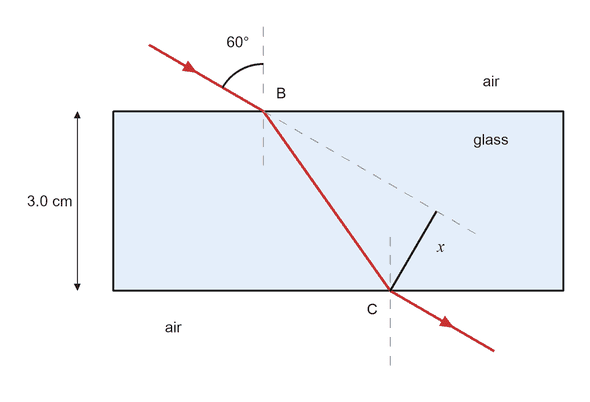
(i) Show that the angle of refraction inside the slab satisfies .
(ii) Find and hence the refractive index of the glass.
- 273 marks
Question 27
Water is poured steadily into an empty tank so that the water level rises at . A student looks vertically down at a mark on the bottom of the tank. (Refractive index of water .)
(i) At what rate does the apparent depth of the mark (below the water surface) increase?
(ii) At what rate does the image of the mark rise above the bottom of the tank? Does this rate depend on how much water is already in the tank?
- 283 marks
Question 28
On a hot afternoon, model the air above a straight road as two layers: a thin layer of hot air next to the road with refractive index , and cooler air above it with refractive index . (Hypothetical data.)
(a) Find the critical angle for light going from the cooler air into the hot layer.
(b) Light from the sky is totally reflected at the boundary only if it travels almost parallel to the road. Find the largest angle the light may make with the road.
(c) A driver's eyes are above the road. Treating the boundary as lying on the road surface and the light paths as straight lines, find roughly how far ahead the nearest part of the shining 'pool of water' appears.
- 293 marks
Question 29
ABC is the cross-section of a right-angled isosceles glass prism (refractive index ) with the right angle at B. A ray strikes face AB at an angle of incidence of , travelling downwards into the prism, as shown.
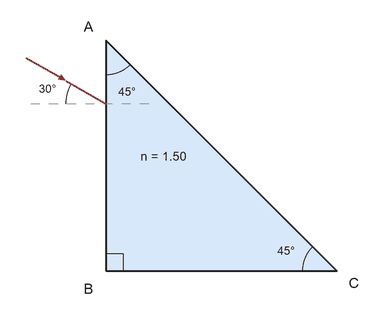
(a) Find the angle of refraction at AB.
(b) Find the angle of incidence at face AC and show that the ray is totally reflected there.
(c) Find the angle at which the ray leaves face BC, and the angle between the incident ray and the emergent ray.
- 303 marks
Question 30
A short pulse of light enters a straight optical fibre long (core refractive index , cladding ). Part of the pulse travels straight along the axis; another part zig-zags, meeting the walls exactly at the critical angle. ()
(a) Find the time taken by the light that travels along the axis.
(b) Show that the zig-zag path is longer than the fibre by the factor , and find how much later this part of the pulse arrives.
(c) Why does this limit how close together pulses can be sent along the fibre?
- 313 marks
Question 31
Refractive indices of water and glass are 4/3 and 3/2 respectively. A ray of light travelling in water is incident on the water glass interface at 30°. Calculate the angle of refraction.
- 323 marks
Question 32
Velocity of light in glass is m/s and that in air is m/s. By how much would an ink dot appear to be raised, when covered by a glass plate 6.0 cm thick?
- 333 marks
Question 33
A ray of light is incident at an angle of 60° on one face of a rectangular glass slab of thickness 0.1 m and refractive index 1.5. Calculate the lateral shift produced.
- 343 marks
Question 34
A glass slab is immersed in water. Find the critical angle at glass–water interface. Given , .
- 353 marks
Question 35
A mark is made at the bottom of a beaker and a microscope is focussed on it. The microscope is raised through 0.015 m. To what height must water be poured into the beaker to bring the mark again into focus. Given .
- 363 marks
Question 36
Refractive index of glass is 1.5. Find the speed of light in glass, if its speed in air is m/s. Also find the critical angle for glass.
- 373 marks
Question 37
Velocity of light in a liquid is m/s and in air it is m/s. If a ray of light passes from this liquid to air, calculate the value of the critical angle.
- 383 marks
Question 38
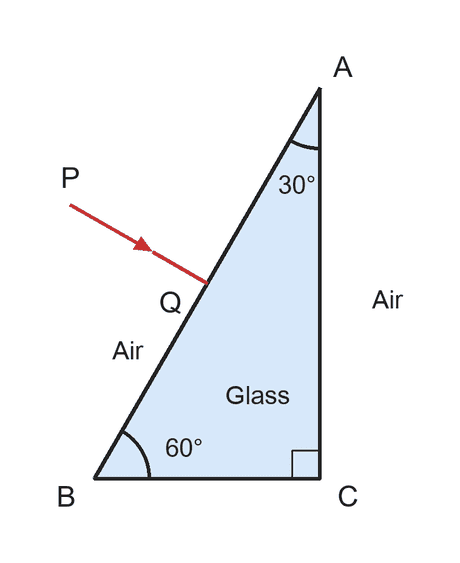
A ray of light falls normally on refracting face of a prism of refractive index 1.6. If the refracted ray just grazes the surface of the prism. Find the angle of the prism.
- 393 marks
Question 39
Calculate the maximum value of the refracting angle of a prism made of a material of refractive index 1.55, if the emerging ray just grazes the surface of the prism.
- 403 marks
Question 40
A ray of light is incident on one face of a prism at an angle of 50°. If the angle of prism is 60° and the ray is deviated through an angle of 42°, find the angle which the emergent ray makes with the second face of the prism.
- 413 marks
Question 41
A ray of light strikes on one face of an equilateral glass prism of refractive index 1.5 at an angle of 41.4° with the surface of the prism. Find the angle of emergence and the angle of minimum deviation. Is the angle of deviation minimum?
- 423 marks
Question 42
The angle of an equilateral glass prism is 59.5°. The angle of minimum deviation is 38.5°. Without using the value of refractive index of the glass, calculate the angle of incidence for a ray of light suffering minimum deviation.
- 433 marks
Question 43
In the given figure, is the cross-section of a right-angled prism with angles as shown. is a ray incident normally at . Complete the passage of the ray through the prism. Explain what happens at the interfaces between glass and air. Calculate , where is the angle of emergence in air, the critical angle of the glass–air is 42° and the refractive index of glass is 1.5.