Refraction of Light at Plane Surfaces · Question 17 of 80
A transparent solid cylindrical rod has a refractive index of 2/√3 .
Question 171 markMCQMedium
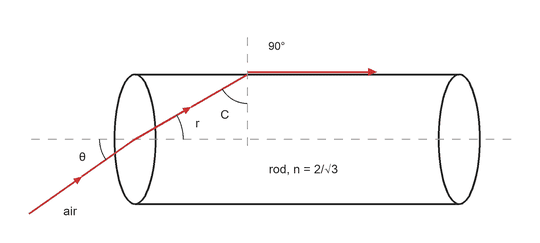
A transparent solid cylindrical rod has a refractive index of 32. It is surrounded by air. A light ray is incident at the mid-point of one end of the rod as shown in the figure. The incident angle θ for which the light ray graze along the wall of the rod is
Select your answer
(A) sin−1(21)
(B) sin−1(23)
(C) sin−1(32)
(D) sin−1(31)
Correct answer
Answer: (D) sin−1(31)
Key idea: The ray grazes along the wall of the rod when it meets the wall at exactly the critical angle C, where sinC=n1. The end face of the rod is perpendicular to its wall.
Step 1 — Find the critical angle at the wall.
We take the reciprocal of the refractive index 32.
sinC=n1
sinC=23
C=60∘
Step 2 — Find the angle of refraction at the end face.
The normal to the end face (the rod's axis) is perpendicular to the normal to the wall. So the angle r that the ray makes with the axis and the angle C it makes with the wall's normal add up to 90∘.
r=90∘−C
r=30∘
Step 3 — Apply Snell's law at the end face.
The ray goes from air, of refractive index 1, into the rod.
1×sinθ=nsinr
sinθ=32×21
sinθ=31
θ=sin−1(31)
This is about 35.3∘. For smaller values of θ the ray meets the wall at more than 60∘ and is totally reflected, so it stays inside the rod.
Why the other options are wrong:
(A) is wrong: The angle sin−1(1/2) is 30∘, the angle of refraction r inside the rod, not the angle θ in air.
(B) is wrong: The angle sin−1(3/2) is 60∘, the critical angle C at the wall, not the angle of incidence on the end face.
(C) is wrong: It takes sinθ equal to the refractive index itself; the number 2/3 is about 1.155, and a sine can never exceed 1, so no such angle exists.
Therefore, the ray grazes along the wall when θ = sin⁻¹(1/√3): option (D).