Solution:
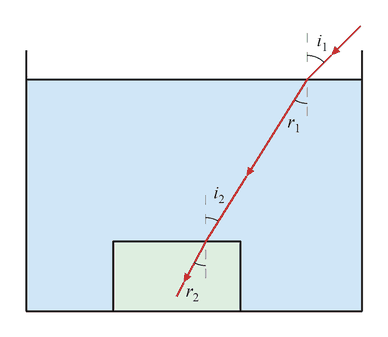
Key idea: At each boundary Snell's law says that nsinθ is the same on both sides. The water surface and the top of the slab are both horizontal, so the angle of refraction at the water surface is also the angle of incidence on the glass.
Step 1 — Find the angle of refraction in water.
The ray goes from air into water at an angle of incidence of 45∘, and the refractive index of water is 34.
1×sin45∘=34sinr1
sinr1=43×0.7071
sinr1≈0.5303
r1≈32.03∘
Step 2 — Find the angle of incidence on the glass.
The water surface and the top face of the slab are parallel, so the normals at the two points are parallel too. The refracted ray in water therefore meets the glass at the same angle, i2=r1.
i2≈32.03∘
Step 3 — Find the angle of refraction in glass.
Snell's law at the water–glass boundary uses the refractive indices of both media.
nwsini2=ngsinr2
34×0.5303=23sinr2
sinr2≈0.4714
r2≈28.13∘
Step 4 — Check with the shortcut.
Step 1 showed that nwsinr1 equals 1×sin45∘, so the water layer drops out and we can go straight from air to glass.
23sinr2=sin45∘
sinr2=32×0.7071
sinr2≈0.4714
This is the same as before. The water layer only shifts the ray sideways; it does not change the final angle in the glass.
Therefore, the angle of refraction in the glass is about 28.13°.