
Opening your dashboard
Class 10 Maths Chapter 22: Heights and Distances Solutions
60 textbook questions with step-by-step answers, free to read, for ICSE 2026-27.
Get talked through Ch 22, not just shown the answer
Reading a finished solution is not the same as being able to do it. The AI tutor takes one question at a time and works it with you, in your own words, until you can.
- Ask it out loud, in your own words
- It gives you the next step, not the answer
- Stuck on part (ii)? Start there
60 questions with solutions
1–3 marks · Mixed difficulty
The first 30 solutions are on this page. This chapter is a long one, so the rest open on their own page to keep this one quick to load.
- 11 mark
Question 1
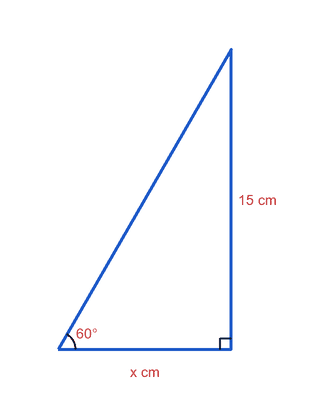
The measure of x is :
 Solve with AI
Answer
(A) 15√3 cm
(B) 15 cm
- Correct
(C) 5√3 cm
(D) 5 cm
Answer: (C) 5√3 cm
Concept: In a right-angled triangle, for an acute angle θ: , and . Choose the ratio that links the side you know with the side you want.
Standard values: , , , , , and .
Step 1 — Name the sides for the 60° angle.
The 60° angle is at the bottom-left corner. The side of 15 cm is the vertical side, OPPOSITE this angle, and x cm is the horizontal side ADJACENT to it. A ratio that uses opposite and adjacent is tan.
Step 2 — Write the tangent ratio.
We put the opposite side over the adjacent side and use tan 60° = √3.
Step 3 — Solve for x.
We multiply both sides by x and divide by √3, then multiply top and bottom by √3 to clear the root.
So x = 5√3 cm (about 8·66 cm).
Watch out: X is next to the 60° angle, so it goes in the DENOMINATOR of tan 60°. Writing x = 15 tan 60° puts it in the wrong place.
Why the other options are wrong:
- (A) 15√3 cm: 15√3 cm is what you get from x = 15 × tan 60°, which treats x as the side opposite 60°.
- (B) 15 cm: 15 cm would make the triangle isosceles, which needs a 45° angle, not 60°.
- (D) 5 cm: with x = 5 cm, tan of the angle would be 15 ÷ 5 = 3, which is about 71·6°, not 60°.
Therefore, x = 5√3 cm, option (C).
- 21 mark
Question 2
The value of x is :
 Solve with AI
Answer
(A) 40 m
(B) 30 m
- Correct
(C) 20 m
(D) 40√3 m
Answer: (C) 20 m
Concept: In a right-angled triangle, for an acute angle θ: , and . Choose the ratio that links the side you know with the side you want.
Standard values: , , , , , and .
Step 1 — Name the sides for the 60° angle.
The 60° angle is at the top vertex. The 40 m side is the HYPOTENUSE (it faces the right angle), and the vertical side x m runs from the 60° vertex to the right angle, so it is ADJACENT to the 60° angle. The ratio linking adjacent and hypotenuse is cos.
Step 2 — Write the cosine ratio.
We put the adjacent side over the hypotenuse.
Step 3 — Solve for x.
We multiply both sides by 40 and use cos 60° = ½.
So x = 20 m.
Watch out: The 60° angle is at the TOP here, so the vertical side x is adjacent to it (use cos), not opposite it.
Why the other options are wrong:
- (A) 40 m: 40 m is the hypotenuse itself; a leg of a right triangle is always shorter than the hypotenuse.
- (B) 30 m: 30 m would make the cosine of the top angle equal to 30 ÷ 40 = 0·75, which is about 41·4°, not 60°.
- (D) 40√3 m: 40√3 m ≈ 69·3 m is longer than the 40 m hypotenuse, which is impossible for a leg.
Therefore, x = 20 m, option (C).
- 31 mark
Question 3
In the given figure, AB = BD, BC = 20 cm and ∠D = 45°, the length of AC is :
 Solve with AI
Answer
(A) 54·64 cm
- Correct
(B) 48·28 cm
(C) 40 cm
(D) 14·64 cm
Answer: (B) 48·28 cm
Concept: In a right-angled triangle, for an acute angle θ: , and . Choose the ratio that links the side you know with the side you want. In a right triangle with a 45° angle, the two legs are equal and the hypotenuse is √2 times a leg.
Step 1 — Look at right triangle BCD.
C is the right angle and ∠D = 45°, so ∠DBC = 45° too. The triangle is isosceles, and so DC equals BC, which is 20 cm.
Step 2 — Find the hypotenuse BD.
BD faces the right angle, so we use sin 45° = BC ÷ BD.
So BD ≈ 28·28 cm.
Step 3 — Use AB = BD.
The figure tells us AB = BD, so AB ≈ 28·28 cm as well.
Step 4 — Add along the line.
A, B and C lie on one vertical line with B between A and C, so AC = AB + BC.
Watch out: AB equals the slanting side BD (the hypotenuse), not the leg DC. Use 20√2, not 20.
Why the other options are wrong:
- (A) 54·64 cm: 54·64 cm = 20 + 20√3 cm. It takes BD as 20√3, but a 45° right triangle has hypotenuse 20√2, not 20√3.
- (C) 40 cm: 40 cm = 20 + 20 takes AB as 20 cm (the leg DC), but AB equals BD, the longer hypotenuse.
- (D) 14·64 cm: 14·64 cm = 20√3 − 20 subtracts, but B lies between A and C, so the two parts must be added.
Therefore, AC ≈ 48·28 cm, option (B).
- 41 mark
Question 4
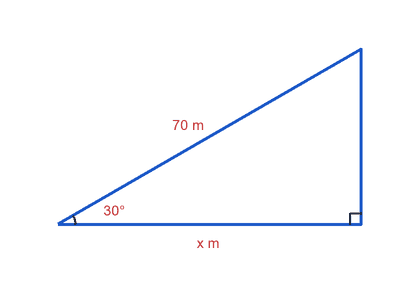
The measure of x correct to the nearest metre is :
 Solve with AI
Answer
(A) 70 m
(B) 35 m
- Correct
(C) 61 m
(D) 140 m
Answer: (C) 61 m
Concept: In a right-angled triangle, for an acute angle θ: , and . Choose the ratio that links the side you know with the side you want.
Step 1 — Name the sides for the 30° angle.
The 70 m side faces the right angle, so it is the HYPOTENUSE. The horizontal side x m runs from the 30° vertex to the right angle, so it is ADJACENT to 30°. Adjacent and hypotenuse are linked by cos.
Step 2 — Write the cosine ratio and solve.
We multiply the hypotenuse by cos 30° = 0·866.
Step 3 — Round to the nearest metre.
60·62 m is nearer to 61 m than to 60 m, because its decimal part is more than 0·5.
Watch out: Sin 30° gives the VERTICAL side (35 m); the horizontal side next to 30° needs cos 30°.
Why the other options are wrong:
- (A) 70 m: 70 m is the hypotenuse; the side x is a leg and must be shorter.
- (B) 35 m: 35 m = 70 sin 30° is the vertical side, opposite the 30° angle, not x.
- (D) 140 m: 140 m = 70 ÷ sin 30° is longer than the hypotenuse, which is impossible for a leg.
Therefore, x ≈ 61 m, option (C).
- 51 mark
Question 5
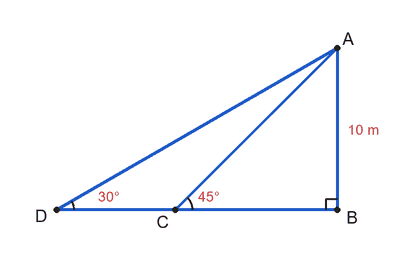
The length of DC is :
 Solve with AI
Answer
(A) 10 m
(B) 10(√3 + 1) m
(C) 20 m
- Correct
(D) 10(√3 – 1) m
Answer: (D) 10(√3 – 1) m
Concept: When one height is seen at two different angles from two points on the same horizontal line, write the horizontal distance of each point from the foot as (that is, ). The gap between the points is the difference of these distances if the points are on the same side, and their sum if they are on opposite sides.
Standard values: , , , , , and .
Step 1 — Find CB from the 45° angle.
In right ΔABC, AB = 10 m is opposite the 45° angle at C and CB is adjacent to it, so tan 45° = AB ÷ CB.
So CB = 10 m.
Step 2 — Find DB from the 30° angle.
In right ΔABD, AB is opposite the 30° angle at D and DB is adjacent to it.
So DB = 10√3 m.
Step 3 — Subtract.
D, C and B lie on one line with C between D and B, so DC = DB − CB.
That is about 7·32 m.
Watch out: D and C are on the SAME side of B, so DC is the difference of the two distances, not their sum.
Why the other options are wrong:
- (A) 10 m: 10 m is CB, the distance of C from the foot B, not DC.
- (B) 10(√3 + 1) m: 10(√3 + 1) m adds the distances, but C lies between D and B, so they must be subtracted.
- (C) 20 m: 20 m is the length of AD (10 ÷ sin 30°), the slanting line, not DC.
Therefore, DC = 10(√3 – 1) m, option (D).
- 63 marks
Question 6
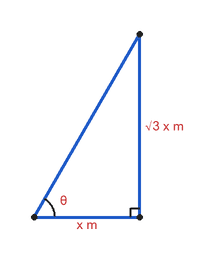
The height of a tree is √3 times the length of its shadow.
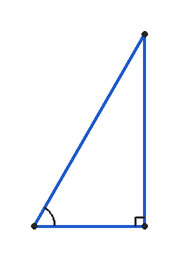
Find the angle of elevation of the sun.
Solve with AIWritten solution
Solution:
Concept: The angle of elevation of a point above the observer is the angle between the horizontal line through the observer's eye and the line of sight to that point. The height, the horizontal distance and the line of sight form a right-angled triangle, so .
Standard values: , , , , , and .
Step 1 — Set up the triangle.
Let the shadow be x metres long. Then the height of the tree is √3 x metres. The tree (vertical), its shadow (horizontal) and the sun's ray from the top of the tree to the tip of the shadow form a right-angled triangle. The angle of elevation θ of the sun is at the tip of the shadow.
Step 2 — Write tan θ.
The height is opposite θ and the shadow is adjacent to θ.
Step 3 — Read off the angle.
The acute angle whose tangent is √3 is 60°, because tan 60° = √3.
Watch out: Tan θ is height ÷ shadow (√3), not shadow ÷ height (1/√3, which would give 30°).
Therefore, the angle of elevation of the sun is 60°.
- 73 marks
Question 7
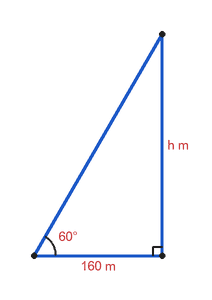
The angle of elevation of the top of a tower, from a point on the ground and at a distance of 160 m from its foot, is found to be 60°.

Find the height of the tower.
Solve with AIWritten solution
Solution:
Concept: The angle of elevation of a point above the observer is the angle between the horizontal line through the observer's eye and the line of sight to that point. The height, the horizontal distance and the line of sight form a right-angled triangle, so .
Standard values: , , , , , and .
Step 1 — Set up the triangle.
Let the height of the tower be h m. The tower, the 160 m of ground from the point to the foot, and the line of sight to the top form a right-angled triangle, with the 60° angle at the point on the ground.
Step 2 — Write tan 60°.
The height is opposite the 60° angle and the 160 m is adjacent to it.
Step 3 — Solve for h.
We multiply both sides by 160 and use tan 60° = √3 ≈ 1·732.
Watch out: The 160 m is along the ground (adjacent to the angle), so the height is 160 × tan 60°, not 160 ÷ tan 60°.
Therefore, the height of the tower is 160√3 m ≈ 277·12 m.
- 83 marks
Question 8
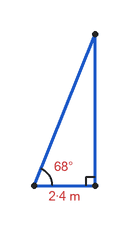
A ladder is placed along a wall such that its upper end is resting against a vertical wall. The foot of the ladder is 2·4 m from the wall and the ladder is making an angle of 68° with the ground.
Find the height, upto which the ladder reaches.
Solve with AIWritten solution
Solution:
Concept: In a right-angled triangle, for an acute angle θ: , and . Choose the ratio that links the side you know with the side you want.
Step 1 — Set up the triangle.
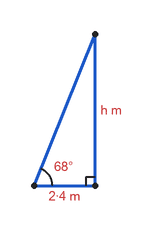
Let the ladder reach a height h m up the wall. The wall (vertical), the ground (horizontal) and the ladder form a right-angled triangle. The ladder makes 68° with the ground at its foot, which is 2·4 m from the wall.
Step 2 — Choose the ratio.
The height h is opposite the 68° angle and the 2·4 m is adjacent to it, so we use tan 68°.
Step 3 — Solve for h.
We multiply both sides by 2·4 and read tan 68° = 2·4751 from the tables.
Watch out: The ladder's length is not given, so sin and cos cannot be used directly; tan links the two sides we have.
Therefore, the ladder reaches a height of about 5·94 m.
- 93 marks
Question 9
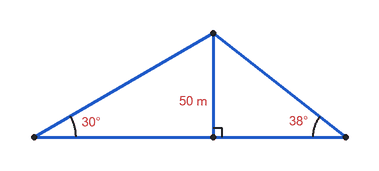
Two persons are standing on the opposite sides of a tower. They observe the angles of elevation of the top of the tower to be 30° and 38° respectively. Find the distance between them, if the height of the tower is 50 m.
 Solve with AI
Written solution
Solution:
Concept: When one height is seen at two different angles from two points on the same horizontal line, write the horizontal distance of each point from the foot as (that is, ). The gap between the points is the difference of these distances if the points are on the same side, and their sum if they are on opposite sides.
Step 1 — Draw the picture.
Let the tower be AB, with top A and foot B, AB = 50 m. Let the persons stand at P and Q on opposite sides of B, with the elevation of A equal to 30° from P and 38° from Q. Triangles ABP and ABQ are right-angled at B.

Step 2 — Find PB.
In ΔABP, AB is opposite the 30° angle and PB is adjacent to it, so PB = AB ÷ tan 30°.
Step 3 — Find QB.
In ΔABQ, AB is opposite the 38° angle, so QB = AB ÷ tan 38°, with tan 38° = 0·7813 from the tables.
Step 4 — Add the distances.
The persons are on opposite sides of the tower, so the distance between them is PB + QB.
Watch out: Decide first whether the two points are on the SAME side of the foot (subtract the distances) or on OPPOSITE sides (add them). A quick sketch settles it.
Therefore, the distance between the two persons is about 150·6 m.
- 103 marks
Question 10
A boy, 1·6 m tall, is 20 m away from a tower and observes the angle of elevation of the top of the tower to be (i) 45° (ii) 60°.
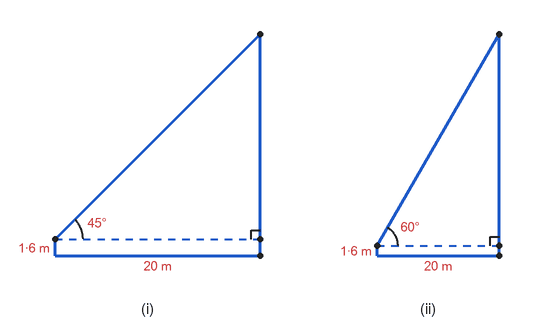
Find the height of the tower in each case.
Solve with AIWritten solution
Solution:
Concept: The angle of elevation of a point above the observer is the angle between the horizontal line through the observer's eye and the line of sight to that point. The height, the horizontal distance and the line of sight form a right-angled triangle, so . The angle is measured at the boy's EYE, so the right triangle gives only the part of the tower ABOVE eye level; the boy's height is then added.
Step 1 — Set up the triangle.
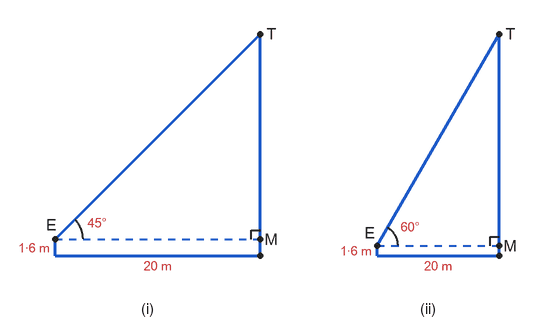
Let the eye of the boy be E, 1·6 m above the ground, and let the horizontal line from E meet the tower at M. Then EM = 20 m, and M is 1·6 m above the foot of the tower. If the top of the tower is T, ΔTME is right-angled at M, and the angle of elevation is at E.
Step 2 — Part (i): elevation 45°.
TM is opposite the angle and EM is adjacent to it, so TM = 20 tan 45°.
Now we add the height of the eye above the ground.
So the tower is 21·6 m high in case (i).
Step 3 — Part (ii): elevation 60°.
In the same way, TM = 20 tan 60°, with tan 60° = √3 ≈ 1·732.
So the tower is 36·24 m high in case (ii).
Watch out: Do not forget to add the boy's 1·6 m: the triangle starts at his eye, not at the ground.
Therefore, the height of the tower is (i) 21·6 m and (ii) 36·24 m.
- 113 marks
Question 11
The upper part of a tree, broken over by the wind, makes an angle of 45° with the ground; and the distance from the root to the point where the top of the tree touches the ground, is 15 m.

What was the height of the tree before it was broken ?
Solve with AIWritten solution
Solution:
Concept: In a right-angled triangle, for an acute angle θ: , and . Choose the ratio that links the side you know with the side you want. When a tree breaks, the broken part keeps its length: the full height is the standing part PLUS the broken part.
Step 1 — Set up the triangle.
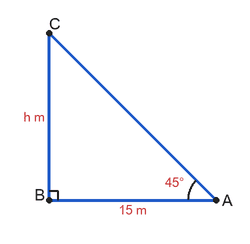
Let the tree break at C, so BC (standing part, vertical) is h m and the broken part CA (slanting) is l m, with its top A on the ground. The ground AB = 15 m, and the broken part makes 45° with the ground at A. ΔABC is right-angled at B.
Step 2 — Find the standing part BC.
BC is opposite the 45° angle and AB is adjacent to it, so we use tan 45°.
So the standing part is 15 m.
Step 3 — Find the broken part CA.
CA is the hypotenuse and AB is adjacent to the 45° angle, so we use cos 45°.
Step 4 — Add the two parts.
Before it broke, the tree was the standing part and the broken part in one straight line.
Watch out: The height of the tree is NOT just 15 m (the standing part); the slanting broken part must be added too.
Therefore, the height of the tree before it was broken was about 36·21 m.
- 123 marks
Question 12
The angle of elevation of the top of an unfinished tower from a point at a distance of 80 m from its base is 30°.
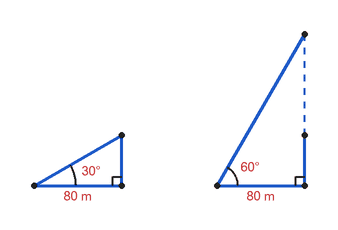
How much higher must the tower be raised so that its angle of elevation at the same point may be 60° ?
Solve with AIWritten solution
Solution:
Concept: The angle of elevation of a point above the observer is the angle between the horizontal line through the observer's eye and the line of sight to that point. The height, the horizontal distance and the line of sight form a right-angled triangle, so .
Standard values: , , , , , and .
Step 1 — Present height.
Let the tower's foot be B and the observer P, with PB = 80 m. The top is now seen at 30°, so the present height is PB × tan 30°.
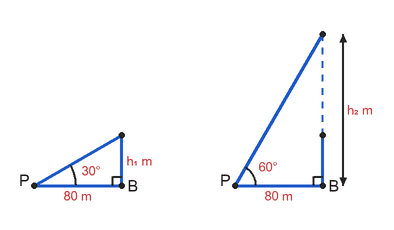
Step 2 — Height needed for 60°.
For the top to be seen at 60° from the same point, the height must be PB × tan 60°.
Step 3 — Find the increase.
The tower must be raised by the difference of the two heights. Writing both over √3 makes the subtraction exact.
Watch out: The angle does not double because the height doubles: the new height is 3 times the old one (tan 60° = 3 tan 30°).
Therefore, the tower must be raised by m ≈ 92·38 m.
- 133 marks
Question 13
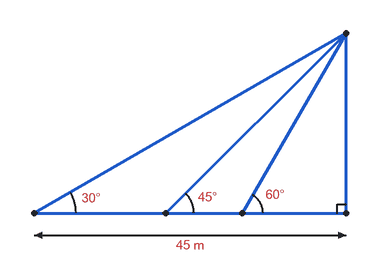
At a particular time, when the sun's altitude is 30°, the length of the shadow of a vertical tower is 45 m. Calculate :
(i) the height of the tower,
(ii) the length of the shadow of the same tower, when the sun's altitude is :
(a) 45° (b) 60°.
 Solve with AI
Written solution
Solution:
Concept: The angle of elevation of a point above the observer is the angle between the horizontal line through the observer's eye and the line of sight to that point. The height, the horizontal distance and the line of sight form a right-angled triangle, so . The sun's altitude is the angle of elevation of the sun, seen from the tip of the shadow, so .
Standard values: , , , , , and .
Step 1 — Part (i): the height.
The tower (h m), its 45 m shadow and the sun's ray form a right triangle, with the 30° angle at the tip of the shadow. The height is opposite this angle and the shadow is adjacent to it.
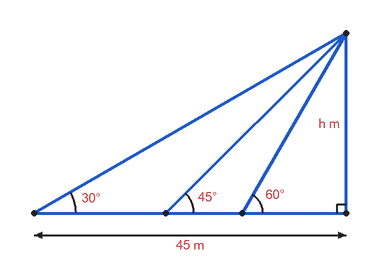
So the tower is 15√3 m ≈ 25·98 m high.
Step 2 — Part (ii)(a): altitude 45°.
Now the height is known and the shadow s is found from tan 45° = h ÷ s.
Step 3 — Part (ii)(b): altitude 60°.
In the same way, s = h ÷ tan 60°.
Watch out: The higher the sun, the SHORTER the shadow. Check: 45 m at 30°, 25·98 m at 45° and 15 m at 60°.
Therefore, (i) the height of the tower is 15√3 m ≈ 25·98 m; (ii) the shadow is (a) ≈ 25·98 m at 45° and (b) 15 m at 60°.
- 143 marks
Question 14
Two vertical poles are on either side of a road. A 30 m long ladder is placed between the two poles. When the ladder rests against one pole, it makes angle 32°24' with the pole and when it is turned to rest against another pole, it makes angle 32°24' with the road.

Calculate the width of the road.
Solve with AIWritten solution
Solution:
Concept: In a right-angled triangle, for an acute angle θ: , and . Choose the ratio that links the side you know with the side you want.
Here 32°24′ means 32·4°, because 24′ is 24/60 of a degree, that is 0·4°.
Step 1 — Understand the picture.
The foot F of the ladder stays at one point on the road between the poles; only its top moves from one pole to the other. So the width of the road = (distance of F from the first pole) + (distance of F from the second pole). In each position the ladder (30 m) is the hypotenuse of a right triangle.

Step 2 — Ladder against the first pole.
Here the ladder makes 32°24′ with the POLE, so this angle is at the top of the ladder. The ground distance is OPPOSITE this angle, so it is 30 sin 32°24′ (sin 32°24′ = 0·5358).
Step 3 — Ladder against the second pole.
Here the ladder makes 32°24′ with the ROAD, so this angle is at the foot. The ground distance is ADJACENT to it, so it is 30 cos 32°24′ (cos 32°24′ = 0·8443).
Step 4 — Add the two distances.
The foot is between the poles, so the width is the sum.
Watch out: The same angle is measured from the pole in one position and from the road in the other, so one distance uses sin and the other uses cos.
Therefore, the width of the road is about 41·40 m.
- 153 marks
Question 15
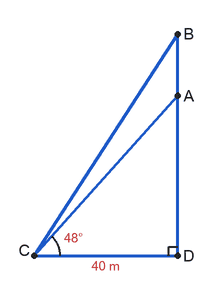
Two climbers are at points A and B on a vertical cliff face. To an observer C, 40 m from the foot of the cliff, on the level ground, A is at an elevation of 48° and B of 57°.

What is the distance between the climbers ?
Solve with AIWritten solution
Solution:
Concept: The angle of elevation of a point above the observer is the angle between the horizontal line through the observer's eye and the line of sight to that point. The height, the horizontal distance and the line of sight form a right-angled triangle, so .
Step 1 — Draw the picture.
Let D be the foot of the cliff, so CD = 40 m along the ground. A and B are on the vertical cliff face above D, with B higher, since its elevation (57°) is the larger one. Triangles ADC and BDC are both right-angled at D.
Step 2 — Find BD.
BD is opposite the 57° angle at C and CD is adjacent to it; from the tables tan 57° = 1·5399.
Step 3 — Find AD.
In the same way, AD = 40 tan 48°, with tan 48° = 1·1106.
Step 4 — Subtract.
Both climbers are on the same vertical line above D, so the distance between them is the difference of their heights.
Watch out: The larger angle of elevation belongs to the HIGHER climber; subtract the smaller height from the larger.
Therefore, the distance between the climbers is about 17·17 m.
- 163 marks
Question 16
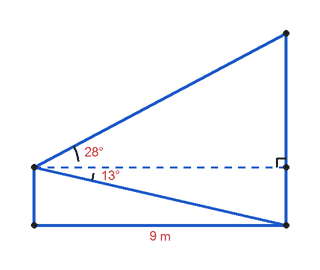
A man stands 9 m away from a flag-pole. He observes that angle of elevation of the top of the pole is 28° and the angle of depression of the bottom of the pole is 13°.
Calculate the height of the pole.
Solve with AIWritten solution
Solution:
Concept: The angle of elevation of a point above the observer is the angle between the horizontal line through the observer's eye and the line of sight to that point. The height, the horizontal distance and the line of sight form a right-angled triangle, so . The angle of depression of a point below the observer is the angle between the horizontal line through the observer's eye and the line of sight down to that point.
Step 1 — Split the pole at eye level.
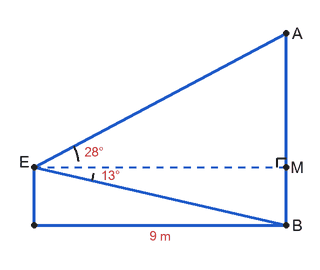
Let the man's eye be E and the pole be AB, with top A and bottom B. The horizontal line from E meets the pole at M, with EM = 9 m. This line splits the pole into AM (above the eye) and MB (below the eye). Triangles AME and BME are right-angled at M.
Step 2 — Find AM from the elevation.
The top A is seen at 28° above the horizontal, so AM = 9 tan 28° , where tan 28° is 0·5317 from the tables.
Step 3 — Find MB from the depression.
The bottom B is seen at 13° below the horizontal, so MB = 9 tan 13° , where tan 13° is 0·2309 from the tables.
Step 4 — Add the two parts.
The pole is the part above the eye plus the part below it.
Watch out: The man's height is not given and is not needed: the angle of depression to the foot already gives the part below his eye.
Therefore, the height of the pole is about 6·86 m.
- 173 marks
Question 17
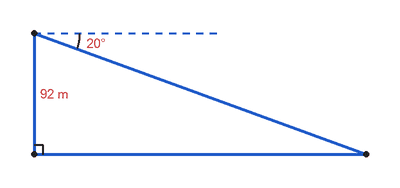
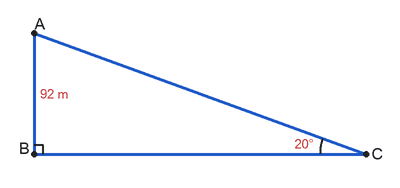
From the top of a cliff 92 m high, the angle of depression of a buoy is 20°.
Calculate, to the nearest metre, the distance of the buoy from the foot of the cliff.
Solve with AIWritten solution
Solution:
Concept: The angle of depression of a point below the observer is the angle between the horizontal line through the observer's eye and the line of sight down to that point. It equals the angle of elevation of the observer as seen from that point (alternate angles, because the two horizontals are parallel), so .
Step 1 — Set up the triangle.
Let the cliff be AB, with top A and foot B, AB = 92 m, and let the buoy be at C. The angle of depression of C from A is 20°, so the angle of elevation of A from C is also 20° (alternate angles). ΔABC is right-angled at B.
Step 2 — Write tan 20°.
At C, the cliff AB is opposite the 20° angle and BC is adjacent to it.
Step 3 — Solve for BC.
We divide 92 by tan 20° = 0·3640 from the tables.
Step 4 — Round.
252·75 m to the nearest metre is 253 m.
Watch out: The 20° depression is at the TOP, between the horizontal and the line of sight. Inside the triangle it appears at the buoy, so the cliff height is the side opposite it.
Therefore, the buoy is about 253 m from the foot of the cliff.
- 181 mark
Question 18
According to the information given in the following figure, the length of BC is :
 Solve with AI
Answer
(A) √3 m
(B) (√3 – 1) m
- Correct
(C) (√3 + 1) m
(D) 2√3 m
Answer: (C) (√3 + 1) m
Concept: In a right-angled triangle, for an acute angle θ: , and . Choose the ratio that links the side you know with the side you want.
Standard values: , , , , , and .
Step 1 — Find BD in ΔABD.
AD = 1 m is perpendicular to BC. In right ΔADB, AD is opposite the 45° angle at B and BD is adjacent to it.
So BD = 1 m.
Step 2 — Find DC in ΔADC.
In right ΔADC, AD is opposite the 30° angle at C and DC is adjacent to it.
So DC = √3 m.
Step 3 — Add.
D lies between B and C, so BC = BD + DC.
Watch out: Dividing by tan 30° = 1/√3 MULTIPLIES by √3; DC = √3 m, not 1/√3 m.
Why the other options are wrong:
- (A) √3 m: √3 m is only DC, one of the two parts of BC.
- (B) (√3 – 1) m: (√3 − 1) m subtracts the parts, but D lies between B and C, so they are added.
- (D) 2√3 m: 2√3 m would need BD = √3 m as well, but the 45° angle makes BD equal to AD = 1 m.
Therefore, BC = (√3 + 1) m, option (C).
- 191 mark
Question 19
The measurement of h is :
 Solve with AI
Answer
- Correct
(A) √(8 × 6) cm
(B) √(4/3) cm
(C) (8 – 6) cm
(D) 2√2 cm
Answer: (A) √(8 × 6) cm
Concept: In a right-angled triangle, for an acute angle θ: , and . Choose the ratio that links the side you know with the side you want. Also, 40° and 50° are complementary (40° + 50° = 90°), so tan 50° = cot 40° and tan 40° × tan 50° = 1.
Step 1 — Name the points.
Let the top be A and the foot B, with AB = h cm. The angle of 40° is at D, 8 cm from B, and the angle of 50° is at C, 6 cm from B (DB = 8 cm and CB = 6 cm, as the dimension lines show). Both triangles are right-angled at B.
Step 2 — Write the two tangents.
In each triangle, h is opposite the marked angle and the ground distance is adjacent to it.
Step 3 — Multiply the two equations.
The left sides multiply to tan 40° × tan 50°. Since tan 50° = cot 40°, this product is 1, so the right sides must also multiply to 1.
Watch out: Do not divide the two equations: dividing removes h. Multiplying uses tan 40° × tan 50° = 1 and keeps h².
Note: The printed data fit only approximately: 8 tan 40° ≈ 6·71 cm while 6 tan 50° ≈ 7·15 cm. The book intends the product method above, and √48 ≈ 6·93 cm lies between these two values, so (A) is the intended answer.
Why the other options are wrong:
- (B) √(4/3) cm: √(4/3) cm = √(8 ÷ 6) cm ≈ 1·15 cm divides the distances instead of multiplying them; from 8 cm away such a small height would be seen at only about 8°, not 40°.
- (C) (8 – 6) cm: (8 − 6) cm = 2 cm has no link to the tangents; from 8 cm away it would be seen at about 14°, not 40°.
- (D) 2√2 cm: 2√2 cm ≈ 2·83 cm is far too short; from 8 cm away it would be seen at about 19·5°, not 40°.
Therefore, h = √(8 × 6) cm, option (A).
- 201 mark
Question 20
The length of AC is :
 Solve with AI
Answer
(A) 22 m
- Correct
(B) 38 m
(C) 23 m
(D) 45 m
Answer: (B) 38 m
Concept: In a right-angled triangle, for an acute angle θ: , and . Choose the ratio that links the side you know with the side you want. In a rectangle the opposite sides are equal.
Step 1 — Use the rectangle EBCD.
E, B, C and D form a rectangle (right angles at B and C, as marked), so EB equals DC (30 m) and BC equals ED (8 m).
Step 2 — Find AB from the 45° angle.
In right ΔABE, AB is opposite the 45° angle at E and EB is adjacent to it.
So AB = 30 m.
Step 3 — Add along AC.
B lies on AC between A and C, so AC = AB + BC.
Watch out: Remember to add the 8 m below the horizontal line EB: the angle gives only the part AB above it.
Why the other options are wrong:
- (A) 22 m: 22 m = 30 − 8 subtracts BC, but B lies between A and C, so BC must be added.
- (C) 23 m: 23 m is less than AB alone (30 m), so it cannot be the whole of AC.
- (D) 45 m: 45 m would need AB = 37 m, but tan 45° = 1 makes AB equal to EB, which is 30 m.
Therefore, AC = 38 m, option (B).
- 211 mark
Question 21
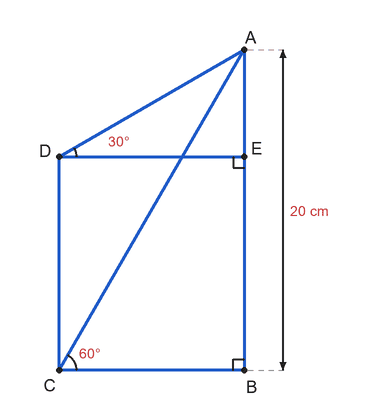
Using the information given in the following figure, the measure of AE is :
 Solve with AI
Answer
(A) 20 cm
(B) 10 cm
- Correct
(C) cm
(D) 20√3 cm
Answer: (C) cm
Concept: In a right-angled triangle, for an acute angle θ: , and . Choose the ratio that links the side you know with the side you want.
Standard values: , , , , , and .
Step 1 — Find CB from the 60° angle.
In right ΔABC, AB = 20 cm is opposite the 60° angle at C and CB is adjacent to it.
So CB = 20/√3 cm (about 11·55 cm).
Step 2 — Use the rectangle DEBC.
DE ⊥ AB and DC ⊥ CB (as marked), so DEBC is a rectangle and DE equals CB, which is 20/√3 cm.
Step 3 — Find AE from the 30° angle.
In right ΔAED, AE is opposite the 30° angle at D and DE is adjacent to it.
Watch out: AE is only the part of AB above E; it is found from DE, which equals CB, not from the full 20 cm.
Why the other options are wrong:
- (A) 20 cm: 20 cm is the whole height AB, but E lies below A, so AE is only part of it.
- (B) 10 cm: 10 cm would need DE = 10√3 ≈ 17·32 cm, but DE equals CB, which is 20/√3 ≈ 11·55 cm.
- (D) 20√3 cm: 20√3 cm ≈ 34·6 cm is longer than AB = 20 cm, which is impossible for a part of AB.
Therefore, AE = cm, option (C).
- 221 mark
Question 22
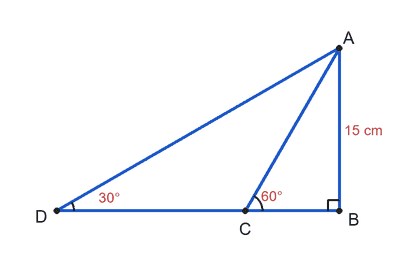
The length of DC is :
 Solve with AI
Answer
(A) 15√3 cm
(B) 15(√3 – 1) cm
(C) 15(√3 + 1) cm
- Correct
(D) 10√3 cm
Answer: (D) 10√3 cm
Concept: When one height is seen at two different angles from two points on the same horizontal line, write the horizontal distance of each point from the foot as (that is, ). The gap between the points is the difference of these distances if the points are on the same side, and their sum if they are on opposite sides.
Standard values: , , , , , and .
Step 1 — Find DB from the 30° angle.
In right ΔABD, AB = 15 cm is opposite the 30° angle at D.
Step 2 — Find CB from the 60° angle.
In right ΔABC, AB is opposite the 60° angle at C. We then clear the root.
Step 3 — Subtract.
C lies between D and B, so DC = DB − CB.
Watch out: 15/√3 is 5√3 (multiply top and bottom by √3), not 5.
Why the other options are wrong:
- (A) 15√3 cm: 15√3 cm is DB, the whole distance from D to the foot B, not DC.
- (B) 15(√3 – 1) cm: 15(√3 − 1) cm takes CB = 15 cm, which would need a 45° angle at C, not 60°.
- (C) 15(√3 + 1) cm: 15(√3 + 1) cm adds, and also uses CB = 15 cm; C lies between D and B, so the distances are subtracted.
Therefore, DC = 10√3 cm, option (D).
- 233 marks
Question 23
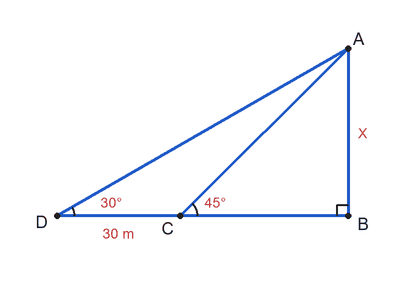
In the figure, given below, it is given that AB is perpendicular to BD and is of length X metres. DC = 30 m, ∠ADB = 30° and ∠ACB = 45°. Find X.
 Solve with AI
Written solution
Solution:
Concept: When one height is seen at two different angles from two points on the same horizontal line, write the horizontal distance of each point from the foot as (that is, ). The gap between the points is the difference of these distances if the points are on the same side, and their sum if they are on opposite sides.
Standard values: , , , , , and .
Step 1 — Find CB in terms of X.
In right ΔABC, AB = X is opposite the 45° angle at C, so CB = X ÷ tan 45°.
Step 2 — Find DB in terms of X.
In right ΔABD, AB = X is opposite the 30° angle at D.
Step 3 — Use DC = 30 m.
C lies between D and B, so DB − CB = DC.
Step 4 — Solve and rationalise.
We divide by (√3 − 1) and multiply top and bottom by (√3 + 1), using (√3 − 1)(√3 + 1) = 2.
Watch out: DC is the DIFFERENCE DB − CB because C is between D and B; check with the answer: DB ≈ 70·98 m, CB ≈ 40·98 m, and 70·98 − 40·98 = 30.
Therefore, X = 15(√3 + 1) m ≈ 40·98 m.
- 243 marks
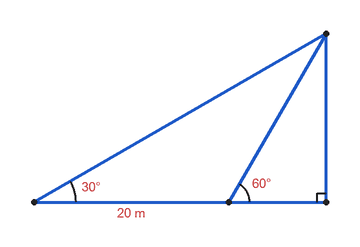
Question 24
Find the height of a tree when it is found that on walking away from it 20 m, in a horizontal line through its base, the elevation of its top changes from 60° to 30°.
 Solve with AI
Written solution
Solution:
Concept: When one height is seen at two different angles from two points on the same horizontal line, write the horizontal distance of each point from the foot as (that is, ). The gap between the points is the difference of these distances if the points are on the same side, and their sum if they are on opposite sides.
Standard values: , , , , , and .
Step 1 — Draw the picture.
Let the tree be AB, with top A, foot B and height h m. From the first point C the elevation is 60°; walking 20 m directly away to D, it becomes 30°. So D, C and B are on one line with C between D and B, and CD = 20 m.

Step 2 — Write both distances in terms of h.
In each right triangle, AB is opposite the angle at the observer.
Step 3 — Use the 20 m walk.
The walk is the difference of the two distances.
Writing the left side over √3 gives (3h − h) ÷ √3.
Step 4 — Solve for h.
We multiply both sides by √3 and divide by 2.
Watch out: Walking AWAY makes the angle smaller, so the 30° point is the farther one; the 20 m is DB − CB.
Therefore, the height of the tree is 10√3 m ≈ 17·32 m.
- 253 marks
Question 25
From the top of a light house 100 m high, the angles of depression of two ships are observed as 48° and 36° respectively.
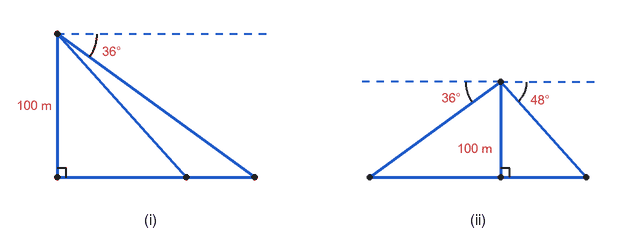
Find the distance between the two ships (in the nearest metre) if:
(i) the ships are on the same side of the light house,
(ii) the ships are on the opposite sides of the light house.
Solve with AIWritten solution
Solution:
Concept: The angle of depression of a point below the observer is the angle between the horizontal line through the observer's eye and the line of sight down to that point. It equals the angle of elevation of the observer as seen from that point (alternate angles, because the two horizontals are parallel), so . When one height is seen at two different angles from two points on the same horizontal line, write the horizontal distance of each point from the foot as (that is, ).
Step 1 — Set up the picture.
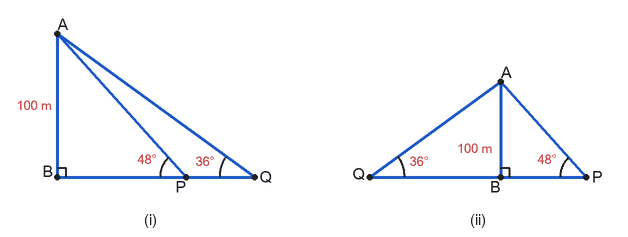
Let the lighthouse be AB, with top A and foot B, AB = 100 m. Let the ships be at P (depression 48°) and Q (depression 36°). The angle of depression from A equals the angle of elevation of A from each ship, so ΔABP and ΔABQ are right-angled at B with angles 48° at P and 36° at Q.
Step 2 — Find PB.
AB is opposite the 48° angle at P; tan 48° = 1·1106.
Step 3 — Find QB.
AB is opposite the 36° angle at Q; tan 36° = 0·7265.
The ship with the smaller angle of depression (Q) is farther away.
Step 4 — Part (i): same side.
Both ships are on one side of the foot, so the distance between them is QB − PB.
To the nearest metre this is 48 m.
Step 5 — Part (ii): opposite sides.
Now the ships are on either side of the foot, so the distance is QB + PB.
To the nearest metre this is 228 m.
Watch out: Decide first whether the two points are on the SAME side of the foot (subtract the distances) or on OPPOSITE sides (add them). A quick sketch settles it.
Therefore, the distance between the ships is (i) 48 m when they are on the same side and (ii) 228 m when they are on opposite sides of the lighthouse.
- 263 marks
Question 26
Two pillars of equal heights stand on either side of a roadway, which is 150 m wide. At a point in the roadway between the pillars the elevations of the tops of the pillars are 60° and 30°; find the height of the pillars and the position of the point.
 Solve with AI
Written solution
Solution:
Concept: When one height is seen at two different angles from two points on the same horizontal line, write the horizontal distance of each point from the foot as (that is, ). The gap between the points is the difference of these distances if the points are on the same side, and their sum if they are on opposite sides.
Standard values: , , , , , and .
Step 1 — Draw the picture.
Let the pillars be AB and CD, each of height h m, with feet B and D, and BD = 150 m. Let P be the point on the road between them, with the top A seen at 60° and the top C seen at 30°.

Step 2 — Write both distances in terms of h.
In each right triangle the pillar is opposite the angle at P.
Step 3 — Use the width of the road.
P lies between the pillars, so PB + PD equals BD, which is 150 m.
Writing the left side over √3 gives (h + 3h) ÷ √3.
Step 4 — Solve for h.
We multiply by √3 and divide by 4.
Step 5 — Find the position of P.
Now we substitute h into the two distances.
Watch out: P is BETWEEN the pillars, so the two distances add up to the width of the road (not subtract).
Therefore, each pillar is 37·5√3 m ≈ 64·95 m high, and the point is 37·5 m from the pillar whose top is seen at 60° (and 112·5 m from the other pillar).
- 273 marks
Question 27
From the figure, given alongside, calculate the length of CD.
 Solve with AI
Written solution
Solution:
Concept: In a right-angled triangle, for an acute angle θ: , and . Choose the ratio that links the side you know with the side you want. In a rectangle the opposite sides are equal.
Step 1 — Use the rectangle DEBC.
DE ⊥ AB and AB ⊥ CB (as marked), with DC vertical, so DEBC is a rectangle. Hence DE equals CB (15 m) and CD equals BE.
Step 2 — Find AB from the 47° angle.
In right ΔABC, AB is opposite the 47° angle at C; tan 47° = 1·0724.
Step 3 — Find AE from the 22° angle.
In right ΔAED, AE is opposite the 22° angle at D and DE = 15 m is adjacent; tan 22° = 0·4040.
Step 4 — Find CD.
CD equals BE, which is AB minus AE.
Watch out: CD is not found from a triangle of its own; it is the part BE of the tall side, left after AE is removed.
Therefore, the length of CD is about 10·03 m.
- 283 marks
Question 28
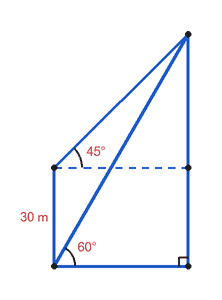
The angle of elevation of the top of a tower is observed to be 60°. At a point, 30 m vertically above the first point of observation, the elevation is found to be 45°.
Find :
(i) the height of the tower,
(ii) its horizontal distance from the points of observation.
Solve with AIWritten solution
Solution:
Concept: The angle of elevation of a point above the observer is the angle between the horizontal line through the observer's eye and the line of sight to that point. The height, the horizontal distance and the line of sight form a right-angled triangle, so .
Standard values: , , , , , and .
Step 1 — Draw the picture.
Let the tower be AB, with top A, foot B and height H m. Let P be the first point on the ground, at horizontal distance d m from B, and Q the point 30 m vertically above P. The horizontal from Q meets the tower at M, so QM = d and MB = 30 m.
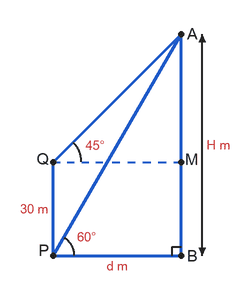
Step 2 — Equation from P.
From P the top is seen at 60°, and H is opposite this angle.
Step 3 — Equation from Q.
From Q the top is seen at 45°; the side opposite this angle is AM = H − 30.
Step 4 — Solve for d.
We put H = √3 d into the equation from Q, then rationalise.
Step 5 — Find H.
From H − 30 = d we get the height.
Watch out: From the higher point Q the triangle's vertical side is H − 30, not H.
Therefore, (i) the height of the tower is about 70·98 m; (ii) its horizontal distance from the points of observation is 15(√3 + 1) m ≈ 40·98 m.
- 293 marks
Question 29
From the top of a cliff, 60 metres high, the angles of depression of the top and bottom of a tower are observed to be 30° and 60°.
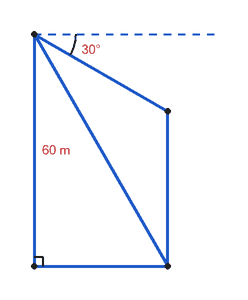
Find the height of the tower.
Solve with AIWritten solution
Solution:
Concept: The angle of depression of a point below the observer is the angle between the horizontal line through the observer's eye and the line of sight down to that point. It equals the angle of elevation of the observer as seen from that point (alternate angles, because the two horizontals are parallel), so .
Standard values: , , , , , and .
Step 1 — Draw the picture.
Let the cliff be AB (top A, foot B, AB = 60 m) and the tower CD (top D, foot C). The horizontal from A meets the line of the tower above D; the horizontal from D meets AB at M. The bottom C is seen at 60° below the horizontal and the top D at 30°.
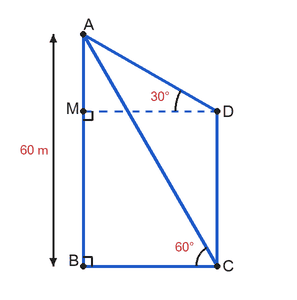
Step 2 — Find the distance BC.
In right ΔABC, AB is opposite the 60° angle at C (equal to the depression).
Step 3 — Find AM.
MD equals BC, which is 20√3 m, and in right ΔAMD the side AM is opposite the 30° angle at D.
Step 4 — Find the tower.
The tower CD equals MB, the part of the cliff below M.
Watch out: AM = 20 m is the part of the cliff ABOVE the tower's top; the tower is what is left, 60 − 20.
Therefore, the height of the tower is 40 m.
- 303 marks
Question 30
A man on a cliff observes a boat, at an angle of depression 30°, which is sailing towards the shore to the point immediately beneath him. Three minutes later, the angle of depression of the boat is found to be 60°.
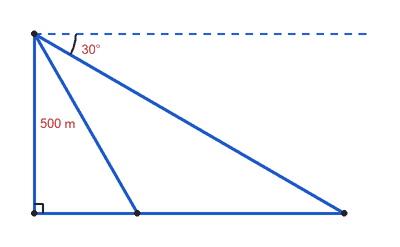
Assuming that the boat sails at a uniform speed, determine :
(i) how much more time it will take to reach the shore ?
(ii) the speed of the boat in metre per second, if the height of the cliff is 500 m.
Solve with AIWritten solution
Solution:
Concept: The angle of depression of a point below the observer is the angle between the horizontal line through the observer's eye and the line of sight down to that point. It equals the angle of elevation of the observer as seen from that point (alternate angles, because the two horizontals are parallel), so .
Standard values: , , , , , and .
At a uniform speed, time is proportional to distance.
Step 1 — Draw the picture.
Let the cliff be AB, with top A, foot B and height h m. Let the boat be at P (depression 30°) and three minutes later at Q (depression 60°), moving towards B.
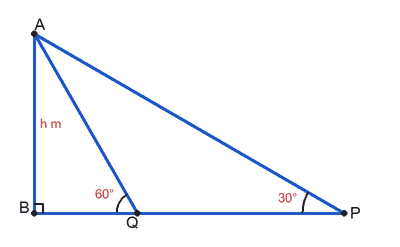
Step 2 — Write both distances in terms of h.
In each right triangle the cliff AB is opposite the angle at the boat.
Step 3 — Distance covered in 3 minutes.
The boat went from P to Q, so the distance is PB − QB.
Step 4 — Part (i): time still needed.
The distance still to go is QB = h/√3, which is exactly half of PQ = 2h/√3. At a uniform speed, half the distance takes half the time.
So it takes 1·5 minutes more.
Step 5 — Part (ii): the speed.
With h = 500 m, PQ = 1000/√3 m, covered in 3 minutes = 180 seconds.
Watch out: Part (i) does not need the height at all: h cancels in the ratio QB : PQ = 1 : 2.
Therefore, (i) the boat takes 1·5 minutes more to reach the shore; (ii) its speed is about 3·21 m/s.
- 313 marks
Question 31
A man in a boat rowing away from a lighthouse 150 m high, takes 2 minutes to change the angle of elevation of the top of the lighthouse from 60° to 45°.

Find the speed of the boat.
- 323 marks
Question 32
A person standing on the bank of a river observes that the angle of elevation of the top of a tree standing on the opposite bank is 60°. When he moves 40 m away from the bank, he finds the angle of elevation to be 30°.
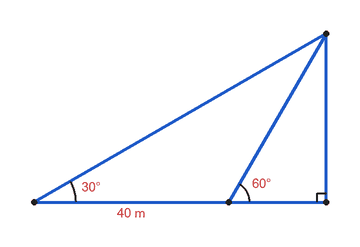
Find :
(i) the height of the tree, correct to 2 decimal places.
(ii) the width of the river.
- 333 marks
Question 33
The horizontal distance between two towers is 75 m and the angular depression of the top of the first tower as seen from the top of the second, which is 160 m high, is 45°.
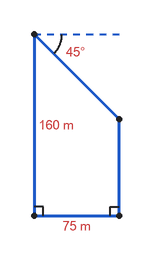
Find the height of the first tower.
- 343 marks
Question 34
The length of the shadow of a tower standing on level plane is found to be 2y metres longer when the sun's altitude is 30° than when it was 45°.
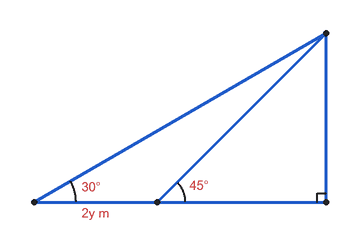
Prove that the height of the tower is y(√3 + 1) metres.
- 353 marks
Question 35
An aeroplane flying horizontally 1 km above the ground and going away from the observer is observed at an elevation of 60°. After 10 seconds, its elevation is observed to be 30°; find the uniform speed of the aeroplane in km per hour.

- 363 marks
Question 36
From the top of a hill, the angles of depression of two consecutive kilometre stones, due east, are found to be 30° and 45° respectively.
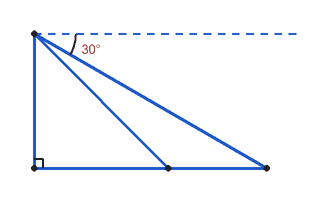
Find the distances of the two stones from the foot of the hill.
- 371 mark
Question 37
If CD = 10 m, the length of AB is :
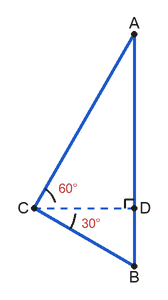
- 381 mark
Question 38
If tan x° = , the length of CB is :
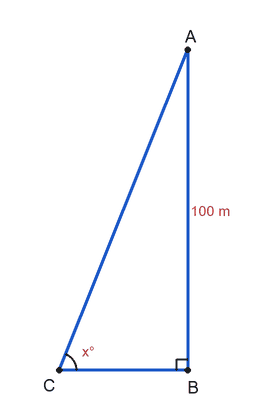
- 391 mark
Question 39
The length of AC is :
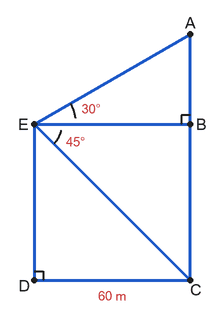
- 401 mark
Question 40
BCDE is a square with side 90 cm and ∠F = 45°. The length of AF is :
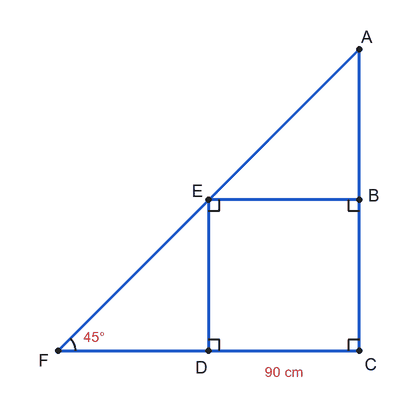
- 411 mark
Question 41
The length of DC is :
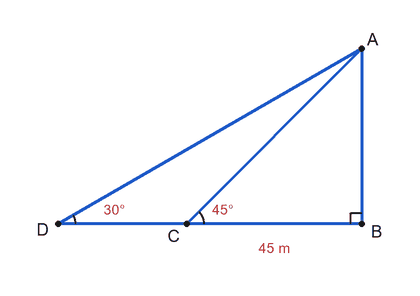
- 421 mark
Question 42
The ratio of the length of a vertical pole and length of its shadow on the horizontal surface is 3 : √3.

Assertion (A) : The angle of elevation of the sun is 60°.
Reason (R) : If angle of elevation of the sun is θ, tan θ = = √3 = tan 60°.
- 431 mark
Question 43
The length of the ladder placed against a vertical wall is twice the distance between the foot of the ladder and the wall.

Assertion (A) : The angle that the ladder makes with the wall is 60°
Reason (R) : If ladder makes angle θ with the wall then sin θ =
- 441 mark
Question 44
For the following figure, tan A = and tan B =
Statement (1) : x = 36 cm.
Statement (2) : tan A = ⇒ h = 15; tan B = ⇒
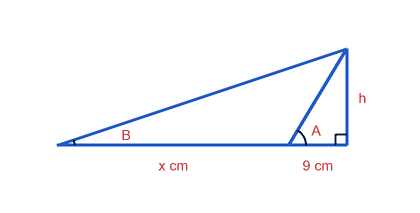
- 451 mark
Question 45
CD = 100 m, ∠ADB = 15° and ∠BDC = 45°
Statement (1) : AB =
Statement (2) : AB = (100 tan 60° – 100 tan 45°) m
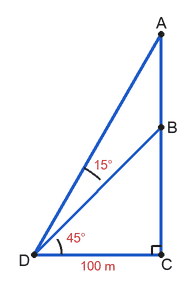
- 463 marks
Question 46
Find AD.
(i)
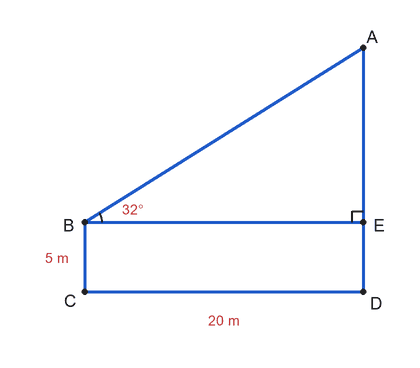
(ii)

- 473 marks
Question 47
In the following diagram, AB is a floor-board; PQRS is a cubical box with each edge = 1 m and ∠B = 60°. Calculate the length of the board AB.
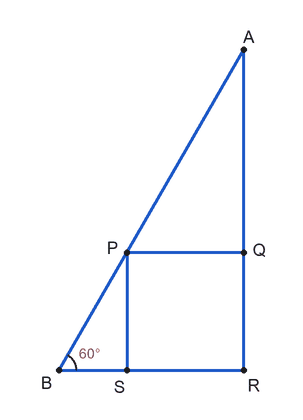
- 483 marks
Question 48
Calculate BC.

- 493 marks
Question 49
Calculate AB.
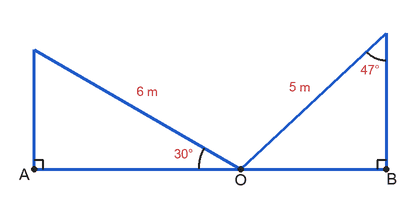
- 503 marks
Question 50
The radius of a circle is given as 15 cm and chord AB subtends an angle of 131° at the centre C of the circle.
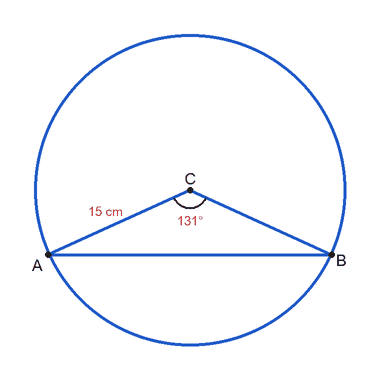
Using trigonometry, calculate :
(i) the length of AB;
(ii) the distance of AB from the centre C.
- 513 marks
Question 51
At a point on level ground, the angle of elevation of a vertical tower is found to be such that its tangent is . On walking 192 metres towards the tower; the tangent of the angle is found to be .
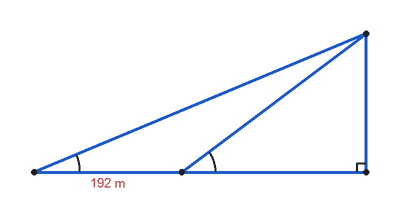
Find the height of the tower.
- 523 marks
Question 52
A vertical tower stands on horizontal plane and is surmounted by a vertical flagstaff of height h metre. At a point on the plane, the angle of elevation of the bottom of the flagstaff is α and that of the top of flagstaff is β.
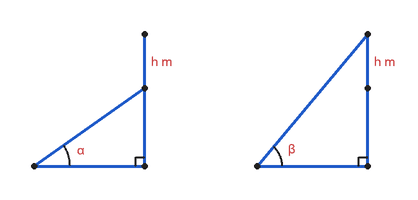
Prove that the height of the tower is .
- 533 marks
Question 53
With reference to the given figure, a man stands on the ground at point A, which is on the same horizontal plane as B, the foot of the vertical pole BC. The height of the pole is 10 m. The man's eye is 2 m above the ground. He observes the angle of elevation of C, the top of the pole, as x°, where tan x° = . Calculate : (i) the distance AB in metres; (ii) angle of elevation of the top of the pole when he is standing 15 metres from the pole. Give your answer to the nearest degree.

- 543 marks
Question 54
From a window A, 10 m above the ground the angle of elevation of the top C of a tower is x°, where tan x° = and the angle of depression of the foot D of the tower is y°, where tan y° = . (See the given figure). Calculate the height CD of the tower in metres.
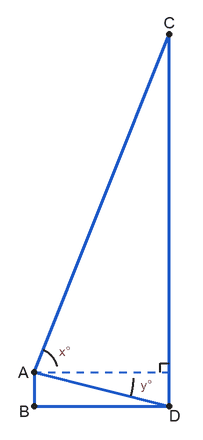
- 553 marks
Question 55
A vertical tower is 20 m high. A man standing at some distance from the tower knows that the cosine of the angle of elevation of the top of the tower is 0·53.

How far is he standing from the foot of the tower ?
- 563 marks
Question 56
A vertical pole and a vertical tower are on the same level ground in such a way that from the top of the pole the angle of elevation of the top of the tower is 60° and the angle of depression of the bottom of the tower is 30°.

Find : (i) the height of the tower, if the height of the pole is 20 m; (ii) the height of the pole, if the height of the tower is 75 m.
- 573 marks
Question 57
In the given figure, from the top of a building AB = 60 m high, the angles of depression of the top and bottom of a vertical lamp post CD are observed to be 30° and 60° respectively.
Find :
(i) the horizontal distance between AB and CD.
(ii) the height of the lamp post.
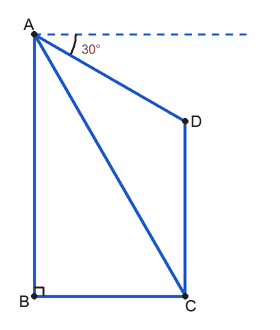
- 583 marks
Question 58
An aeroplane, at an altitude of 250 m, observes the angles of depression of two boats on the opposite banks of a river to be 45° and 60° respectively.
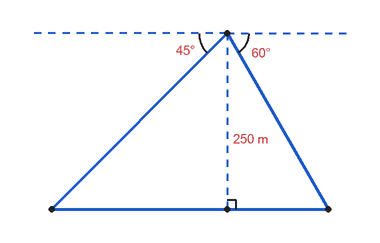
If the boats are on the opposite sides of the aeroplane, find the width of the river. Write the answer correct to the nearest whole number.
- 593 marks
Question 59
The horizontal distance between two towers is 120 m. The angle of elevation of the top and angle of depression of the bottom of the first tower as observed from the top of the second tower are 30° and 24° respectively.
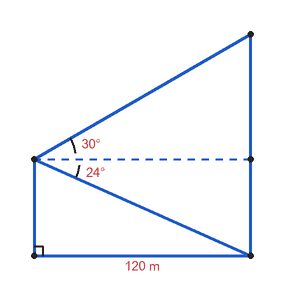
Find the height of the two towers. Give your answer correct to 3 significant figures.
- 603 marks
Question 60
The angles of depression of two ships A and B as observed from the top of a light house 60 m high, are 60° and 45° respectively.
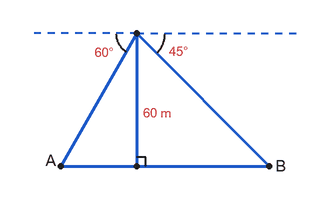
If the two ships are on the opposite sides of the light house, find the distance between the two ships. Give your answer correct to the nearest whole number.
What Class 10 Maths Ch 22 covers
The sections of the chapter, in the order the book takes them. Every question above comes from one of these.
- 01Line of Sight and Angle of Elevation
- 02Angle of Depression
More ways to study this chapter
The same chapter asked three other ways. Practise it, revise it, and see what the board has set on Ch 22 before.
- Competency-Based Questions (CBQ)Case study questions: a situation, and the part of the chapter that answers it.40questionsOpen
- Previous Year QuestionsQuestions that have actually appeared in board papers, each tagged with its year.14questionsOpen
- Practice QuestionsExtra questions per chapter, for when one attempt at a method is not enough.40questionsOpen
Ch 22 in past ICSE papers
The same chapter as the board has actually asked it. These are worded differently from the textbook exercise, which is the point of reading them.
- 14 marks
Board paper question 1
An aeroplane at an altitude of 1500 meters finds that two ships are sailing towards it in the same direction. The angles of depression as observed from the aeroplane are and respectively.
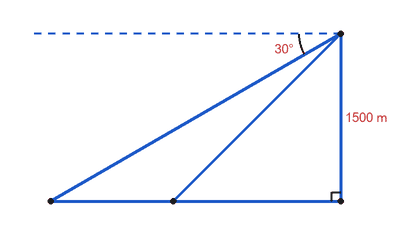
Find the distance between the two ships.
Solve with AIWritten solution
Solution:
Concept: The angle of depression of an object is measured DOWN from the horizontal at the observer's eye; the angle of elevation is measured UP from the horizontal. The angle of depression from the top equals the angle of elevation from the ground point, because they are alternate angles between parallel horizontals. In a right triangle, , that is, height ÷ horizontal distance.
Given: The aeroplane A is 1500 m above the point O on the ground; ship C has angle of depression and ship D has ; both ships are on the same side of O.
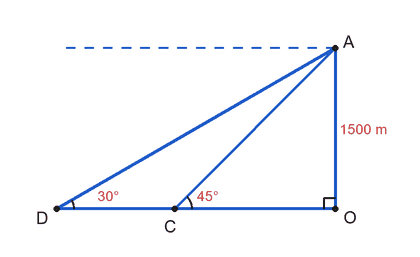
Step 1 — Turn the depressions into elevations.
The horizontal at A is parallel to the ground, so (alternate angles) the angle of elevation of A from C is and from D is . Triangles AOC and AOD are right-angled at O.
Step 2 — Find OC, the distance of the nearer ship.
In triangle AOC, the height AO is opposite the angle and OC is adjacent to it.
Step 3 — Find OD, the distance of the farther ship.
In triangle AOD, the same height is opposite the angle.
Step 4 — Find the distance between the ships.
Both ships are on the same side of O, so the distance between them is the difference OD − OC. We take .
Watch out: The smaller angle of depression belongs to the FARTHER ship; ships on the same side give a difference, not a sum.
Therefore, the distance between the two ships is about 1098 m.
- 24 marks
Board paper question 2
The angles of depression of two ships A and B as observed from the top of a lighthouse 60 m high are and respectively.
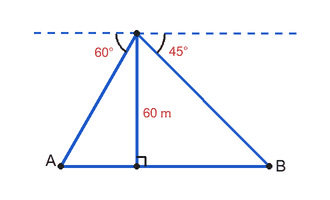
If the two ships are on the opposite sides of the light house, find the distance between the two ships. Give your answer correct to the nearest whole number.
Solve with AIWritten solution
Solution:
Concept: The angle of depression of an object is measured DOWN from the horizontal at the observer's eye; the angle of elevation is measured UP from the horizontal. The angle of depression from the top equals the angle of elevation from the ground point, because they are alternate angles between parallel horizontals. In a right triangle, , that is, height ÷ horizontal distance.
Given: LF is the lighthouse, LF = 60 m, with foot F; the angles of depression of ship A and ship B are and ; the ships are on opposite sides of F.

Step 1 — Turn the depressions into elevations.
By alternate angles, the angle of elevation of L is from A and from B. Triangles LFA and LFB are right-angled at F.
Step 2 — Find AF.
In triangle LFA, the height LF is opposite the angle and AF is adjacent to it.
Step 3 — Find FB.
In triangle LFB, the height LF is opposite the angle.
Step 4 — Add the two distances.
The ships are on opposite sides of the lighthouse, so F lies between them and AB = AF + FB.
To the nearest whole number, 94.64 m is 95 m.
Watch out: Ships on OPPOSITE sides give a sum of the two distances; ships on the same side would give a difference.
Therefore, the distance between the two ships is 95 m (to the nearest whole number).
- 34 marks
Board paper question 3
The angle of elevation from a point P of the top of a tower QR, 50 m high is and that of the tower PT from a point Q is . Find the height of the tower PT, correct to the nearest metre.
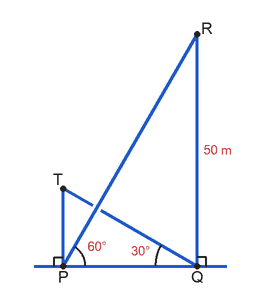 Solve with AI
Written solution
Solution:
Concept: In a right triangle, . For an angle of elevation, the opposite side is the height and the adjacent side is the horizontal distance.
Given: Tower QR = 50 m stands at Q and tower PT at P, both on level ground PQ; the elevation of R from P is and the elevation of T from Q is .
Step 1 — Find the distance PQ between the towers.
In triangle PQR (right-angled at Q), the height QR is opposite the angle at P and PQ is adjacent.
Step 2 — Find the height PT.
In triangle QPT (right-angled at P), the height PT is opposite the angle at Q and PQ is adjacent, so we use the PQ just found.
Step 3 — Round as asked.
To the nearest metre, 16.67 m is 17 m.
Watch out: Keep exact until the end; rounding it early can change the last figure.
Therefore, the height of the tower PT is 17 m (to the nearest metre).
- 44 marks
Board paper question 4
A man observes the angle of elevation of the top of the tower to be 45°. He walks towards it in a horizontal line through its base. On covering 20 m the angle of elevation changes to 60°.
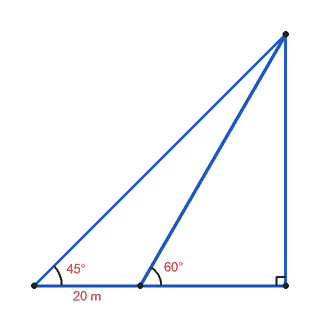
Find the height of the tower correct to 2 significant figures.
Solve with AIWritten solution
Solution:
Concept: In a right triangle, . For an angle of elevation, the opposite side is the height and the adjacent side is the horizontal distance.
Given: AB = h m is the tower with foot B; C is the first position (elevation ) and D the second (elevation ), with CD = 20 m.
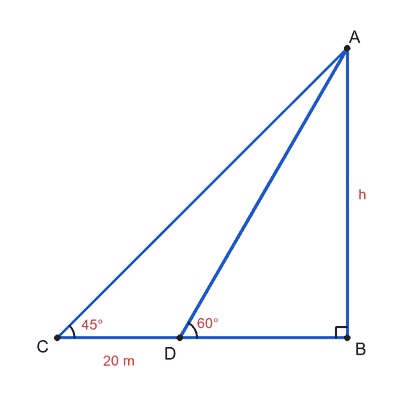
Step 1 — Write CB in terms of h.
In triangle ABC (right-angled at B), the height h is opposite the angle.
Step 2 — Write DB in terms of h.
In triangle ABD, the height h is opposite the angle.
Step 3 — Use the 20 m walked.
The man walks from C to D, so the difference CB − DB is the distance CD, which is 20 m.
Step 4 — Rationalise and evaluate.
We multiply the numerator and the denominator by , so the denominator becomes .
Step 5 — Round to 2 significant figures.
The first two significant figures of 47.32 are 4 and 7, and the next digit (3) is less than 5.
Watch out: 2 significant figures means two digits counted from the first non-zero digit (47), not two decimal places (47.32).
Therefore, the height of the tower is 47 m (correct to 2 significant figures).
- 54 marks
Board paper question 5
From the top of a cliff, the angle of depression of the top and bottom of a tower are observed to be and respectively. If the height of the tower is 20 m.
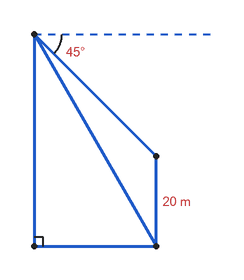
Find :
(i) the height of the cliff.
(ii) the distance between the cliff and the tower.
Solve with AIWritten solution
Solution:
Concept: The angle of depression of an object is measured DOWN from the horizontal at the observer's eye; the angle of elevation is measured UP from the horizontal. The angle of depression from the top equals the angle of elevation from the ground point, because they are alternate angles between parallel horizontals. In a right triangle, , that is, height ÷ horizontal distance.
Given: AB = H m is the cliff and CD = 20 m the tower; from A, the angle of depression of the top C is and of the bottom D is . Draw CE horizontal from C to the cliff; then BD and EC are both equal to d, and AE = H − 20.
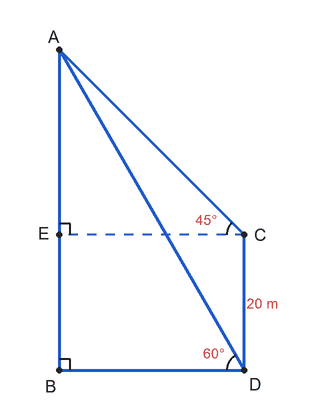
Step 1 — Use the bottom of the tower.
By alternate angles, the angle of elevation of A from D is . In triangle ABD, AB = H is opposite this angle and BD = d is adjacent.
Step 2 — Use the top of the tower.
The angle of elevation of A from C is . In triangle AEC, AE = H − 20 is opposite it and EC = d is adjacent.
Step 3 — Solve for d.
We put from Step 1 into the equation of Step 2.
Step 4 — Find H.
From Step 2, H = d + 20.
Watch out: AE is H − 20, not H: the triangle starts at the TOP of the tower.
Therefore, (i) the height of the cliff is m ≈ 47.32 m; (ii) the distance between the cliff and the tower is m ≈ 27.32 m.
- 61 mark
Board paper question 6
A lighthouse is 80 m high. The angle of elevation of its top from a point 80 m away from its foot along the same horizontal line is:
 Solve with AI
Answer
(A)
- Correct
(B)
(C)
(D)
Answer: (B)
Concept: In a right triangle, . For an angle of elevation, the opposite side is the height and the adjacent side is the horizontal distance.
Step 1 — Form the right triangle.
The lighthouse (80 m) is the side opposite the angle of elevation θ, and the 80 m along the ground is the adjacent side.
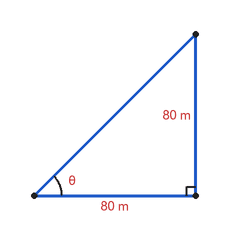
Step 2 — Find tan θ.
We divide the height by the distance.
Step 3 — Find θ.
The acute angle whose tangent is 1 is .
Watch out: When height = distance the angle is always , whatever the actual length.
Why the other options are wrong:
- (A) : , which would need the height to be times the distance.
- (C) : , which would need the distance to be times the height.
- (D) : An angle of elevation of would mean standing at the foot itself, at distance 0.
Therefore, the angle of elevation is , option (B).
All 14 board paper questions for this chapter, solved the same way.
Class 10 Maths Ch 22 questions students ask
How many questions are there in Class 10 Maths Ch 22?
60 questions. Every one is solved step by step on this page.
Are these Class 10 Maths solutions free?
Yes. Every question and its full working is free to read, with no account needed.
Can I download the Class 10 Maths Ch 22 solutions as a PDF?
There is no PDF to download. Every solution is on this page instead, which means it is searchable, always the current syllabus, and readable on a phone. Use your browser's print option if you want it on paper.