A person standing on the bank of a river observes that the angle of elevation of the top of a tree standing on the…
Question 323 marksMedium
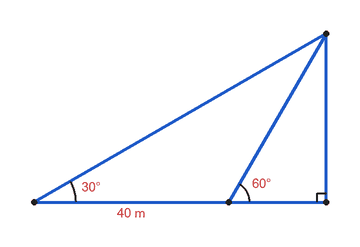
A person standing on the bank of a river observes that the angle of elevation of the top of a tree standing on the opposite bank is 60°. When he moves 40 m away from the bank, he finds the angle of elevation to be 30°.
Find :
(i) the height of the tree, correct to 2 decimal places.
(ii) the width of the river.
Solution:
Concept: The angle of elevation of a point above the observer is the angle between the horizontal line through the observer's eye and the line of sight to that point. The height, the horizontal distance and the line of sight form a right-angled triangle, so tan(elevation)=horizontal distanceheight.
Standard values: tan30∘=31, tan45∘=1, tan60∘=3, sin30∘=21, cos60∘=21, cos30∘=23 and sin60∘=23.
Step 1 — Draw the picture.
Let the tree be AB (top A, foot B on the far bank), height h m, and let the river be w m wide. The person first stands at C on the near bank (CB = w) and then at D, 40 m farther back (DB = w + 40).
Step 2 — Equation from C.
From C the top is seen at 60°.
tan60∘=whh=3w
Step 3 — Equation from D.
From D the top is seen at 30°.
tan30∘=w+40hh=3w+40
Step 4 — Solve for w.
The two expressions for h are equal; we multiply both sides by √3.
3w=3w+403w=w+402w=40w=20
Step 5 — Find h.
We substitute w = 20 into the equation from C.
h=203=20×1.732=34.64
Watch out: The second distance is w + 40, measured from the TREE, not 40 alone.
Therefore, (i) the height of the tree is 20√3 m ≈ 34·64 m; (ii) the width of the river is 20 m.