
Question 103 marksEasy
A boy, 1·6 m tall, is 20 m away from a tower and observes the angle of elevation of the top of the tower to be (i) 45° (ii) 60°.
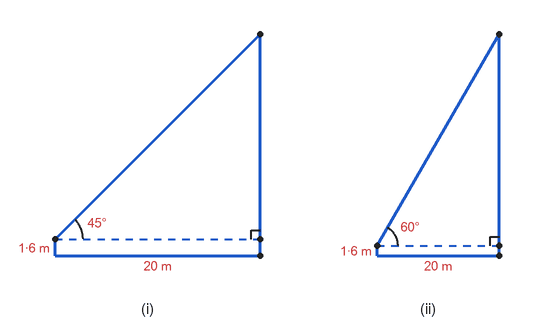
Find the height of the tower in each case.
Confirming your payment
Sign up now and get 250 free tokens.
Heights and Distances · Question 10 of 60
A boy, 1·6 m tall, is 20 m away from a tower and observes the angle of elevation of the top of the tower to be (i) 45° (ii) 60°.
Find the height of the tower in each case.
Solution:
Concept: The angle of elevation of a point above the observer is the angle between the horizontal line through the observer's eye and the line of sight to that point. The height, the horizontal distance and the line of sight form a right-angled triangle, so . The angle is measured at the boy's EYE, so the right triangle gives only the part of the tower ABOVE eye level; the boy's height is then added.
Step 1 — Set up the triangle.
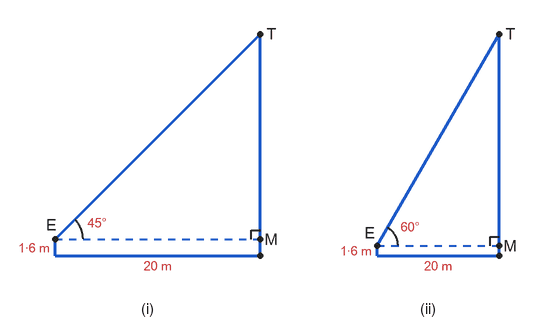
Let the eye of the boy be E, 1·6 m above the ground, and let the horizontal line from E meet the tower at M. Then EM = 20 m, and M is 1·6 m above the foot of the tower. If the top of the tower is T, ΔTME is right-angled at M, and the angle of elevation is at E.
Step 2 — Part (i): elevation 45°.
TM is opposite the angle and EM is adjacent to it, so TM = 20 tan 45°.
Now we add the height of the eye above the ground.
So the tower is 21·6 m high in case (i).
Step 3 — Part (ii): elevation 60°.
In the same way, TM = 20 tan 60°, with tan 60° = √3 ≈ 1·732.
So the tower is 36·24 m high in case (ii).
Watch out: Do not forget to add the boy's 1·6 m: the triangle starts at his eye, not at the ground.
Therefore, the height of the tower is (i) 21·6 m and (ii) 36·24 m.