
Opening your dashboard
Class 10 Maths Chapter 22 Heights and Distances: Previous Year Questions
14 questions on Chapter 22, each solved step by step. Class 10 Maths, ICSE 2026-27.
14 questions with solutions
1–5 marks · Mixed difficulty
- 14 marks
Question 1
An aeroplane at an altitude of 1500 meters finds that two ships are sailing towards it in the same direction. The angles of depression as observed from the aeroplane are and respectively.
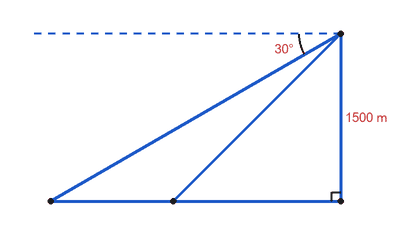
Find the distance between the two ships.
Solve with AIWritten solution
Solution:
Concept: The angle of depression of an object is measured DOWN from the horizontal at the observer's eye; the angle of elevation is measured UP from the horizontal. The angle of depression from the top equals the angle of elevation from the ground point, because they are alternate angles between parallel horizontals. In a right triangle, , that is, height ÷ horizontal distance.
Given: The aeroplane A is 1500 m above the point O on the ground; ship C has angle of depression and ship D has ; both ships are on the same side of O.
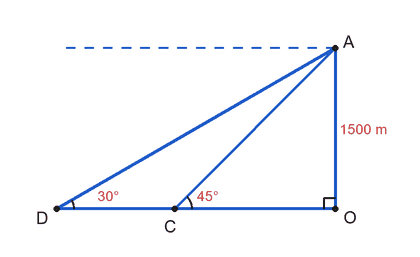
Step 1 — Turn the depressions into elevations.
The horizontal at A is parallel to the ground, so (alternate angles) the angle of elevation of A from C is and from D is . Triangles AOC and AOD are right-angled at O.
Step 2 — Find OC, the distance of the nearer ship.
In triangle AOC, the height AO is opposite the angle and OC is adjacent to it.
Step 3 — Find OD, the distance of the farther ship.
In triangle AOD, the same height is opposite the angle.
Step 4 — Find the distance between the ships.
Both ships are on the same side of O, so the distance between them is the difference OD − OC. We take .
Watch out: The smaller angle of depression belongs to the FARTHER ship; ships on the same side give a difference, not a sum.
Therefore, the distance between the two ships is about 1098 m.
- 24 marks
Question 2
The angles of depression of two ships A and B as observed from the top of a lighthouse 60 m high are and respectively.
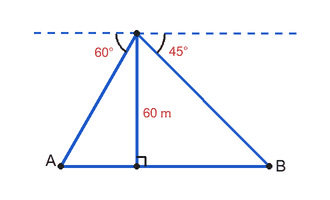
If the two ships are on the opposite sides of the light house, find the distance between the two ships. Give your answer correct to the nearest whole number.
Solve with AIWritten solution
Solution:
Concept: The angle of depression of an object is measured DOWN from the horizontal at the observer's eye; the angle of elevation is measured UP from the horizontal. The angle of depression from the top equals the angle of elevation from the ground point, because they are alternate angles between parallel horizontals. In a right triangle, , that is, height ÷ horizontal distance.
Given: LF is the lighthouse, LF = 60 m, with foot F; the angles of depression of ship A and ship B are and ; the ships are on opposite sides of F.

Step 1 — Turn the depressions into elevations.
By alternate angles, the angle of elevation of L is from A and from B. Triangles LFA and LFB are right-angled at F.
Step 2 — Find AF.
In triangle LFA, the height LF is opposite the angle and AF is adjacent to it.
Step 3 — Find FB.
In triangle LFB, the height LF is opposite the angle.
Step 4 — Add the two distances.
The ships are on opposite sides of the lighthouse, so F lies between them and AB = AF + FB.
To the nearest whole number, 94.64 m is 95 m.
Watch out: Ships on OPPOSITE sides give a sum of the two distances; ships on the same side would give a difference.
Therefore, the distance between the two ships is 95 m (to the nearest whole number).
- 34 marks
Question 3
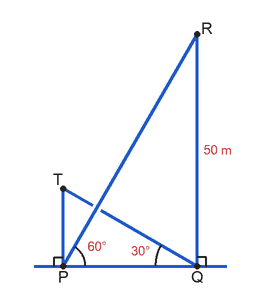
The angle of elevation from a point P of the top of a tower QR, 50 m high is and that of the tower PT from a point Q is . Find the height of the tower PT, correct to the nearest metre.
 Solve with AI
Written solution
Solution:
Concept: In a right triangle, . For an angle of elevation, the opposite side is the height and the adjacent side is the horizontal distance.
Given: Tower QR = 50 m stands at Q and tower PT at P, both on level ground PQ; the elevation of R from P is and the elevation of T from Q is .
Step 1 — Find the distance PQ between the towers.
In triangle PQR (right-angled at Q), the height QR is opposite the angle at P and PQ is adjacent.
Step 2 — Find the height PT.
In triangle QPT (right-angled at P), the height PT is opposite the angle at Q and PQ is adjacent, so we use the PQ just found.
Step 3 — Round as asked.
To the nearest metre, 16.67 m is 17 m.
Watch out: Keep exact until the end; rounding it early can change the last figure.
Therefore, the height of the tower PT is 17 m (to the nearest metre).
- 44 marks
Question 4
A man observes the angle of elevation of the top of the tower to be 45°. He walks towards it in a horizontal line through its base. On covering 20 m the angle of elevation changes to 60°.
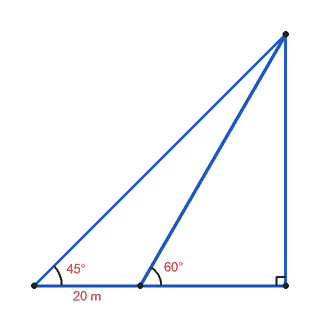
Find the height of the tower correct to 2 significant figures.
Solve with AIWritten solution
Solution:
Concept: In a right triangle, . For an angle of elevation, the opposite side is the height and the adjacent side is the horizontal distance.
Given: AB = h m is the tower with foot B; C is the first position (elevation ) and D the second (elevation ), with CD = 20 m.
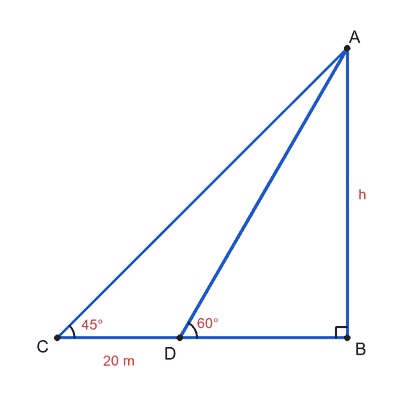
Step 1 — Write CB in terms of h.
In triangle ABC (right-angled at B), the height h is opposite the angle.
Step 2 — Write DB in terms of h.
In triangle ABD, the height h is opposite the angle.
Step 3 — Use the 20 m walked.
The man walks from C to D, so the difference CB − DB is the distance CD, which is 20 m.
Step 4 — Rationalise and evaluate.
We multiply the numerator and the denominator by , so the denominator becomes .
Step 5 — Round to 2 significant figures.
The first two significant figures of 47.32 are 4 and 7, and the next digit (3) is less than 5.
Watch out: 2 significant figures means two digits counted from the first non-zero digit (47), not two decimal places (47.32).
Therefore, the height of the tower is 47 m (correct to 2 significant figures).
- 54 marks
Question 5
From the top of a cliff, the angle of depression of the top and bottom of a tower are observed to be and respectively. If the height of the tower is 20 m.
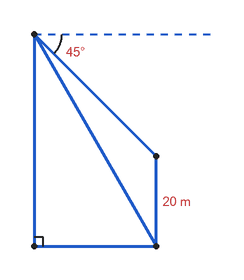
Find :
(i) the height of the cliff.
(ii) the distance between the cliff and the tower.
Solve with AIWritten solution
Solution:
Concept: The angle of depression of an object is measured DOWN from the horizontal at the observer's eye; the angle of elevation is measured UP from the horizontal. The angle of depression from the top equals the angle of elevation from the ground point, because they are alternate angles between parallel horizontals. In a right triangle, , that is, height ÷ horizontal distance.
Given: AB = H m is the cliff and CD = 20 m the tower; from A, the angle of depression of the top C is and of the bottom D is . Draw CE horizontal from C to the cliff; then BD and EC are both equal to d, and AE = H − 20.
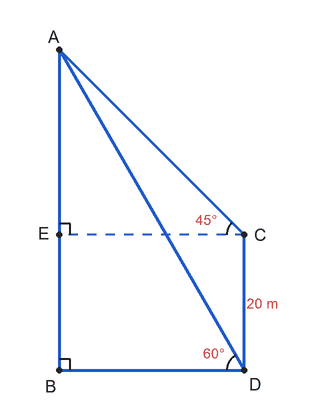
Step 1 — Use the bottom of the tower.
By alternate angles, the angle of elevation of A from D is . In triangle ABD, AB = H is opposite this angle and BD = d is adjacent.
Step 2 — Use the top of the tower.
The angle of elevation of A from C is . In triangle AEC, AE = H − 20 is opposite it and EC = d is adjacent.
Step 3 — Solve for d.
We put from Step 1 into the equation of Step 2.
Step 4 — Find H.
From Step 2, H = d + 20.
Watch out: AE is H − 20, not H: the triangle starts at the TOP of the tower.
Therefore, (i) the height of the cliff is m ≈ 47.32 m; (ii) the distance between the cliff and the tower is m ≈ 27.32 m.
- 61 mark
Question 6
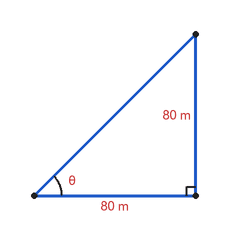
A lighthouse is 80 m high. The angle of elevation of its top from a point 80 m away from its foot along the same horizontal line is:
 Solve with AI
Answer
(A)
- Correct
(B)
(C)
(D)
Answer: (B)
Concept: In a right triangle, . For an angle of elevation, the opposite side is the height and the adjacent side is the horizontal distance.
Step 1 — Form the right triangle.
The lighthouse (80 m) is the side opposite the angle of elevation θ, and the 80 m along the ground is the adjacent side.
Step 2 — Find tan θ.
We divide the height by the distance.
Step 3 — Find θ.
The acute angle whose tangent is 1 is .
Watch out: When height = distance the angle is always , whatever the actual length.
Why the other options are wrong:
- (A) : , which would need the height to be times the distance.
- (C) : , which would need the distance to be times the height.
- (D) : An angle of elevation of would mean standing at the foot itself, at distance 0.
Therefore, the angle of elevation is , option (B).
- 73 marks
Question 7
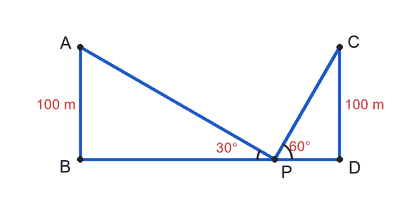
Two lamp posts AB and CD each of height 100 m are on either side of the road. P is a point on the road between the two lamp posts. The angles of elevation of the top of the lamp posts from the point P are 60° and 30°. Find the distances PB and PD.
 Solve with AI
Written solution
Solution:
Concept: In a right triangle, . For an angle of elevation, the opposite side is the height and the adjacent side is the horizontal distance.
Given: Lamp posts AB and CD are each 100 m high, P is on the road between them; the figure marks and .
Step 1 — Find PB.
In triangle ABP (right-angled at B), the post AB is opposite the angle at P and PB is adjacent.
Step 2 — Find PD.
In triangle CDP (right-angled at D), the post CD is opposite the angle at P.
Step 3 — Check with the figure.
The post seen at the smaller angle must be farther away, and indeed PB (173.2 m) is longer than PD (57.7 m), as drawn.
Watch out: Match each angle to its own post as marked in the figure: at P for AB and for CD.
Therefore, PB = m ≈ 173.2 m and PD = m ≈ 57.7 m.
- 84 marks
Question 8
From the top of a tower 100 m high, a man observes the angles of depression of two ships A and B, on opposite sides of the tower as and respectively. If the foot of tower and the ships are in the same horizontal line, find the distance between the two ships A and B to the nearest metre.
(Use Mathematical Tables for this question.)
 Solve with AI
Written solution
Solution:
Concept: The angle of depression of an object is measured DOWN from the horizontal at the observer's eye; the angle of elevation is measured UP from the horizontal. The angle of depression from the top equals the angle of elevation from the ground point, because they are alternate angles between parallel horizontals. In a right triangle, , that is, height ÷ horizontal distance.
Given: DC = 100 m is the tower with foot C; the angles of depression of ship A and ship B from D are and ; A and B are on opposite sides of C. From the tables, .
Step 1 — Turn the depressions into elevations.
By alternate angles, and , in triangles right-angled at C.
Step 2 — Find AC.
In triangle DCA, DC is opposite the angle and AC is adjacent.
Step 3 — Find CB.
In triangle DCB, DC is opposite the angle; we use the table value of .
Step 4 — Add the two distances.
The ships are on opposite sides of the tower, so AB = AC + CB.
To the nearest metre this is 228 m.
Watch out: Divide by (CB = 100 ÷ 0.7813); multiplying (100 × 0.7813 = 78.13) gives the wrong distance.
Therefore, the distance between the two ships is 228 m (to the nearest metre).
- 95 marks
Question 9
The angle of elevation of the top of a 100 m high tree from two points A and B on the opposite side of the tree are and respectively. Find the distance AB, to the nearest metre.
 Solve with AI
Written solution
Solution:
Concept: In a right triangle, . For an angle of elevation, the opposite side is the height and the adjacent side is the horizontal distance.
Given: DC = 100 m is the tree with foot C; the elevation of D is from A and from B; A and B are on opposite sides of the tree. From the tables, .
Step 1 — Find AC.
In triangle DCA (right-angled at C), DC is opposite the angle at A and AC is adjacent.
Step 2 — Find CB.
In triangle DCB, DC is opposite the angle at B.
Step 3 — Add the two distances.
A and B are on opposite sides of the tree, so AB = AC + CB.
To the nearest metre this is 178 m.
Watch out: The larger angle () belongs to the NEARER point, so AC is less than 100 m.
Therefore, the distance AB is 178 m (to the nearest metre).
- 105 marks
Question 10
In the given diagram, AB is a vertical tower 100 m away from the foot of a 30 storied building CD. The angles of depression from the point C and E. (E being the mid-point of CD), are and respectively. (Use mathematical table for the required values rounded off correct to two places of decimals only.)
Find the height of the:
(a) tower AB
(b) building CD
 Solve with AI
Written solution
Solution:
Concept: The angle of depression of an object is measured DOWN from the horizontal at the observer's eye; the angle of elevation is measured UP from the horizontal. The angle of depression from the top equals the angle of elevation from the ground point, because they are alternate angles between parallel horizontals. In a right triangle, , that is, height ÷ horizontal distance.
Given: AB is the tower and CD the building, BD = 100 m; E is the mid-point of CD; the angles of depression of A from C and from E are and . From the tables, rounded to two decimal places, and .
Step 1 — Draw the horizontal AP.
Draw AP horizontal from the top of the tower to the building. Then ABDP is a rectangle, so AP equals BD (100 m) and PD = AB. By alternate angles, and .
Step 2 — Find CP.
In triangle CPA (right-angled at P), CP is opposite the angle and AP is adjacent.
Step 3 — Find EP.
In triangle EPA, EP is opposite the angle.
Step 4 — Use E as the mid-point.
E lies between C and P, so CE = CP − EP. Since E is the mid-point of CD, ED = CE.
(a)
Step 5 — Find the tower AB.
P lies between E and D, so PD = ED − EP, and AB = PD (opposite sides of the rectangle).
(b)
Step 6 — Find the building CD.
E is the mid-point, so CD is twice CE.
Watch out: Use the ROUNDED table values (0.70 and 0.25) as the stem asks; the '30 storied' detail is not needed.
Therefore, (a) the height of the tower AB is 20 m; (b) the height of the building CD is 90 m.
- 111 mark
Question 11
Assertion (A): If the length of shadow of a person is equal to his height, then the angle of elevation of the sun is .

Reason (R): For any right-angled triangle,
Solve with AIAnswer
(A) (A) is true, (R) is false.
(B) (A) is false, (R) is true.
- Correct
(C) Both (A) and (R) are true, and (R) is the correct reason for (A).
(D) Both (A) and (R) are true, and (R) is the incorrect reason for (A).
Answer: (C) Both (A) and (R) are true, and (R) is the correct reason for (A).
Concept: In a right triangle, . For an angle of elevation, the opposite side is the height and the adjacent side is the horizontal distance. To judge an assertion–reason item, decide whether A is true, whether R is true, and whether R is what makes A true.
Step 1 — Judge the Reason.
The Reason is the definition of in a right triangle, so it is true.
Step 2 — Set up the triangle.
The person (height h) is the perpendicular, the shadow is the base, and the sun's ray is the hypotenuse; θ is the angle of elevation of the sun at the tip of the shadow.
Step 3 — Use the Reason.
The shadow equals the height, so both are h.
So , and the Assertion is true.
Step 4 — Check whether R explains A.
The Assertion was proved by using exactly the formula in the Reason, so R is the correct reason for A.
Why the other options are wrong:
- (A) (A) is true, (R) is false: The Reason is the definition of tan θ, so it is true.
- (B) (A) is false, (R) is true: The Assertion is true, as Step 3 shows.
- (D) Both (A) and (R) are true, and (R) is the incorrect reason for (A): The Reason is exactly the formula used to prove the Assertion, so it is the correct reason.
Therefore, both A and R are true and R is the correct reason for A, option (C).
- 125 marks
Question 12
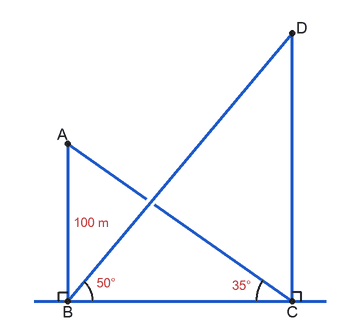
The angle of elevation of the top of a hill from the foot of a tower at B is . The angle of elevation of the top of the tower 100 m high from the foot of the hill at C is .
Find the :
(a) horizontal distance BC between the Hill and the Tower.
(b) height CD of the Hill. (Take )
(c) time taken by a cyclist to cover the distance BC, cycling at 20 m/sec.
Solve with AIWritten solution
Solution:
Concept: In a right triangle, . For an angle of elevation, the opposite side is the height and the adjacent side is the horizontal distance.
Given: Tower AB = 100 m stands at B and hill CD at C on level ground; the elevation of the hill top D from B is and of the tower top A from C is ; , and from the tables .
(a)
Step 1 — Find BC from the tower.
In triangle ABC (right-angled at B), the tower AB is opposite the angle at C and BC is adjacent.
(b)
Step 2 — Find CD from the hill.
In triangle DCB (right-angled at C), the hill CD is opposite the angle at B and the same BC is adjacent.
(c)
Step 3 — Find the time.
Time is distance divided by speed, with the distance BC in metres and the speed in m/s.
Watch out: Each angle sits at the foot of the OTHER object: at C looks up to the tower, at B looks up to the hill.
Therefore, (a) BC ≈ 142.82 m; (b) the height of the hill CD ≈ 171.38 m; (c) the cyclist takes about 7.14 seconds.
- 135 marks
Question 13
A flagpole is erected at the top of a building. The angle of elevation of the top and foot of the flagpole from a point 100 m away, on the same level as that of the foot of the building, are and respectively. Find the height of the flagpole. Give your answer correct to the nearest metre.
 Solve with AI
Written solution
Solution:
Concept: In a right triangle, . For an angle of elevation, the opposite side is the height and the adjacent side is the horizontal distance.
Given: BC is the building and CD the flagpole on it; A is 100 m from the foot B; the elevation of the top D is and of the foot C is . From the tables, and .
Step 1 — Find BD, the height of the top of the flagpole.
In triangle ABD (right-angled at B), BD is opposite the angle and AB is adjacent.
Step 2 — Find BC, the height of the building.
In triangle ABC, BC is opposite the angle.
Step 3 — Find the flagpole.
The flagpole is the part of BD above the building, so CD = BD − BC.
To the nearest metre this is 5 m.
Watch out: Subtract the two heights; do not use , which is not the flagpole's ratio.
Therefore, the height of the flagpole is 5 m (to the nearest metre).
- 145 marks
Question 14
As observed from the top of a light house, 80 m above sea level, the angle of depression of a ship, sailing directly towards it, changes from to .
(a) Draw a free hand sketch representing the given information.
(b) Find the distance travelled by the ship during the period of observation. Give your answer to the nearest meter.
Solve with AIWritten solution
Solution:
Concept: The angle of depression of an object is measured DOWN from the horizontal at the observer's eye; the angle of elevation is measured UP from the horizontal. The angle of depression from the top equals the angle of elevation from the ground point, because they are alternate angles between parallel horizontals. In a right triangle, , that is, height ÷ horizontal distance.
Given: LF is the lighthouse, LF = 80 m, with foot F at sea level; the ship moves towards F from P (angle of depression ) to Q (angle of depression ). From the tables, and .
(a)
Step 1 — Draw the sketch.
Draw LF vertical, the sea level FP horizontal, and the horizontal through L. The ship is first at P and later at Q, nearer to F; mark the angles of depression and (equal to the angles of elevation at P and Q).

(b)
Step 2 — Find FP.
In triangle LFP (right-angled at F), LF is opposite the angle at P and FP is adjacent.
Step 3 — Find FQ.
In triangle LFQ, LF is opposite the angle at Q.
Step 4 — Find the distance travelled.
The ship moves from P to Q along the same line towards F, so PQ = FP − FQ.
To the nearest metre this is 58 m.
Watch out: As the ship comes closer, the angle of depression INCREASES ( to ); the larger angle is the nearer point Q.
Therefore, the ship travels about 58 m during the observation.