Solution:
Concept: In a right triangle, tanθ=adjacent sideopposite side. For an angle of elevation, the opposite side is the height and the adjacent side is the horizontal distance.
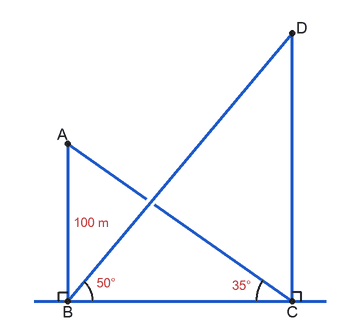
Given: Tower AB = 100 m stands at B and hill CD at C on level ground; the elevation of the hill top D from B is 50∘ and of the tower top A from C is 35∘; tan50∘=1.20, and from the tables tan35∘=0.7002.
(a)
Step 1 — Find BC from the tower.
In triangle ABC (right-angled at B), the tower AB is opposite the 35∘ angle at C and BC is adjacent.
tan35∘BC=BCAB=0.7002100≈142.82 m
(b)
Step 2 — Find CD from the hill.
In triangle DCB (right-angled at C), the hill CD is opposite the 50∘ angle at B and the same BC is adjacent.
tan50∘CD=BCCD=142.82×1.20≈171.38 m
(c)
Step 3 — Find the time.
Time is distance divided by speed, with the distance BC in metres and the speed in m/s.
time=20142.82≈7.14 s
Watch out: Each angle sits at the foot of the OTHER object: 35∘ at C looks up to the tower, 50∘ at B looks up to the hill.
Therefore, (a) BC ≈ 142.82 m; (b) the height of the hill CD ≈ 171.38 m; (c) the cyclist takes about 7.14 seconds.