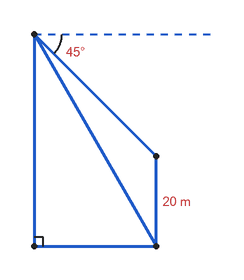
From the top of a cliff, the angle of depression of the top and bottom of a tower are observed to be 45^° and 60^°…
Question 54 marksAsked 2020Medium
From the top of a cliff, the angle of depression of the top and bottom of a tower are observed to be 45∘ and 60∘ respectively. If the height of the tower is 20 m.
Find :
(i) the height of the cliff.
(ii) the distance between the cliff and the tower.
Solution:
Concept: The angle of depression of an object is measured DOWN from the horizontal at the observer's eye; the angle of elevation is measured UP from the horizontal. The angle of depression from the top equals the angle of elevation from the ground point, because they are alternate angles between parallel horizontals. In a right triangle, tanθ=adjacent sideopposite side, that is, height ÷ horizontal distance.
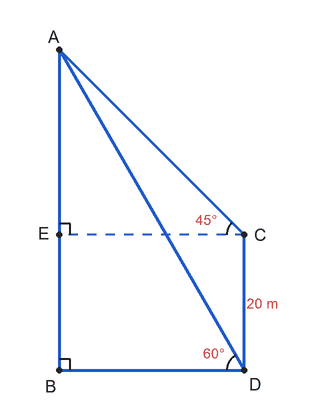
Given: AB = H m is the cliff and CD = 20 m the tower; from A, the angle of depression of the top C is 45∘ and of the bottom D is 60∘. Draw CE horizontal from C to the cliff; then BD and EC are both equal to d, and AE = H − 20.
Step 1 — Use the bottom of the tower.
By alternate angles, the angle of elevation of A from D is 60∘. In triangle ABD, AB = H is opposite this angle and BD = d is adjacent.
tan60∘H=dH=3d
Step 2 — Use the top of the tower.
The angle of elevation of A from C is 45∘. In triangle AEC, AE = H − 20 is opposite it and EC = d is adjacent.
tan45∘H−20=dH−20=d
Step 3 — Solve for d.
We put H=3d from Step 1 into the equation of Step 2.
3d−20d(3−1)d=d=20=3−120=10(3+1)≈27.32 m
Step 4 — Find H.
From Step 2, H = d + 20.
H=27.32+20=47.32 m
Watch out: AE is H − 20, not H: the 45∘ triangle starts at the TOP of the tower.
Therefore, (i) the height of the cliff is 10(3+3) m ≈ 47.32 m; (ii) the distance between the cliff and the tower is 10(3+1) m ≈ 27.32 m.