
Question 503 marksMedium
The radius of a circle is given as 15 cm and chord AB subtends an angle of 131° at the centre C of the circle.
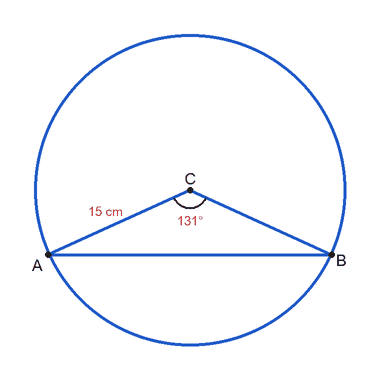
Using trigonometry, calculate :
(i) the length of AB;
(ii) the distance of AB from the centre C.
Confirming your payment
Sign up now and get 250 free tokens.
Heights and Distances · Question 50 of 60
The radius of a circle is given as 15 cm and chord AB subtends an angle of 131° at the centre C of the circle.
Using trigonometry, calculate :
(i) the length of AB;
(ii) the distance of AB from the centre C.
Solution:
Concept: The perpendicular from the centre of a circle to a chord bisects the chord, and (in isosceles ΔACB with CA = CB) it also bisects the angle at the centre. In a right-angled triangle, for an acute angle θ: , and . Choose the ratio that links the side you know with the side you want.
Step 1 — Draw the perpendicular.
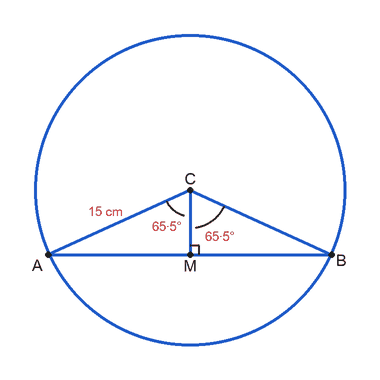
Let CM ⊥ AB. Since CA and CB are both radii (15 cm), CM bisects AB and also bisects ∠ACB = 131°.
Step 2 — Part (i): find AM and AB.
In right ΔAMC, CA = 15 cm is the hypotenuse and AM is opposite the 65·5° angle; sin 65·5° = 0·9100.
AB is twice AM.
Step 3 — Part (ii): find CM.
CM is adjacent to the 65·5° angle; cos 65·5° = 0·4147.
Watch out: Use HALF of 131° in the right triangle AMC; the right angle is at M, not at C.
Therefore, (i) AB ≈ 27·30 cm; (ii) the distance of AB from the centre C is about 6·22 cm.