
Question 293 marksMedium
From the top of a cliff, 60 metres high, the angles of depression of the top and bottom of a tower are observed to be 30° and 60°.
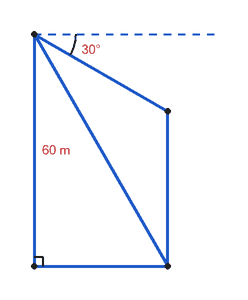
Find the height of the tower.
Confirming your payment
Sign up now and get 250 free tokens.
Heights and Distances · Question 29 of 60
From the top of a cliff, 60 metres high, the angles of depression of the top and bottom of a tower are observed to be 30° and 60°.
Find the height of the tower.
Solution:
Concept: The angle of depression of a point below the observer is the angle between the horizontal line through the observer's eye and the line of sight down to that point. It equals the angle of elevation of the observer as seen from that point (alternate angles, because the two horizontals are parallel), so .
Standard values: , , , , , and .
Step 1 — Draw the picture.
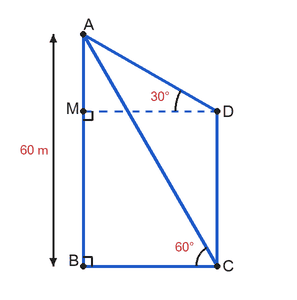
Let the cliff be AB (top A, foot B, AB = 60 m) and the tower CD (top D, foot C). The horizontal from A meets the line of the tower above D; the horizontal from D meets AB at M. The bottom C is seen at 60° below the horizontal and the top D at 30°.
Step 2 — Find the distance BC.
In right ΔABC, AB is opposite the 60° angle at C (equal to the depression).
Step 3 — Find AM.
MD equals BC, which is 20√3 m, and in right ΔAMD the side AM is opposite the 30° angle at D.
Step 4 — Find the tower.
The tower CD equals MB, the part of the cliff below M.
Watch out: AM = 20 m is the part of the cliff ABOVE the tower's top; the tower is what is left, 60 − 20.
Therefore, the height of the tower is 40 m.