A man on a cliff observes a boat, at an angle of depression 30°, which is sailing towards the shore to the point…
Question 303 marksMedium
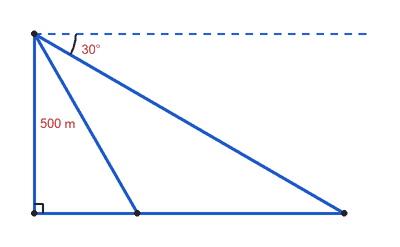
A man on a cliff observes a boat, at an angle of depression 30°, which is sailing towards the shore to the point immediately beneath him. Three minutes later, the angle of depression of the boat is found to be 60°.
Assuming that the boat sails at a uniform speed, determine :
(i) how much more time it will take to reach the shore ?
(ii) the speed of the boat in metre per second, if the height of the cliff is 500 m.
Solution:
Concept: The angle of depression of a point below the observer is the angle between the horizontal line through the observer's eye and the line of sight down to that point. It equals the angle of elevation of the observer as seen from that point (alternate angles, because the two horizontals are parallel), so tan(depression)=horizontal distancevertical drop.
Standard values: tan30∘=31, tan45∘=1, tan60∘=3, sin30∘=21, cos60∘=21, cos30∘=23 and sin60∘=23.
At a uniform speed, time is proportional to distance.
Step 1 — Draw the picture.
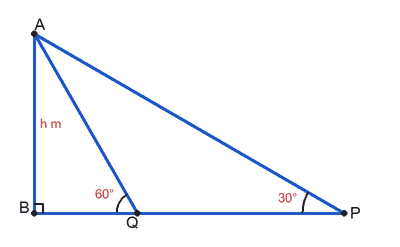
Let the cliff be AB, with top A, foot B and height h m. Let the boat be at P (depression 30°) and three minutes later at Q (depression 60°), moving towards B.
Step 2 — Write both distances in terms of h.
In each right triangle the cliff AB is opposite the angle at the boat.
PB=tan30∘h=3hQB=tan60∘h=3h
Step 3 — Distance covered in 3 minutes.
The boat went from P to Q, so the distance is PB − QB.
PQ=3h−3h=33h−h=32h
Step 4 — Part (i): time still needed.
The distance still to go is QB = h/√3, which is exactly half of PQ = 2h/√3. At a uniform speed, half the distance takes half the time.
Time=21×3=1.5
So it takes 1·5 minutes more.
Step 5 — Part (ii): the speed.
With h = 500 m, PQ = 1000/√3 m, covered in 3 minutes = 180 seconds.
PQ=31000≈577.35Speed=180577.35≈3.21
Watch out: Part (i) does not need the height at all: h cancels in the ratio QB : PQ = 1 : 2.
Therefore, (i) the boat takes 1·5 minutes more to reach the shore; (ii) its speed is about 3·21 m/s.