
Question 173 marksEasy
From the top of a cliff 92 m high, the angle of depression of a buoy is 20°.
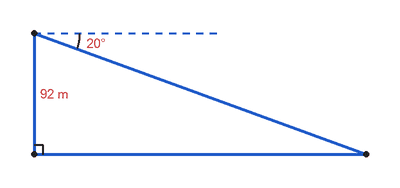
Calculate, to the nearest metre, the distance of the buoy from the foot of the cliff.
Confirming your payment
Sign up now and get 250 free tokens.
Heights and Distances · Question 17 of 60
From the top of a cliff 92 m high, the angle of depression of a buoy is 20°.
Calculate, to the nearest metre, the distance of the buoy from the foot of the cliff.
Solution:
Concept: The angle of depression of a point below the observer is the angle between the horizontal line through the observer's eye and the line of sight down to that point. It equals the angle of elevation of the observer as seen from that point (alternate angles, because the two horizontals are parallel), so .
Step 1 — Set up the triangle.
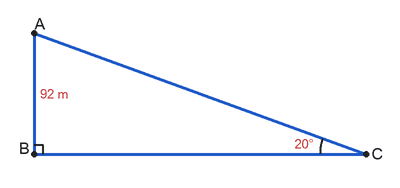
Let the cliff be AB, with top A and foot B, AB = 92 m, and let the buoy be at C. The angle of depression of C from A is 20°, so the angle of elevation of A from C is also 20° (alternate angles). ΔABC is right-angled at B.
Step 2 — Write tan 20°.
At C, the cliff AB is opposite the 20° angle and BC is adjacent to it.
Step 3 — Solve for BC.
We divide 92 by tan 20° = 0·3640 from the tables.
Step 4 — Round.
252·75 m to the nearest metre is 253 m.
Watch out: The 20° depression is at the TOP, between the horizontal and the line of sight. Inside the triangle it appears at the buoy, so the cliff height is the side opposite it.
Therefore, the buoy is about 253 m from the foot of the cliff.