
Question 163 marksMedium
A man stands 9 m away from a flag-pole. He observes that angle of elevation of the top of the pole is 28° and the angle of depression of the bottom of the pole is 13°.
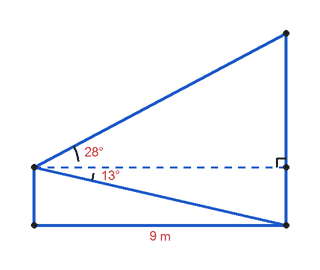
Calculate the height of the pole.
Confirming your payment
Sign up now and get 250 free tokens.
Heights and Distances · Question 16 of 60
A man stands 9 m away from a flag-pole. He observes that angle of elevation of the top of the pole is 28° and the angle of depression of the bottom of the pole is 13°.
Calculate the height of the pole.
Solution:
Concept: The angle of elevation of a point above the observer is the angle between the horizontal line through the observer's eye and the line of sight to that point. The height, the horizontal distance and the line of sight form a right-angled triangle, so . The angle of depression of a point below the observer is the angle between the horizontal line through the observer's eye and the line of sight down to that point.
Step 1 — Split the pole at eye level.
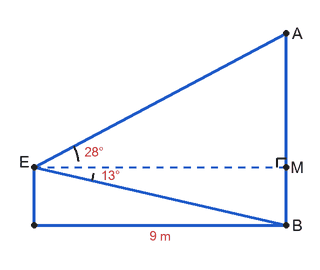
Let the man's eye be E and the pole be AB, with top A and bottom B. The horizontal line from E meets the pole at M, with EM = 9 m. This line splits the pole into AM (above the eye) and MB (below the eye). Triangles AME and BME are right-angled at M.
Step 2 — Find AM from the elevation.
The top A is seen at 28° above the horizontal, so AM = 9 tan 28° , where tan 28° is 0·5317 from the tables.
Step 3 — Find MB from the depression.
The bottom B is seen at 13° below the horizontal, so MB = 9 tan 13° , where tan 13° is 0·2309 from the tables.
Step 4 — Add the two parts.
The pole is the part above the eye plus the part below it.
Watch out: The man's height is not given and is not needed: the angle of depression to the foot already gives the part below his eye.
Therefore, the height of the pole is about 6·86 m.