
Opening your dashboard
Class 10 Maths Chapter 22 Heights and Distances: Competency-Based Questions (CBQ)
40 questions on Chapter 22, each worked through on its own page with the AI tutor. Class 10 Maths, ICSE 2026-27.
40 questions
1–5 marks · Mixed difficulty
- 11 mark
Question 1
Competency: Understanding
Asha stands on level ground, 20 m from a flagpole, and measures the angle of elevation of its top from her eye level. Her younger brother, who is much shorter, then stands at exactly the same spot and measures the angle from his eye level. His angle of elevation is :
- 21 mark
Question 2
Competency: Application
At 4 p.m. a street lamp post 6 m high casts a shadow m long on level ground. At the same moment, the shadow of a nearby office building is 45 m long.
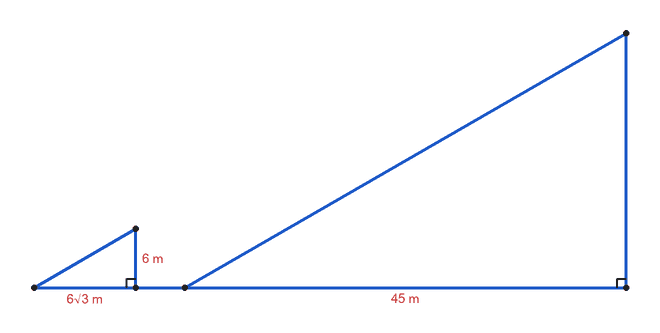
The height of the building is :
- 31 mark
Question 3
Competency: Application & Analysis
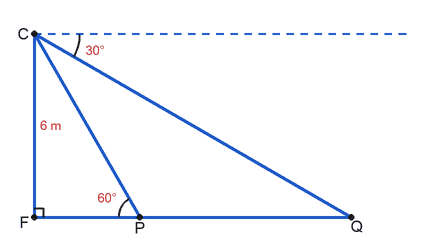
A CCTV camera C is fixed 6 m above the floor on a vertical wall of a warehouse. The camera can tilt so that the angle of depression of its line of sight is anything from to , as shown. The length PQ of the strip of floor that the camera can cover is :
- 41 mark
Question 4
Competency: Analysis & Evaluation
A forest guard is on top of a watch-tower 30 m high. He sees two water-holes on level ground, on opposite sides of the tower and in line with its foot. Their angles of depression are and .
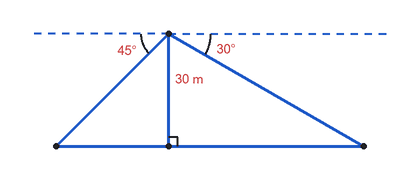
A trainee works out the distance between the water-holes :
Step 1 : Distance of the first water-hole from the tower m
Step 2 : Distance of the second water-hole from the tower m
Step 3 : Distance between the water-holes m
Step 4 : m
The guard says the water-holes are much farther apart than this. In which step is the mistake?
- 51 mark
Question 5
Competency: Understanding & Analysis
Assertion (A) : When the sun's altitude increases from to , the shadow of a vertical pole on level ground becomes one-third as long.
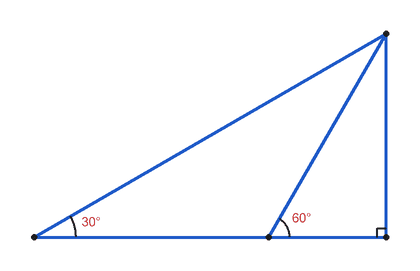
Reason (R) : The length of the shadow of a vertical pole is inversely proportional to the sun's altitude.
- 61 mark
Question 6
Competency: Analysis
Riya stands on level ground at a point where the angle of elevation of the top of a mobile tower is . She walks straight back, away from the tower, until the angle of elevation is .

Compared with her first distance from the tower, her new distance is :
- 72 marks
Question 7
Competency: Application
An escalator in a metro station is a straight slope that makes an angle of with the horizontal floor. It moves at 0·5 m/s and carries a passenger from the lower floor to the upper floor in 24 seconds.
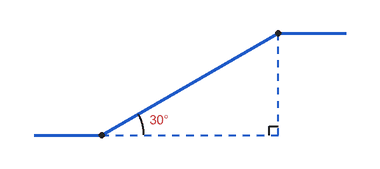
Find how high the upper floor is above the lower floor.
- 82 marks
Question 8
Competency: Evaluation
A tree is 21 m high. From a point P on level ground, the angle of elevation of its top is .
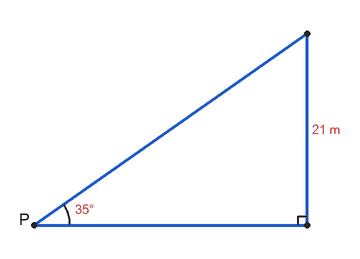
Arjun uses and says, "P is 14·7 m from the foot of the tree."
(a) Without doing the calculation, explain why his answer cannot be right.
(b) Find the correct distance of P from the foot of the tree.
- 92 marks
Question 9
Competency: Application & Evaluation
The lamp of a lighthouse is 50 m above sea level. Because of rocks, no ship may come within 200 m of the foot of the lighthouse. The keeper, standing beside the lamp, measures the angle of depression of a fishing boat as .
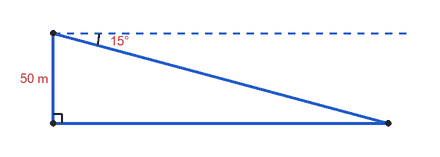
Taking , decide whether the boat has entered the forbidden zone.
- 102 marks
Question 10
Competency: Analysis
A student fixes a stick 2 m long upright on level ground and notes the length of its shadow at three different times of the day. One entry in her table is wrong.
Sun's altitude Length of shadow 3·46 m 2·83 m 1·15 m Which entry is wrong? Give the correct value. (Take .)
- 113 marks
Question 11
Competency: Application
An adventure park has a zip-line AC. It runs in a straight line from the top A of a tower AB, 35 m high, to the top C of a landing platform CD, 15 m high. The tower and the platform stand on level ground and are m apart.

Find :
(a) the angle that the zip-line makes with the horizontal,
(b) the length of the zip-line,
(c) the time a rider takes to go from A to C at an average speed of 8 m/s.
- 123 marks
Question 12
Competency: Analysis & Evaluation
Neha rides in a glass lift on the outside wall of a mall. A fountain stands on the level ground, m from the foot of the lift shaft. When the lift is at floor P, the angle of depression of the fountain is . When the lift has gone up to floor Q, the angle of depression of the fountain is .
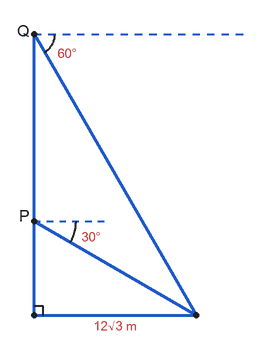
Each floor of the mall is 4 m high.
(a) How many floors did the lift go up between P and Q?
(b) Neha says, "The angle of depression doubled, so my height above the ground doubled." Is she right? Give a reason.
- 133 marks
Question 13
Competency: Creativity
A school is putting up a spotlight on a vertical pole to light the centre of an open-air stage. The centre of the stage is on level ground, 6 m from the foot of the pole. The lighting engineer says the beam is best when its angle of depression from the light is more than but less than .
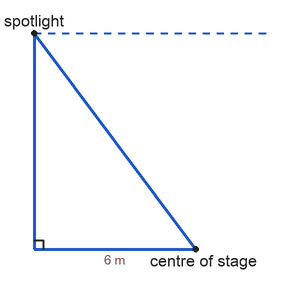
Suggest a suitable height for the spotlight. Show that your height meets the engineer's condition, and state the full range of heights that would be acceptable. (Take .)
- 145 marks
Question 14
Competency: Analysis & Evaluation
Case study: For a Maths project, three students measure the heights of three objects in their school compound. Each time, they stand on level ground at a measured distance from the foot of the object and read the angle of elevation of its top with a clinometer held at eye level. The eye level of each student is 1·5 m above the ground.
Object Distance from the foot Angle of elevation of the top Flagpole 10 m Water tank 12 m Neem tree 20 m 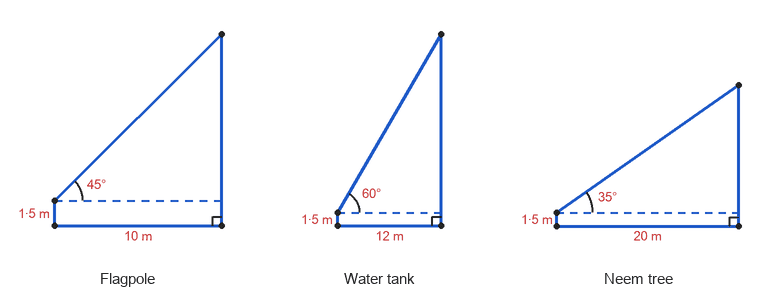
Take and .
(a) Find the height of each object. Which is the tallest?
(b) The student at the flagpole walks straight back until the angle of elevation of its top is . How far does she walk back?
(c) Kiran forgets to add the eye level in all three answers. For which object is his answer wrong by the greatest percentage of the true height? What does this tell you about when the eye level matters most?
- 154 marks
Question 15
Competency: Application & Analysis
Case study: At a desert fair, a hot-air balloon rises straight up at a steady speed from a point G on level ground. An observer sits at O, 90 m from G, with her instrument at ground level. At one moment the angle of elevation of the balloon is (position P). Exactly 2 minutes later it is (position Q).
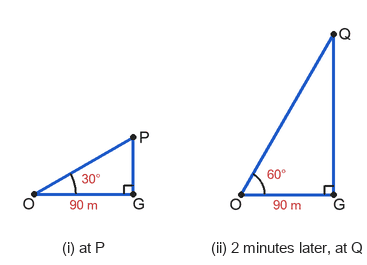
Take .
(a) Find the height of the balloon at P and at Q.
(b) Find the speed at which the balloon is rising, in metres per minute.
(c) The fair's safety rule says the balloon must stop at a height of 200 m. If it keeps rising at the same speed, about how many seconds after Q does it reach 200 m? At that moment, is its angle of elevation from O more or less than ? (Take .)
- 161 mark
Question 16
Competency: Application & Analysis
Ravi stands at a point P on level ground. In one direction he sees a mobile tower 36 m high whose foot is m from P. In another direction he sees a water tank 20 m high whose foot is 20 m from P. Both stand on the same level ground. Which top does Ravi see at the larger angle of elevation? (Ignore Ravi's height.)
- 171 mark
Question 17
Competency: Understanding & Analysis
Assertion (A) : A straight ropeway cable 600 m long rises times as high when it is inclined at to the horizontal as when it is inclined at .
Reason (R) : A straight cable 600 m long covers a greater horizontal distance when it is inclined at than when it is inclined at .
- 181 mark
Question 18
Competency: Application & Analysis
A fire-watcher sits at the top of a forest watch-tower, with her eyes 15 m above the level ground. She sees the top of a 6 m high tree at an angle of depression of . The tree and the tower stand on the same level ground. How far is the tree from the foot of the tower? (Take .)
- 191 mark
Question 19
Competency: Analysis
Three kites P, Q and R are flown from level ground at the same time. Each is held by a taut straight string (ignore any sag). (Hypothetical data.)
Kite Length of string Angle of the string with the ground P 100 m Q 70 m R 60 m Take and . Which kite is highest above the ground?
- 201 mark
Question 20
Competency: Understanding & Analysis
Assertion (A) : If an observer on level ground doubles her distance from a tower, the angle of elevation of its top does not become half of its earlier value. (Ignore the observer's height.)
Reason (R) : The tangent of the angle of elevation is inversely proportional to the distance from the tower, but the tangent of an angle is not proportional to the angle.
- 211 mark
Question 21
Competency: Analysis
Take .
Statement 1 : A vertical pole 5 m high casts a shadow 4 m long on level ground. The sun's altitude is then more than .
Statement 2 : A tree 12 m high casts a shadow 20 m long on level ground. The sun's altitude is then less than .
- 221 mark
Question 22
Competency: Application & Analysis
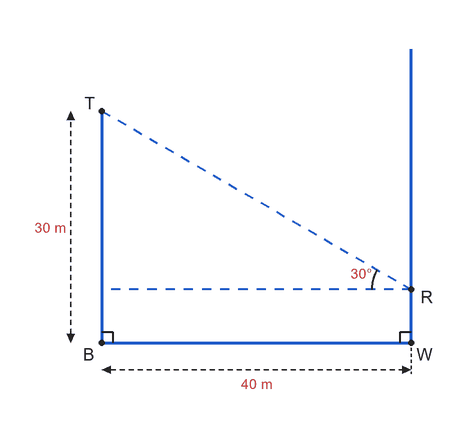
In the figure, a vertical water tank BT is 30 m high. A tall vertical wall stands at W, 40 m from the foot B of the tank, on level ground. The sun's altitude is , and the ray of sunlight through the top T of the tank falls on the wall at R. The height of R above the ground is : (Take .)
- 231 mark
Question 23
Competency: Application & Analysis
At a small airport, a ceiling lamp L on the ground sends a vertical beam of light on to the base of a cloud, making a bright spot C. Two light detectors P and Q stand on the level ground, on the same side of L and in a straight line with it. From Q the angle of elevation of C is , and from P it is , as shown (ignore the heights of the detectors). The distance PL is how many times the distance QL?
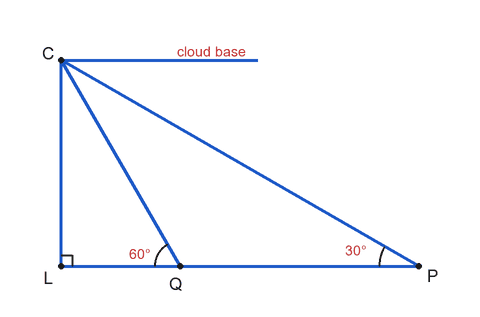
- 241 mark
Question 24
Competency: Analysis
From a point P on level ground, an observer finds that the top of a 6 m high compound wall and the top of an 18 m high building behind it are exactly in the same line of sight. The wall and the building are in a straight line with P, and the wall is m from P. The distance between the wall and the building is :
- 251 mark
Question 25
Competency: Analysis
For a school exhibition, students build a 1 : 500 scale model of a TV tower that is 60 m high, so the model is 12 cm high. A small camera lying on the table, cm from the foot of the model, photographs the top of the model. How far from the foot of the real tower should a camera at ground level be placed, so that it sees the top of the real tower at the same angle of elevation? (Take . Hypothetical data.)
- 262 marks
Question 26
Competency: Application & Analysis
A straight staircase in a school building climbs from the ground floor to the first floor, which is 3·6 m higher. Every step rises by the same height of 18 cm. The straight line through the front edges of the steps makes an angle of with the level floor. Extended downwards, this line meets the ground floor at A, and it ends at B, the front edge of the first floor.
(a) Find the horizontal depth of each step, correct to the nearest centimetre.
(b) How many rises of 18 cm does the staircase have, and what is the horizontal distance between A and B? (Take .)
- 272 marks
Question 27
Competency: Application & Analysis
A lamp L is fixed at the top of a vertical pole 6 m high, in the middle of a level school courtyard. A point on the ground is well lit if its angle of depression, as seen from L, is or more. (Hypothetical data.)
(a) Explain why the well-lit points form a circle around the foot of the pole, and find its radius.
(b) Find the area of this well-lit circle. (Take and .)
- 282 marks
Question 28
Competency: Application & Evaluation
A school wants a straight wheelchair ramp up to its stage, which is 0·6 m above the level floor of the hall. The school's building rule says that the angle that a ramp makes with the floor must satisfy . (Hypothetical data.)
(a) Find the least horizontal length of floor that the ramp needs.
(b) Only 6 m of floor is free in front of the stage, so Rahul suggests a straight ramp that covers exactly 6 m horizontally. Does his ramp follow the rule? Give a reason.
- 292 marks
Question 29
Competency: Application
A horizontal sunshade projects 1 m out from a wall, just above a window. The top edge of the window is 0·4 m below the level of the sunshade, and the window is 1·2 m high. The sun is directly in front of the window with an altitude of , and a ray of sunlight just grazes the outer edge of the sunshade and falls on the wall. Will the whole window be in shade? (Take .)
- 302 marks
Question 30
Competency: Application
A small aeroplane flies horizontally at a height of 2 km towards an airport. At one moment the pilot sees the base of the control tower (at ground level) at an angle of depression of .
(a) How far is the aeroplane, horizontally, from the tower at that moment?
(b) The aeroplane's speed over the ground is 360 km/h. After how many seconds will it be directly above the tower? (Take .)
- 312 marks
Question 31
Competency: Application & Analysis
The top platform of a playground slide is 2 m above the level ground. The old slide makes an angle of with the ground. It is replaced by a steeper slide at , fixed to the same platform.
(a) How much less ground length, measured horizontally from the point directly below the platform, does the new slide need?
(b) How much shorter is the new slide than the old one? (Take and .)
- 323 marks
Question 32
Competency: Application & Evaluation
A 28 m high chimney is to be demolished. A safety rule (hypothetical) says that spectators must stand so far away that the angle of elevation of the top of the chimney from their eye level is at most . Take and ignore the height of the spectators' eyes.
(a) What is the least distance from the foot of the chimney at which a spectator may stand? Give your answer correct to one decimal place.
(b) A spectator stands 32 m from the foot. Is she allowed to stand there? Give a reason.
(c) If the chimney were 20 % taller, by what percentage would the least distance increase?
- 333 marks
Question 33
Competency: Analysis & Evaluation
A wind turbine has its hub H at the top of a vertical tower FH. One blade HB, 15 m long, is pointing straight up. A surveyor stands at a point P on level ground, m from the foot F of the tower, and measures the angle of elevation of the hub as .
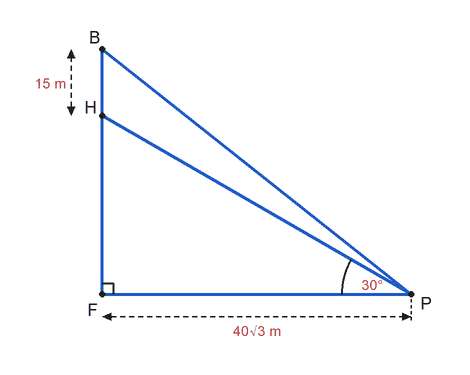
(a) Find the height of the hub above the ground.
(b) Find the height of the blade tip B above the ground.
(c) Without using a table, say whether the angle of elevation of B from P is more or less than . Give a reason. (Take .)
- 343 marks
Question 34
Competency: Application & Analysis
On a flat roof, solar panels are fixed in rows. Each panel PQ is 2 m long and is tilted at to the roof, with its lower edge P on the roof. The sun is in front of the panel at an altitude of , and the ray of sunlight that just touches the upper edge Q meets the roof at S, as shown. R is the point on the roof directly below Q.
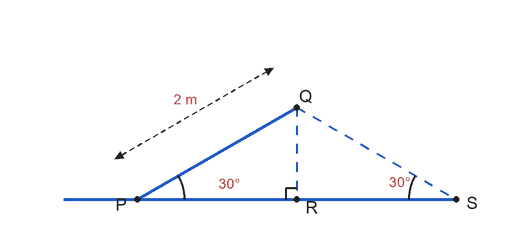
(a) Find the height QR of the upper edge above the roof and the horizontal distance PR.
(b) Find the length RS of the shadow of the upper edge on the roof.
(c) The lower edge of the next row must not be nearer to P than S, so that the panels do not shade each other. Find the least distance between the lower edges of two rows. (Take .)
- 353 marks
Question 35
Competency: Application & Evaluation
In a football match, a penalty is taken from the penalty spot, which is 11 m from the goal line, directly in front of the centre of the goal. The crossbar is 2·44 m above the ground. Let be the angle of elevation of the centre T of the crossbar as seen from the spot S (ignore the height of the player's eyes). Use , and .
(a) Find , correct to four decimal places.
(b) Between which two whole numbers of degrees does lie?
(c) A player says, "If I kick the ball along a straight line at to the ground, it will pass under the crossbar." Is he right? Find the height of the ball when it crosses the goal line, to two decimal places.
- 363 marks
Question 36
Competency: Analysis & Evaluation
A tower is 30 m high. A student measures its angle of elevation from eye level, but her clinometer can be wrong by either way. She may stand 30 m from the foot (where the true angle is ) or m from the foot (where the true angle is ). Use , , , and .
(a) Standing 30 m away, between what two heights can her calculated height lie?
(b) Standing m away, between what two heights can her calculated height lie?
(c) Which position gives the more reliable height? Give a reason using the two ranges.
- 375 marks
Question 37
Competency: Analysis & Evaluation
Case study: For a school project, three students find the height of a mobile tower. They stand on level ground in a straight line with the foot of the tower, all on the same side of it, and read the angle of elevation of the top from eye level. Their eye heights are about equal and are ignored. Some entries of their sheet are missing. (Hypothetical data.)
Student Distance from the foot of the tower Angle of elevation Anil m Bela not recorded Chitra m not recorded Take .
(a) Find the height of the tower from Anil's reading.
(b) Find Bela's distance from the foot of the tower and Chitra's angle of elevation.
(c) Divya stands exactly midway between Anil and Chitra. Find her distance from the foot of the tower. Is her angle of elevation more than or less than ? Give a reason.
- 384 marks
Question 38
Competency: Analysis & Evaluation
Case study: At a river ghat, a lifeguard sits at the top T of a watch-tower TF, 12 m high. Two bathers A and B are in the water on the same side of the tower, in a straight line with its foot F. From T, the angle of depression of A is and that of B is . The figure marks these as the equal angles of elevation of T seen from A and from B.
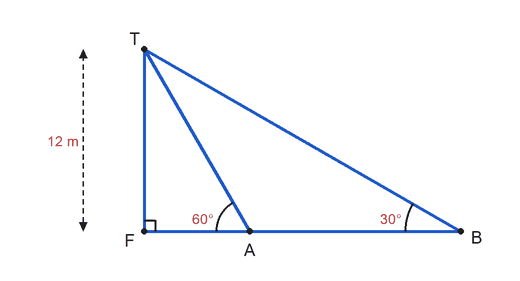
Take .
(a) Find the distances FA and FB.
(b) Find the distance AB between the two bathers.
(c) The lifeguard has two rescue lines, one 15 m long and one 25 m long. Each line is stretched taut from T to the bather along the line of sight. Which line(s) can reach A, and which can reach B?
- 394 marks
Question 39
Competency: Analysis & Evaluation
Case study: A temple tower (gopuram) FC has three tiers, with the tier tops at A and B and the topmost point at C. An artist stands at a point P on level ground, m from the foot F of the tower, and measures the angles of elevation of A, B and C as , and (from eye level, which is ignored).
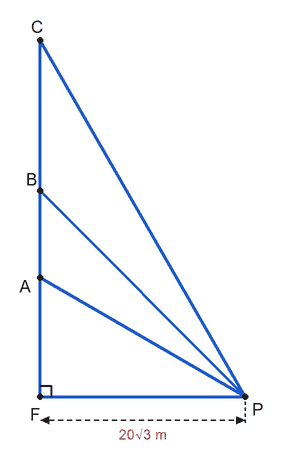
Take .
(a) Find the heights of A, B and C above the ground.
(b) Find the height of each of the three tiers FA, AB and BC.
(c) A painter says, "The top tier BC is exactly twice as tall as the middle tier AB." Is he right? Give a reason.
- 405 marks
Question 40
Competency: Creativity & Application
Case study: A school wants to paint a "clinometer chart" on the ground beside its 12 m high water tank. Each marker is painted on level ground, in a straight line from the foot of the tank, at the distance where the angle of elevation of the top of the tank has a chosen value. (Ignore the eye height of students. Hypothetical data.)
Marker Angle of elevation Distance from the foot of the tank M1 ? M2 ? M3 ? Take .
(a) Find the distance for each marker.
(b) The playground ends 18 m from the foot of the tank. Which of the three markers can be painted on the playground?
(c) The teacher wants one more marker, M4, for an angle of elevation that is more than but less than . Suggest a whole-number distance for M4 and show that it meets the condition. Also state the range of distances that would work.