
Question 363 marksMedium
From the top of a hill, the angles of depression of two consecutive kilometre stones, due east, are found to be 30° and 45° respectively.
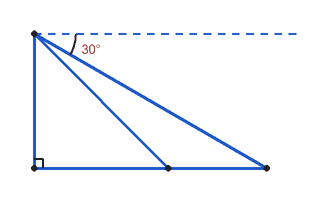
Find the distances of the two stones from the foot of the hill.
Confirming your payment
Sign up now and get 250 free tokens.
Heights and Distances · Question 36 of 60
From the top of a hill, the angles of depression of two consecutive kilometre stones, due east, are found to be 30° and 45° respectively.
Find the distances of the two stones from the foot of the hill.
Solution:
Concept: The angle of depression of a point below the observer is the angle between the horizontal line through the observer's eye and the line of sight down to that point. It equals the angle of elevation of the observer as seen from that point (alternate angles, because the two horizontals are parallel), so .
Standard values: , , , , , and .
Consecutive kilometre stones are exactly 1 km apart.
Step 1 — Draw the picture.
Let the hill be AB, with top A, foot B and height h km. The two stones P and Q are due east, on the same side, 1 km apart. The nearer stone P has the larger depression (45°) and the farther stone Q the smaller one (30°).

Step 2 — Write both distances in terms of h.
In each right triangle the hill AB is opposite the angle at the stone.
Step 3 — Use PQ = 1 km.
The stones are on the same side, so QB − PB = 1.
Step 4 — Solve for h.
We divide by (√3 − 1) and rationalise.
Step 5 — Find the distances.
PB = h and QB = PB + 1.
Watch out: The question asks for the distances of the STONES from the foot, not the height of the hill (though here PB equals the height, because of the 45° angle).
Therefore, the stones are about 1·366 km and 2·366 km from the foot of the hill.