Solution:
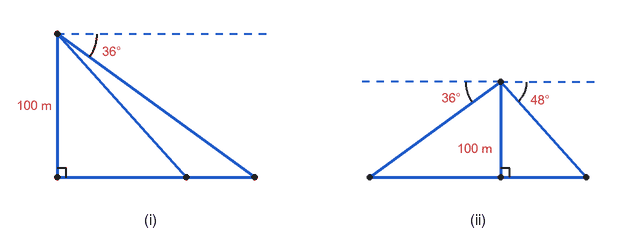
Concept: The angle of depression of a point below the observer is the angle between the horizontal line through the observer's eye and the line of sight down to that point. It equals the angle of elevation of the observer as seen from that point (alternate angles, because the two horizontals are parallel), so tan(depression)=horizontal distancevertical drop. When one height is seen at two different angles from two points on the same horizontal line, write the horizontal distance of each point from the foot as tanθh (that is, hcotθ).
Step 1 — Set up the picture.
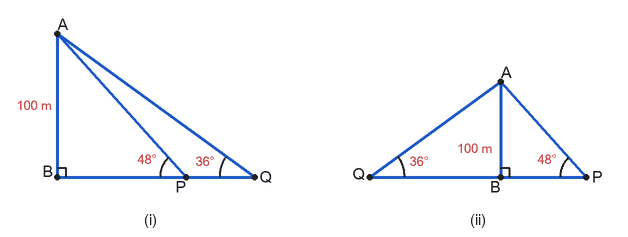
Let the lighthouse be AB, with top A and foot B, AB = 100 m. Let the ships be at P (depression 48°) and Q (depression 36°). The angle of depression from A equals the angle of elevation of A from each ship, so ΔABP and ΔABQ are right-angled at B with angles 48° at P and 36° at Q.
Step 2 — Find PB.
AB is opposite the 48° angle at P; tan 48° = 1·1106.
PB=tan48∘100=1.1106100≈90.04
Step 3 — Find QB.
AB is opposite the 36° angle at Q; tan 36° = 0·7265.
QB=tan36∘100=0.7265100≈137.65
The ship with the smaller angle of depression (Q) is farther away.
Step 4 — Part (i): same side.
Both ships are on one side of the foot, so the distance between them is QB − PB.
PQ=137.65−90.04=47.61
To the nearest metre this is 48 m.
Step 5 — Part (ii): opposite sides.
Now the ships are on either side of the foot, so the distance is QB + PB.
PQ=137.65+90.04=227.69
To the nearest metre this is 228 m.
Watch out: Decide first whether the two points are on the SAME side of the foot (subtract the distances) or on OPPOSITE sides (add them). A quick sketch settles it.
Therefore, the distance between the ships is (i) 48 m when they are on the same side and (ii) 228 m when they are on opposite sides of the lighthouse.