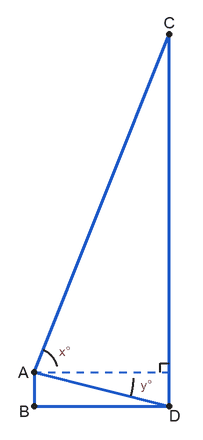
Solution:
Concept: The angle of elevation of a point above the observer is the angle between the horizontal line through the observer's eye and the line of sight to that point. The height, the horizontal distance and the line of sight form a right-angled triangle, so tan(elevation)=horizontal distanceheight. The angle of depression of a point below the observer is the angle between the horizontal line through the observer's eye and the line of sight down to that point.
Step 1 — Read the figure.
The window A is 10 m above B. The dashed horizontal from A meets the tower CD at M, so MD equals AB (10 m) and AM equals BD.
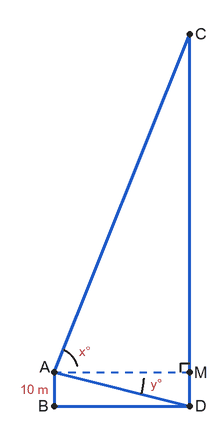
The top C is seen at x° above the horizontal and the foot D at y° below it.
Step 2 — Find AM from the depression.
In right ΔAMD, MD = 10 m is opposite y° and AM is adjacent, with tan y° = 1/4.
AM10=41
AM=40
Step 3 — Find CM from the elevation.
In right ΔAMC, CM is opposite x° and AM = 40 m is adjacent, with tan x° = 5/2.
CM=40×25=100
Step 4 — Add.
The tower is the part above M plus the part below it.
CD=100+10=110
Watch out: 100 m is only the part of the tower above the window; add the 10 m below it.
Therefore, the height of the tower CD is 110 m.