
Question 343 marksMedium
The length of the shadow of a tower standing on level plane is found to be 2y metres longer when the sun's altitude is 30° than when it was 45°.
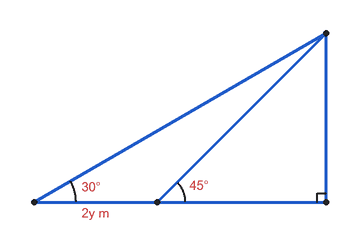
Prove that the height of the tower is y(√3 + 1) metres.
Confirming your payment
Sign up now and get 250 free tokens.
Heights and Distances · Question 34 of 60
The length of the shadow of a tower standing on level plane is found to be 2y metres longer when the sun's altitude is 30° than when it was 45°.
Prove that the height of the tower is y(√3 + 1) metres.
Solution:
Concept: The angle of elevation of a point above the observer is the angle between the horizontal line through the observer's eye and the line of sight to that point. The height, the horizontal distance and the line of sight form a right-angled triangle, so . The sun's altitude is the angle of elevation of the sun from the tip of the shadow, so shadow = h ÷ tan(altitude).
Standard values: , , , , , and .
Step 1 — Write both shadows.
Let the height of the tower be h m.

Step 2 — Use the given difference.
The shadow at 30° is 2y metres longer than the shadow at 45°.
Step 3 — Solve for h and rationalise.
We divide by (√3 − 1) and multiply top and bottom by (√3 + 1), using (√3 − 1)(√3 + 1) = 2.
Watch out: The LOWER sun (30°) gives the LONGER shadow, so subtract the 45° shadow from the 30° shadow.
Therefore, the height of the tower is y(√3 + 1) metres. Hence proved.