
Question 391 markMCQEasy
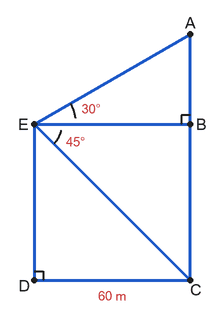
The length of AC is :
Confirming your payment
Sign up now and get 250 free tokens.
Heights and Distances · Question 39 of 60
The length of AC is :
(A) (60 – 20√3) m
(B) 60√3 m
(C) (60 + 20√3) m
(D) 20√3 m
Answer: (C) (60 + 20√3) m
Concept: The angle of elevation of a point above the observer is the angle between the horizontal line through the observer's eye and the line of sight to that point. The height, the horizontal distance and the line of sight form a right-angled triangle, so . The angle of depression of a point below the observer is the angle between the horizontal line through the observer's eye and the line of sight down to that point.
Standard values: , , , , , and .
Step 1 — Use the rectangle EBCD.
ED and BC are vertical and DC, EB are horizontal (right angles at D and B), so EBCD is a rectangle and EB equals DC, which is 60 m.
Step 2 — Find BC from the 45° angle.
In right ΔEBC, BC is opposite the 45° angle at E.
Step 3 — Find AB from the 30° angle.
In right ΔEBA, AB is opposite the 30° angle at E.
Step 4 — Add.
B lies between A and C, so AC = AB + BC.
That is about 94·64 m.
Watch out: 60/√3 = 20√3 (multiply top and bottom by √3), not 20.
Why the other options are wrong:
Therefore, AC = (60 + 20√3) m, option (C).