
Opening your dashboard
Class 10 Chemistry Chapter 4 Analytical Chemistry: Previous Year Questions
39 questions on Chapter 4, each solved step by step. Class 10 Chemistry, ICSE 2026-27.
39 questions with solutions
1–5 marks · Mixed difficulty
- 11 mark
Question 1
Fill in the blanks with the choices given in brackets.
............... (AgCl / ), a white precipitate is soluble in excess .
Solve with AIWritten solution
Solution:
Concept: Silver chloride and lead chloride are both white solids that do not dissolve in water. Ammonium hydroxide dissolves silver chloride by forming a soluble complex, but it does not dissolve lead chloride.
Step 1 — Look at what the blank asks for.
The blank needs the white precipitate that dissolves in excess . So we test each choice against ammonium hydroxide.
Step 2 — Silver chloride dissolves.
Silver chloride reacts with ammonium hydroxide to form diammine silver (I) chloride, which is soluble in water, so the white solid disappears:
Step 3 — Lead chloride does not dissolve.
Lead ions form a chalky white solid with ammonium hydroxide that stays even in excess , so lead chloride does not fit the blank.

Watch out: Both chlorides are white, so the colour does not help; only their behaviour in excess NH₄OH decides it.
Therefore, the answer is AgCl: AgCl (silver chloride), a white precipitate, is soluble in excess NH₄OH.
- 22 marks
Question 2
State your observations when ammonium hydroxide solution is added drop by drop and then in excess to each of the following solutions:
(i) copper sulphate solution
(ii) zinc sulphate solution.
Solve with AIWritten solution
Solution:
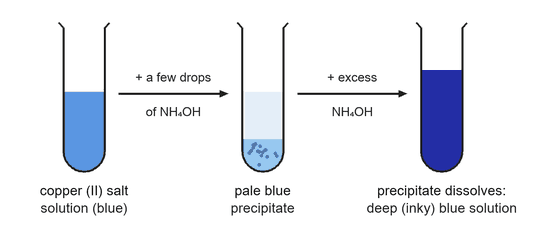
Concept: When an alkali is added to a salt solution, its hydroxide ions () join the metal ions and form the metal hydroxide. Most metal hydroxides are insoluble in water, so they appear as a precipitate. The colour of the precipitate, and whether it dissolves when more alkali is added, tell us which metal ion is present. Copper (II) hydroxide and zinc hydroxide dissolve in excess ammonium hydroxide because they form soluble ammine complexes: tetraammine copper (II) ions, which are deep (inky) blue, and tetraammine zinc (II) ions, which are colourless.
Step 1 — (i) Copper sulphate: add NH₄OH drop by drop.
The few ions from the first drops join the copper (II) ions, so a pale blue precipitate of copper (II) hydroxide forms:
Step 2 — (i) Copper sulphate: add excess NH₄OH.
In excess ammonium hydroxide the pale blue precipitate dissolves, giving a deep (inky) blue solution of tetraammine copper (II) sulphate:
Step 3 — (ii) Zinc sulphate: add NH₄OH drop by drop.
The ions join the zinc ions, so a white gelatinous precipitate of zinc hydroxide forms:
Step 4 — (ii) Zinc sulphate: add excess NH₄OH.
In excess ammonium hydroxide the white precipitate dissolves, giving a colourless solution of tetraammine zinc (II) sulphate:
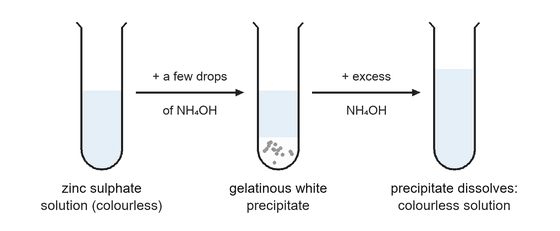
Watch out: Both precipitates dissolve in excess NH₄OH; what tells them apart is the colour: pale blue → deep blue for copper, white → colourless for zinc.
Therefore, (i) copper sulphate gives a pale blue precipitate that dissolves in excess NH₄OH to a deep (inky) blue solution; (ii) zinc sulphate gives a white gelatinous precipitate that dissolves in excess NH₄OH to a colourless solution.
- 33 marks
Question 3
Identify the cations in each of the following case:
(i) NaOH solution when added to the solution 'A' gives a reddish brown precipitate.
(ii) solution when added to the solution 'B' gives a white ppt which does not dissolve in excess.
(iii) NaOH solution when added to the solution 'C' gives a white ppt which is insoluble in excess.
Solve with AIWritten solution
Solution:
Concept: When an alkali is added to a salt solution, its hydroxide ions () join the metal ions and form the metal hydroxide. Most metal hydroxides are insoluble in water, so they appear as a precipitate. The colour of the precipitate, and whether it dissolves when more alkali is added, tell us which metal ion is present. Ammonium hydroxide is a weak alkali: it is only slightly ionised, so it gives only a few ions. Sodium hydroxide is a strong alkali and gives many ions.
Step 1 — (i) Reddish brown precipitate with NaOH.
Iron (III) hydroxide is the only reddish brown hydroxide in the tests we study, so solution A contains the iron (III) (ferric) ion:

Step 2 — (ii) White precipitate with NH₄OH, insoluble in excess.
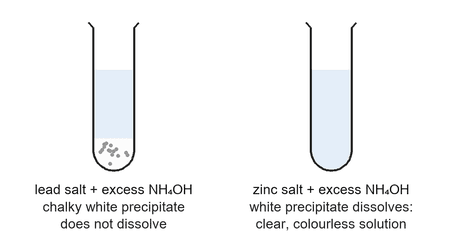
Zinc hydroxide is white but dissolves in excess , and calcium ions give no precipitate with at all. Lead hydroxide is chalky white and stays in excess , so solution B contains the lead ion:
Step 3 — (iii) White precipitate with NaOH, insoluble in excess.
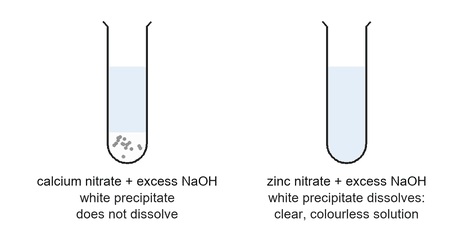
Zinc and lead also give white hydroxides with NaOH, but both dissolve in excess (as sodium zincate and sodium plumbite). Calcium hydroxide is white and only sparingly soluble, so it stays. Solution C contains the calcium ion:
Watch out: In (ii) and (iii) the colour is white every time; the answer is decided by what happens in EXCESS of each alkali.
Note: Pb²⁺ and Ca²⁺ are the expected answers from the ions in the ICSE tables. Outside those tables, Al³⁺ also gives a white precipitate that stays in excess NH₄OH, and Mg²⁺ a white precipitate that stays in excess NaOH.
Therefore, (i) A contains Fe³⁺ (ferric ion); (ii) B contains Pb²⁺ (lead ion); (iii) C contains Ca²⁺ (calcium ion).
- 41 mark
Question 4
A chloride which forms a precipitate that is soluble in excess of ammonium hydroxide, is:
Solve with AIAnswer
(A) Calcium chloride
(B) Ferrous chloride
(C) Ferric chloride
- Correct
(D) Copper chloride
Answer: (D) Copper chloride
Concept: When an alkali is added to a salt solution, its hydroxide ions () join the metal ions and form the metal hydroxide. Most metal hydroxides are insoluble in water, so they appear as a precipitate. The colour of the precipitate, and whether it dissolves when more alkali is added, tell us which metal ion is present. Copper (II) hydroxide and zinc hydroxide dissolve in excess ammonium hydroxide because they form soluble ammine complexes: tetraammine copper (II) ions, which are deep (inky) blue, and tetraammine zinc (II) ions, which are colourless.
Step 1 — Add a little NH₄OH to copper chloride.
Copper chloride solution contains copper (II) ions, which give a pale blue precipitate of copper (II) hydroxide:
Step 2 — Add excess NH₄OH.
In excess ammonium hydroxide the precipitate dissolves, forming a deep blue solution of tetraammine copper (II) chloride, so copper chloride is the chloride we want:
Watch out: The question needs TWO things: a precipitate forms, and then it dissolves in excess. Calcium chloride fails the first; the iron chlorides fail the second.
Why the other options are wrong:
- (A) Calcium chloride: calcium ions give no precipitate at all with ammonium hydroxide, because the ion concentration is too low to precipitate calcium hydroxide.
- (B) Ferrous chloride: it gives a dirty green precipitate of that does not dissolve in excess.
- (C) Ferric chloride: it gives a reddish brown precipitate of that does not dissolve in excess.
Therefore, the chloride is copper chloride, option (D).
- 51 mark
Question 5
Identify the substance underlined, in each of the following cases:
Cation that does not form a precipitate with ammonium hydroxide but forms one with sodium hydroxide.
Solve with AIWritten solution
Solution:
Concept: Ammonium hydroxide is a weak alkali: it is only slightly ionised, so it gives only a few ions. Sodium hydroxide is a strong alkali and gives many ions.
Step 1 — Find the ion that NH₄OH cannot precipitate.
The few ions from ammonium hydroxide are enough to precipitate the hydroxides of iron, copper, zinc and lead, but not calcium hydroxide, which is much more soluble in water than those hydroxides. So a calcium salt solution shows no precipitate, even with excess .
Step 2 — Check that NaOH does precipitate it.
Sodium hydroxide gives many ions, enough to exceed the small solubility of calcium hydroxide, so a white precipitate forms. For example, with calcium nitrate:

Watch out: Every other cation in the tables gives a precipitate with BOTH alkalis; calcium is the only one that needs the strong alkali.
Therefore, the cation is the calcium ion, Ca²⁺.
- 61 mark
Question 6
State one relevant observation for each of the following reactions:
Action of Sodium hydroxide solution on ferrous sulphate solution.
Solve with AIWritten solution
Solution:
Concept: When an alkali is added to a salt solution, its hydroxide ions () join the metal ions and form the metal hydroxide. Most metal hydroxides are insoluble in water, so they appear as a precipitate. The colour of the precipitate, and whether it dissolves when more alkali is added, tell us which metal ion is present.
Step 1 — Name the ion present.
Ferrous sulphate solution contains the iron (II) ion, , so sodium hydroxide will precipitate iron (II) hydroxide.
Step 2 — Write the reaction and the observation.
Iron (II) hydroxide is a dirty green, gelatinous precipitate, and it does not dissolve in excess sodium hydroxide:
Watch out: Dirty green is iron (II); reddish brown is iron (III). Don't mix up ferrous and ferric.
Therefore, a dirty green precipitate of iron (II) hydroxide forms, which is insoluble in excess sodium hydroxide.
- 72 marks
Question 7
Answer the following questions:
(i) How will you distinguish between Ammonium hydroxide and Sodium hydroxide using copper sulphate solution?
(ii) How will you distinguish between dilute hydrochloric acid and dilute sulphuric acid using lead nitrate solution?
Solve with AIWritten solution
Solution:
Concept: Copper (II) hydroxide and zinc hydroxide dissolve in excess ammonium hydroxide because they form soluble ammine complexes: tetraammine copper (II) ions, which are deep (inky) blue, and tetraammine zinc (II) ions, which are colourless. Lead chloride dissolves in hot water, but lead sulphate does not.
Step 1 — (i) Add each alkali to copper sulphate solution.
Add each alkali drop by drop, then in excess, to separate samples of copper sulphate solution. With a few drops, both alkalis give the same pale blue precipitate of copper (II) hydroxide:
Step 2 — (i) Watch what happens in excess.
The two alkalis now behave differently, which tells them apart:
- Ammonium hydroxide: the precipitate dissolves, giving a deep (inky) blue solution of tetraammine copper (II) sulphate.
- Sodium hydroxide: the pale blue precipitate does not dissolve in excess.

Step 3 — Add lead nitrate solution to each acid.
Lead nitrate gives a white precipitate with both acids, because lead chloride and lead sulphate are both only slightly soluble in cold water.
Step 4 — Heat both test tubes.
Since both precipitates are white, their colour cannot tell the acids apart. We use their solubility in hot water instead:
- Dilute hydrochloric acid: the white precipitate of lead chloride dissolves on heating, because lead chloride is soluble in hot water. It reappears as crystals when the solution cools.
- Dilute sulphuric acid: the white precipitate of lead sulphate does not dissolve even on heating, because lead sulphate is insoluble in hot water too.
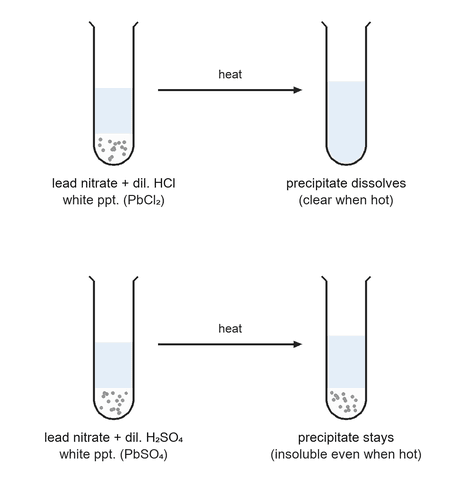
Watch out: In (ii) both acids give a WHITE precipitate, so you must say what happens on heating; naming the colour alone scores nothing.
Therefore, (i) excess NH₄OH dissolves the pale blue precipitate to a deep blue solution, while excess NaOH leaves it undissolved; (ii) the white precipitate with dilute HCl (PbCl₂) dissolves on heating, while the white precipitate with dilute H₂SO₄ (PbSO₄) does not.
- 81 mark
Question 8
The salt solution which does not react with ammonium hydroxide is:
Solve with AIAnswer
- Correct
(A) Calcium Nitrate
(B) Zinc Nitrate
(C) Lead Nitrate
(D) Copper Nitrate
Answer: (A) Calcium Nitrate
Concept: Ammonium hydroxide is a weak alkali: it is only slightly ionised, so it gives only a few ions. Sodium hydroxide is a strong alkali and gives many ions. Its ion concentration is enough to precipitate the hydroxides of zinc, lead and copper, but too low to precipitate calcium hydroxide.
Step 1 — Test calcium nitrate.
Calcium nitrate solution shows no visible change, even with excess : no precipitate forms, so it does not react.
Step 2 — Test the other three.
Zinc nitrate, lead nitrate and copper nitrate each give a precipitate with a few drops of , so each of them does react.
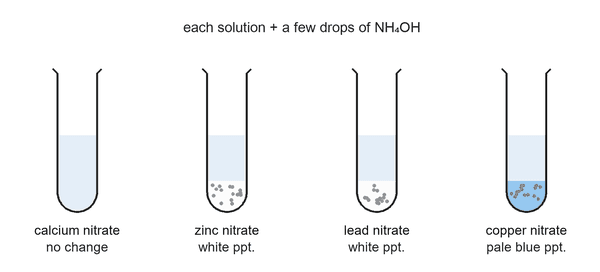
Watch out: A precipitate that later dissolves in excess (zinc, copper) still means the salt REACTED with NH₄OH.
Why the other options are wrong:
- (B) Zinc Nitrate: it gives a white gelatinous precipitate of , which then dissolves in excess ; both are reactions.
- (C) Lead Nitrate: it gives a chalky white precipitate of , which stays in excess.
- (D) Copper Nitrate: it gives a pale blue precipitate of , which dissolves in excess to a deep blue solution.
Therefore, the salt solution that does not react with ammonium hydroxide is calcium nitrate, option (A).
- 91 mark
Question 9
Write a balanced chemical equation for each of the following:
Reaction of sodium hydroxide solution with iron (III) chloride solution.
Solve with AIWritten solution
Solution:
Concept: When an alkali is added to a salt solution, its hydroxide ions () join the metal ions and form the metal hydroxide. Most metal hydroxides are insoluble in water, so they appear as a precipitate. The colour of the precipitate, and whether it dissolves when more alkali is added, tell us which metal ion is present. A balanced equation has the same number of atoms of each element on both sides, because atoms are neither made nor destroyed in a reaction.
Step 1 — Write the reactants and products.
Iron (III) chloride contains the ion, so sodium hydroxide gives iron (III) hydroxide, , and sodium chloride stays in solution.
Step 2 — Balance the equation.
Each ion needs three ions, so we need three NaOH for each , which also gives three NaCl:
Step 3 — Count the atoms on both sides.
We check that every element has the same number of atoms on each side:
Atom Left side Right side Fe 1 1 Cl 3 3 Na 3 3 O 3 3 H 3 3 A reddish brown precipitate of iron (III) hydroxide forms; it does not dissolve in excess NaOH.
Watch out: The subscript in Fe(OH)₃ is 3 because iron here is +3; writing Fe(OH)₂ would be iron (II).
Therefore, FeCl₃ + 3NaOH → Fe(OH)₃↓ + 3NaCl.
- 101 mark
Question 10
Write a balanced chemical equation for each of the following:
Reaction of zinc with potassium hydroxide solution.
Solve with AIWritten solution
Solution:
Concept: An amphoteric substance reacts with both acids and alkalis, giving a salt and water in each case. The oxides and hydroxides of zinc, aluminium and lead are amphoteric, so they dissolve in excess of a strong alkali such as NaOH or KOH. The metals zinc, aluminium and lead themselves also react with hot, concentrated caustic alkalis, giving a soluble salt and hydrogen.
Step 1 — Name the products.
Zinc reacts with hot, concentrated potassium hydroxide to form potassium zincate, , a colourless soluble salt, and hydrogen gas.
Step 2 — Write and balance the equation.
One zinc atom needs two KOH to form one potassium zincate, and the two hydrogen atoms released leave as one molecule of hydrogen:
Step 3 — Count the atoms on both sides.
We check that every element balances:
Atom Left side Right side Zn 1 1 K 2 2 O 2 2 H 2 2 
Watch out: The potassium hydroxide must be hot and concentrated; zinc hardly reacts with a cold, dilute alkali.
Therefore, Zn + 2KOH → K₂ZnO₂ + H₂↑ (potassium zincate and hydrogen).
- 111 mark
Question 11
State one relevant observation for each of the following:
Lead nitrate solution is treated with sodium hydroxide solution drop wise till it is in excess.
Solve with AIWritten solution
Solution:
Concept: An amphoteric substance reacts with both acids and alkalis, giving a salt and water in each case. The oxides and hydroxides of zinc, aluminium and lead are amphoteric, so they dissolve in excess of a strong alkali such as NaOH or KOH.
Step 1 — Add NaOH drop by drop.
The first drops give a chalky white precipitate of lead hydroxide:
Step 2 — Keep adding NaOH until it is in excess.
Lead hydroxide is amphoteric, so it reacts with the excess sodium hydroxide and dissolves, giving a clear, colourless solution of sodium plumbite:

Watch out: With ammonium hydroxide the lead precipitate does NOT dissolve; it dissolves only in excess of a strong alkali.
Therefore, a chalky white precipitate forms first, and it dissolves in excess sodium hydroxide to give a clear, colourless solution (sodium plumbite).
- 124 marks
Question 12
Give a chemical test to distinguish between the following pairs of chemicals:
(i) Lead nitrate solution and Zinc nitrate solution
(ii) Sodium chloride solution and Sodium nitrate solution
Solve with AIWritten solution
Solution:
Concept: For a distinguishing test, choose a reagent that gives a different, visible result with each member of the pair. Copper (II) hydroxide and zinc hydroxide dissolve in excess ammonium hydroxide because they form soluble ammine complexes: tetraammine copper (II) ions, which are deep (inky) blue, and tetraammine zinc (II) ions, which are colourless.
Step 1 — (i) Choose the reagent for lead and zinc.
Lead and zinc hydroxides are both white, and both dissolve in excess NaOH, so NaOH cannot tell them apart. In excess ammonium hydroxide, however, zinc hydroxide dissolves and lead hydroxide does not. So we add drop by drop, then in excess, to each solution.
Step 2 — (i) Lead nitrate.
A chalky white precipitate of lead hydroxide forms, which is insoluble in excess :
Step 3 — (i) Zinc nitrate.
A white gelatinous precipitate of zinc hydroxide forms, which dissolves in excess , giving a clear, colourless solution:
Step 4 — (ii) Choose the reagent for chloride and nitrate.
Both salts are sodium salts, so the difference is in the anion. Chloride ions give a white precipitate with silver nitrate solution (acidified with dilute nitric acid); nitrate ions give none. We add a few drops to each solution.
Step 5 — (ii) Sodium chloride and sodium nitrate.
Sodium chloride gives a curdy white precipitate of silver chloride, which does not dissolve in dilute nitric acid:
Sodium nitrate gives no precipitate: the solution stays clear, because all nitrates are soluble.

Watch out: For (i), sodium hydroxide is the wrong reagent: BOTH white precipitates dissolve in excess NaOH.
Therefore, (i) with excess NH₄OH, lead nitrate gives a white precipitate that stays, while zinc nitrate gives a white precipitate that dissolves; (ii) with silver nitrate, sodium chloride gives a curdy white precipitate, while sodium nitrate gives none.
- 131 mark
Question 13
Write a balanced chemical equation for each of the following reactions:
Ammonium hydroxide is added to ferrous sulphate solution.
Solve with AIWritten solution
Solution:
Concept: When an alkali is added to a salt solution, its hydroxide ions () join the metal ions and form the metal hydroxide. Most metal hydroxides are insoluble in water, so they appear as a precipitate. The colour of the precipitate, and whether it dissolves when more alkali is added, tell us which metal ion is present. A balanced equation has the same number of atoms of each element on both sides, because atoms are neither made nor destroyed in a reaction.
Step 1 — Write the reactants and products.
Ferrous sulphate contains the ion, so ammonium hydroxide precipitates iron (II) hydroxide, , and ammonium sulphate stays in solution.
Step 2 — Balance the equation.
Each ion needs two ions, so we need two ; the two ions pair with the sulphate ion as :
Step 3 — Count the atoms on both sides.
We check that every element balances:
Atom Left side Right side Fe 1 1 S 1 1 O 6 6 N 2 2 H 10 10 A dirty green precipitate of iron (II) hydroxide forms; it is insoluble in excess .
Watch out: Ammonium sulphate is (NH₄)₂SO₄: two ammonium ions for one sulphate ion.
Therefore, FeSO₄ + 2NH₄OH → Fe(OH)₂↓ + (NH₄)₂SO₄.
- 143 marks
Question 14
Distinguish between the following pairs of compounds using the reagent given in the bracket.
(i) Manganese dioxide and copper (II) oxide. (using concentrated HCl)
(ii) Ferrous sulphate solution and ferric sulphate solution. (using sodium hydroxide solution)
(iii) Dilute hydrochloric acid and dilute sulphuric acid. (using lead nitrate solution)
Solve with AIWritten solution
Solution:
Concept: Manganese dioxide is an oxidising agent: it oxidises concentrated HCl to chlorine. Copper (II) oxide is a basic oxide and only neutralises the acid. Iron (II) and iron (III) hydroxides differ in colour. Lead chloride dissolves in hot water; lead sulphate does not.
Step 1 — (i) Warm each oxide with concentrated HCl.
With manganese dioxide, a greenish-yellow gas (chlorine) with a pungent, choking smell is given off; it turns moist starch iodide paper blue-black.
With copper (II) oxide, the black solid dissolves to give a bluish-green solution of copper (II) chloride, and no gas is given off.
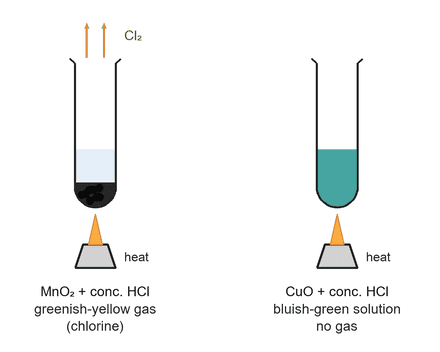
Step 2 — (ii) Add NaOH to each iron salt solution.
Ferrous sulphate gives a dirty green precipitate of iron (II) hydroxide, insoluble in excess:
Ferric sulphate gives a reddish brown precipitate of iron (III) hydroxide, insoluble in excess:
Step 3 — Add lead nitrate solution to each acid.
Lead nitrate gives a white precipitate with both acids, because lead chloride and lead sulphate are both only slightly soluble in cold water.
Step 4 — Heat both test tubes.
Since both precipitates are white, their colour cannot tell the acids apart. We use their solubility in hot water instead:
- Dilute hydrochloric acid: the white precipitate of lead chloride dissolves on heating, because lead chloride is soluble in hot water. It reappears as crystals when the solution cools.
- Dilute sulphuric acid: the white precipitate of lead sulphate does not dissolve even on heating, because lead sulphate is insoluble in hot water too.
Watch out: In (i) say WHICH gas and how you know it (colour, smell, starch iodide paper); 'a gas is evolved' is not enough.
Therefore, (i) MnO₂ gives greenish-yellow chlorine with conc. HCl, while CuO gives a bluish-green solution and no gas; (ii) ferrous sulphate gives a dirty green precipitate with NaOH, ferric sulphate a reddish brown one; (iii) the white precipitate from dilute HCl dissolves on heating, the one from dilute H₂SO₄ does not.
- 151 mark
Question 15
State one relevant observation for each of the following reactions:
(ii) Addition of excess ammonium hydroxide into copper sulphate solution.
Solve with AIWritten solution
Solution:
Concept: Copper (II) hydroxide and zinc hydroxide dissolve in excess ammonium hydroxide because they form soluble ammine complexes: tetraammine copper (II) ions, which are deep (inky) blue, and tetraammine zinc (II) ions, which are colourless. The deep blue solution is the special test for the copper (II) ion.
Step 1 — The first drops of NH₄OH.
At first, the ions precipitate pale blue copper (II) hydroxide:
Step 2 — Excess NH₄OH.
As more ammonium hydroxide is added, the precipitate dissolves, giving a deep (inky) blue solution of tetraammine copper (II) sulphate:
Watch out: With excess NaOH the pale blue precipitate stays; only excess NH₄OH gives the deep blue solution.
Therefore, a pale blue precipitate forms at first and dissolves in excess ammonium hydroxide to give a deep (inky) blue solution.
- 161 mark
Question 16
Write a balanced chemical equation for each of the following:
(iii) Reaction of lead nitrate solution with ammonium hydroxide.
Solve with AIWritten solution
Solution:
Concept: When an alkali is added to a salt solution, its hydroxide ions () join the metal ions and form the metal hydroxide. Most metal hydroxides are insoluble in water, so they appear as a precipitate. The colour of the precipitate, and whether it dissolves when more alkali is added, tell us which metal ion is present. A balanced equation has the same number of atoms of each element on both sides, because atoms are neither made nor destroyed in a reaction.
Step 1 — Write the reactants and products.
Lead nitrate contains the ion, so ammonium hydroxide precipitates lead hydroxide, , and ammonium nitrate stays in solution.
Step 2 — Balance the equation.
Each ion needs two ions, so we need two , which also give two :
Step 3 — Count the atoms on both sides.
We check that every element balances:
Atom Left side Right side Pb 1 1 N 4 4 O 8 8 H 10 10 A chalky white precipitate of lead hydroxide forms; it is insoluble in excess .
The figure compares lead with zinc: in excess the lead precipitate stays, while the zinc one dissolves.
Watch out: Lead nitrate is Pb(NO₃)₂, so the nitrogen count is 2 on the left from lead nitrate plus 2 from NH₄OH.
Therefore, Pb(NO₃)₂ + 2NH₄OH → Pb(OH)₂↓ + 2NH₄NO₃.
- 173 marks
Question 17
Distinguish between the following pairs of compounds using a reagent as a chemical test:
(i) Calcium nitrate and Zinc nitrate solution.
(ii) Ammonium sulphate crystals and Sodium sulphate crystals.
(iii) Magnesium chloride and Magnesium nitrate solution.
Solve with AIWritten solution
Solution:
Concept: For a distinguishing test, choose a reagent that gives a different, visible result with each member of the pair.
Step 1 — (i) Calcium nitrate and zinc nitrate: add NaOH.
Add sodium hydroxide solution drop by drop, then in excess. Calcium nitrate gives a white precipitate of calcium hydroxide that does not dissolve in excess:
Zinc nitrate gives a white gelatinous precipitate of zinc hydroxide that dissolves in excess, giving a colourless solution of sodium zincate:
Ammonium hydroxide also works: calcium nitrate gives no precipitate, while zinc nitrate gives a white precipitate that dissolves in excess.
Step 2 — (ii) Ammonium sulphate and sodium sulphate: warm with NaOH.
Warm each crystal sample with sodium hydroxide solution. An ammonium salt gives ammonia gas, which has a sharp, pungent smell and turns moist red litmus paper blue:
Sodium sulphate gives no gas, because there is no reaction.
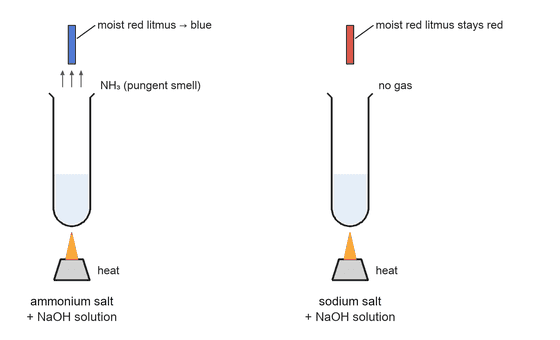
Step 3 — (iii) Magnesium chloride and magnesium nitrate: add silver nitrate.
Add silver nitrate solution to each. Magnesium chloride gives a curdy white precipitate of silver chloride:
Magnesium nitrate gives no precipitate, because all nitrates are soluble.
Watch out: In (iii) both salts contain magnesium, so a cation test (NaOH) gives the same result for both; you must test the anion.
Therefore, (i) NaOH: white precipitate that stays (calcium nitrate) or dissolves in excess (zinc nitrate); (ii) warm with NaOH: ammonia that turns moist red litmus blue (ammonium sulphate) or no gas (sodium sulphate); (iii) AgNO₃: curdy white precipitate (magnesium chloride) or none (magnesium nitrate).
- 181 mark
Question 18
Distinguish between the following as directed:
(b) Lead salt solution and zinc salt solution. [using solution in excess]
Solve with AIWritten solution
Solution:
Concept: Lead hydroxide and zinc hydroxide are both white. Copper (II) hydroxide and zinc hydroxide dissolve in excess ammonium hydroxide because they form soluble ammine complexes: tetraammine copper (II) ions, which are deep (inky) blue, and tetraammine zinc (II) ions, which are colourless. Lead hydroxide forms no such complex, so it stays.
Step 1 — Lead salt solution.
Ammonium hydroxide gives a chalky white precipitate of lead hydroxide, which is insoluble in excess :
Step 2 — Zinc salt solution.
Ammonium hydroxide gives a white gelatinous precipitate of zinc hydroxide, which dissolves in excess , giving a clear, colourless solution. For zinc sulphate, for example:
Watch out: The first drops give a white precipitate with BOTH salts; the test only works when NH₄OH is added in excess.
Therefore, with excess NH₄OH the lead salt gives a chalky white precipitate that stays, while the zinc salt gives a white precipitate that dissolves to a colourless solution.
- 191 mark
Question 19
The metallic hydroxide which forms a deep inky blue solution with excess ammonium hydroxide solution is:
Solve with AIAnswer
(A)
- Correct
(B)
(C)
(D)
Answer: (B)
Concept: Copper (II) hydroxide and zinc hydroxide dissolve in excess ammonium hydroxide because they form soluble ammine complexes: tetraammine copper (II) ions, which are deep (inky) blue, and tetraammine zinc (II) ions, which are colourless. This deep blue solution is the special test for the copper (II) ion.
Step 1 — A little NH₄OH.
With a little , a copper (II) salt gives a pale blue precipitate of .
Step 2 — Excess NH₄OH.
In excess this precipitate dissolves, and the tetraammine copper (II) sulphate formed is deep inky blue:
Watch out: The precipitate itself is PALE blue; it is the solution formed in excess NH₄OH that is deep inky blue.
Why the other options are wrong:
- (A) : it is a dirty green precipitate that does not dissolve in excess .
- (C) : calcium salts give no precipitate with at all, and calcium hydroxide is white, never blue.
- (D) : it is a reddish brown precipitate that does not dissolve in excess .
Therefore, the hydroxide is copper (II) hydroxide, option (B).
- 201 mark
Question 20
Fill in the blanks with the choices given in the brackets:
(d) ............... [Silver chloride / Lead chloride] is a white precipitate that is soluble in excess of Ammonium hydroxide solution.
Solve with AIWritten solution
Solution:
Concept: Silver chloride and lead chloride are both white and insoluble in water. Silver chloride dissolves in ammonium hydroxide by forming a soluble complex; lead chloride does not.
Step 1 — Test silver chloride.
Silver chloride reacts with ammonium hydroxide to form soluble diammine silver (I) chloride, so the white precipitate dissolves:
Step 2 — Test lead chloride.
Lead chloride stays as a white solid in excess ammonium hydroxide, so it does not fit the blank.
Watch out: Both choices are white precipitates; the blank is decided only by solubility in excess NH₄OH.
Therefore, the answer is silver chloride: silver chloride is a white precipitate that is soluble in excess of ammonium hydroxide solution.
- 212 marks
Question 21
Identify the cation in each of the following cases:
(a) Ammonium hydroxide solution when added to Solution B gives a white precipitate which does not dissolve in excess of ammonium hydroxide solution.
(b) Sodium hydroxide solution when added to Solution C gives a white precipitate which is insoluble in excess of sodium hydroxide solution.
Solve with AIWritten solution
Solution:
Concept: When an alkali is added to a salt solution, its hydroxide ions () join the metal ions and form the metal hydroxide. Most metal hydroxides are insoluble in water, so they appear as a precipitate. The colour of the precipitate, and whether it dissolves when more alkali is added, tell us which metal ion is present. Zinc hydroxide dissolves in excess of both alkalis; lead hydroxide dissolves in excess NaOH but not in excess ; calcium gives no precipitate with and a white one with NaOH that stays.
Step 1 — (a) White precipitate with NH₄OH, insoluble in excess.
Zinc hydroxide would dissolve in excess , and calcium would give no precipitate at all. Lead hydroxide is chalky white and stays in excess , so solution B contains the lead ion:
Step 2 — (b) White precipitate with NaOH, insoluble in excess.
Zinc and lead hydroxides would both dissolve in excess NaOH. Calcium hydroxide is white and only sparingly soluble, so it stays; solution C contains the calcium ion:
Watch out: Lead appears in (a) but NOT in (b): its precipitate stays in excess NH₄OH but dissolves in excess NaOH.
Note: these are the expected answers from the ions in the ICSE tables. Outside those tables, Al³⁺ also gives a white precipitate that stays in excess NH₄OH, and Mg²⁺ a white precipitate that stays in excess NaOH.
Therefore, (a) the cation in B is Pb²⁺ (lead ion); (b) the cation in C is Ca²⁺ (calcium ion).
- 221 mark
Question 22
Complete and balance the following equations:
(b)
Solve with AIWritten solution
Solution:
Concept: When an alkali is added to a salt solution, its hydroxide ions () join the metal ions and form the metal hydroxide. Most metal hydroxides are insoluble in water, so they appear as a precipitate. The colour of the precipitate, and whether it dissolves when more alkali is added, tell us which metal ion is present. A balanced equation has the same number of atoms of each element on both sides, because atoms are neither made nor destroyed in a reaction.
Step 1 — Name the products.
Ammonium hydroxide precipitates copper (II) hydroxide from copper sulphate, and ammonium sulphate, , stays in solution.
Step 2 — Balance the equation.
Each ion needs two ions, so two are needed:
Step 3 — Count the atoms on both sides.
We check that every element balances:
Atom Left side Right side Cu 1 1 S 1 1 O 6 6 N 2 2 H 10 10 A pale blue precipitate of copper (II) hydroxide forms. If excess is added, it dissolves to a deep blue solution of tetraammine copper (II) sulphate:
Watch out: Write ammonium sulphate as (NH₄)₂SO₄, not NH₄SO₄: the ammonium ion carries one positive charge.
Therefore, CuSO₄ + 2NH₄OH → Cu(OH)₂↓ + (NH₄)₂SO₄.
- 231 mark
Question 23
Choose the substances given in the box below to answer the following questions:
Iron Magnesium sulphite Zinc Sodium sulphide Lead Ferric chloride Copper Ferrous sulphate (c) The solution of this compound produces dirty green precipitate with NaOH.
Solve with AIWritten solution
Solution:
Concept: When an alkali is added to a salt solution, its hydroxide ions () join the metal ions and form the metal hydroxide. Most metal hydroxides are insoluble in water, so they appear as a precipitate. The colour of the precipitate, and whether it dissolves when more alkali is added, tell us which metal ion is present.
Step 1 — Identify the precipitate.
A dirty green precipitate with NaOH is iron (II) hydroxide, , so the compound must contain the iron (II) (ferrous) ion and dissolve in water.
Step 2 — Pick it from the box.
In the box, ferrous sulphate is the soluble iron (II) compound:
Ferric chloride, the other iron compound, contains iron (III), so it gives a reddish brown precipitate of instead. Iron itself is a metal, not a solution of a compound.
Watch out: Ferrous means iron (II), which gives dirty green; ferric means iron (III), which gives reddish brown.
Therefore, the compound is ferrous sulphate (FeSO₄).
- 241 mark
Question 24
Choose the answer from the list which fits in the description:
[, PbO, NaCl, CuO, ]
(b) An amphoteric oxide.
Solve with AIWritten solution
Solution:
Concept: An amphoteric substance reacts with both acids and alkalis, giving a salt and water in each case. The oxides and hydroxides of zinc, aluminium and lead are amphoteric, so they dissolve in excess of a strong alkali such as NaOH or KOH.
Step 1 — Pick out the oxides.
Only PbO and CuO in the list are oxides; , NaCl and are not oxides at all.
Step 2 — Test lead monoxide with an acid.
With an acid, PbO behaves as a base and gives a salt and water:
Step 3 — Test lead monoxide with an alkali.
With an alkali, PbO behaves as an acid and gives colourless sodium plumbite and water, so PbO is amphoteric:
Copper (II) oxide is a basic oxide: it reacts with acids but not with alkalis.

Watch out: A metal oxide is not automatically basic: the oxides of zinc, aluminium and lead are amphoteric.
Therefore, the amphoteric oxide is PbO (lead monoxide).
- 251 mark
Question 25
The metal hydroxide which reacts with both acids and alkalis to form salt and water is:
Solve with AIAnswer
(A) Calcium hydroxide
(B) Magnesium hydroxide
- Correct
(C) Aluminium hydroxide
(D) Ferric hydroxide
Answer: (C) Aluminium hydroxide
Concept: An amphoteric substance reacts with both acids and alkalis, giving a salt and water in each case. The oxides and hydroxides of zinc, aluminium and lead are amphoteric, so they dissolve in excess of a strong alkali such as NaOH or KOH.
Step 1 — Aluminium hydroxide with an acid.
With hydrochloric acid, aluminium hydroxide behaves as a base and gives a salt and water:
Step 2 — Aluminium hydroxide with an alkali.
With sodium hydroxide it behaves as an acid, forming sodium meta-aluminate and water, so it is amphoteric:
Watch out: 'Reacts with both acids and alkalis' is the definition of amphoteric; look for zinc, aluminium or lead.
Why the other options are wrong:
- (A) Calcium hydroxide: calcium hydroxide is a basic hydroxide (an alkali); it reacts with acids but not with alkalis.
- (B) Magnesium hydroxide: magnesium hydroxide is a basic hydroxide; it reacts with acids but not with alkalis.
- (D) Ferric hydroxide: ferric hydroxide is a basic hydroxide; it reacts with acids but does not dissolve in excess sodium hydroxide.
Therefore, the hydroxide is aluminium hydroxide, option (C).
- 262 marks
Question 26
Rita was given an unknown salt for identification. She prepared a solution of the salt and divided it into two parts.
-
To the first part of the salt solution, she added a few drops of ammonium hydroxide and obtained a reddish-brown precipitate.
-
To the second part of the salt solution, she added a few drops of silver nitrate solution and obtained a white precipitate.
Name:
(a) the cation present and
(b) the anion present in the salt given for identification.
Solve with AIWritten solution
Solution:
Concept: The colour of the precipitate with ammonium hydroxide identifies the cation. A precipitate with silver nitrate identifies a halide anion by its colour: white for chloride, pale yellow for bromide, yellow for iodide.
Step 1 — (a) Find the cation from the first part.
A reddish brown precipitate with is iron (III) hydroxide, so the cation is the iron (III) (ferric) ion:
Step 2 — (b) Find the anion from the second part.
A white precipitate with silver nitrate is silver chloride, so the anion is the chloride ion:
Step 3 — Put the two ions together.
The salt contains and ions, so it is iron (III) chloride, . Both tests written as full equations:
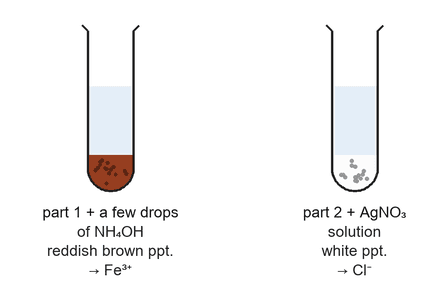
Watch out: The reddish brown precipitate is iron (III), not iron (II), which would be dirty green.
Therefore, (a) the cation is Fe³⁺ (iron (III) or ferric ion); (b) the anion is Cl⁻ (chloride ion), so the salt is iron (III) chloride, FeCl₃.
-
- 271 mark
Question 27
Complete the following sentences by choosing the correct word(s) from the brackets:
............... solution forms a coloured precipitate with ammonium hydroxide which is soluble in excess of ammonium hydroxide. [Ferrous chloride / Copper nitrate]
Solve with AIWritten solution
Solution:
Concept: Copper (II) hydroxide and zinc hydroxide dissolve in excess ammonium hydroxide because they form soluble ammine complexes: tetraammine copper (II) ions, which are deep (inky) blue, and tetraammine zinc (II) ions, which are colourless. Iron (II) hydroxide forms no such complex, so it stays in excess.
Step 1 — Test copper nitrate.
Copper nitrate gives a coloured (pale blue) precipitate of copper (II) hydroxide:
In excess it dissolves, giving a deep blue solution:
Step 2 — Test ferrous chloride.
Ferrous chloride also gives a coloured (dirty green) precipitate of , but it is insoluble in excess , so it does not fit the sentence.
Watch out: Both choices give a COLOURED precipitate; only the words 'soluble in excess' decide the blank.
Therefore, the answer is copper nitrate: copper nitrate solution forms a coloured precipitate with ammonium hydroxide which is soluble in excess of ammonium hydroxide.
- 281 mark
Question 28
Complete the following sentences by choosing the correct word(s) from the brackets:
The salt formed when reacts with hot concentrated is ............... . [sodium zincate / zinc hydroxide]
Solve with AIWritten solution
Solution:
Concept: An amphoteric substance reacts with both acids and alkalis, giving a salt and water in each case. The oxides and hydroxides of zinc, aluminium and lead are amphoteric, so they dissolve in excess of a strong alkali such as NaOH or KOH.
Step 1 — See how zinc oxide behaves with an alkali.
Zinc oxide is amphoteric. With hot, concentrated sodium hydroxide it behaves as an acidic oxide and forms a salt, sodium zincate, and water:
Step 2 — Rule out the other choice.
Zinc hydroxide is not a salt: it is the white precipitate formed when a little NaOH is added to a zinc salt solution, and it is not formed from ZnO here.
Watch out: A salt from an alkali + amphoteric oxide ends in '-ate' (zincate, plumbite, aluminate), not 'hydroxide'.
Therefore, the salt formed when ZnO reacts with hot concentrated NaOH is sodium zincate (Na₂ZnO₂).
- 292 marks
Question 29
Differentiate between the following pairs of compounds using the reagent given in the bracket:
(a) Ammonium chloride and Sodium chloride (using an alkali)
(b) Zinc Nitrate solution and Calcium Nitrate solution (using excess sodium hydroxide solution)
Solve with AIWritten solution
Solution:
Concept: Ammonium salts give ammonia gas when warmed with an alkali; sodium salts do not. Zinc hydroxide dissolves in excess NaOH (it is amphoteric), but calcium hydroxide does not.
Step 1 — (a) Warm each salt with sodium hydroxide.
Ammonium chloride gives ammonia gas, which has a pungent smell and turns moist red litmus paper blue:
Sodium chloride gives no gas and no change.
Step 2 — (b) Add NaOH to each nitrate, then excess.
Zinc nitrate gives a white gelatinous precipitate which dissolves in excess NaOH, giving a clear, colourless solution of sodium zincate:
Calcium nitrate gives a white precipitate which does not dissolve in excess NaOH:
Watch out: In (a) the mixture must be WARMED, and the ammonia is tested with MOIST red litmus.
Therefore, (a) ammonium chloride gives ammonia (moist red litmus turns blue) with an alkali, while sodium chloride gives no gas; (b) with excess NaOH the zinc nitrate precipitate dissolves, while the calcium nitrate precipitate stays.
- 301 mark
Question 30
A salt solution which gives a reddish-brown precipitate with and a white precipitate with solution is:
Solve with AIAnswer
(A)
(B)
- Correct
(C)
(D)
Answer: (C)
Concept: Use the two tests one at a time. A reddish brown precipitate with NaOH shows the cation is . A white precipitate with barium chloride, from the salts offered, shows the anion is sulphate, .
Step 1 — Find the cation.
Iron (III) hydroxide is reddish brown, so the salt must contain :
Step 2 — Find the anion.
Barium sulphate is a white precipitate, so the salt must contain :
Step 3 — Combine the two results.
The only salt offered that has both and is iron (III) sulphate.
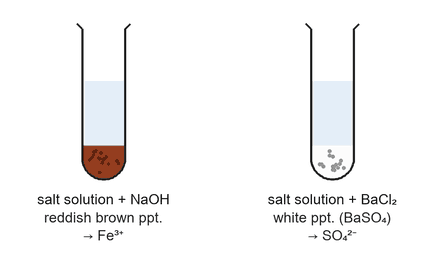
Watch out: Each test identifies only ONE ion; an option must pass both tests.
Why the other options are wrong:
- (A) : has sulphate, so it does give the white precipitate with , but with NaOH it gives a pale blue precipitate, not a reddish brown one.
- (B) : gives a white precipitate with NaOH, and as a nitrate it gives no precipitate with .
- (D) : gives the reddish brown precipitate with NaOH, but a chloride gives no precipitate with .
Therefore, the salt is iron (III) sulphate, option (C).
- 315 marks
Question 31
Ammonium hydroxide solution is added to the solution containing the ions mentioned in List X. List Y gives the details of the precipitate. Match the ions with their coloured precipitates.
List X List Y (a) 1. No visible reaction (b) 2. White precipitate insoluble in excess (c) 3. Gelatinous white precipitate soluble in excess (d) 4. Blue precipitate soluble in excess (e) 5. Dirty green precipitate insoluble in excess 6. Reddish brown precipitate insoluble in excess Solve with AIWritten solution
Solution:
Concept: When an alkali is added to a salt solution, its hydroxide ions () join the metal ions and form the metal hydroxide. Most metal hydroxides are insoluble in water, so they appear as a precipitate. The colour of the precipitate, and whether it dissolves when more alkali is added, tell us which metal ion is present. Ammonium hydroxide is a weak alkali: it is only slightly ionised, so it gives only a few ions. Sodium hydroxide is a strong alkali and gives many ions. So calcium is the exception: gives too few ions to precipitate it.
Step 1 — (a) Zn²⁺.
White gelatinous zinc hydroxide forms, then dissolves in excess as the soluble, colourless tetraammine zinc (II) ion, so Zn²⁺ matches 3. With zinc sulphate, for example:
Step 2 — (b) Fe²⁺.
Dirty green iron (II) hydroxide forms and stays in excess, so Fe²⁺ matches 5:
Step 3 — (c) Pb²⁺.
Chalky white lead hydroxide forms and stays in excess , so Pb²⁺ matches 2:
Step 4 — (d) Fe³⁺.
Reddish brown iron (III) hydroxide forms and stays in excess, so Fe³⁺ matches 6:
Step 5 — (e) Ca²⁺.
No precipitate forms, even in excess, because the concentration from is too low to precipitate calcium hydroxide, so Ca²⁺ matches 1.
Step 6 — Collect the matches.
Entry 4 (blue precipitate soluble in excess) is left over: it describes the copper (II) ion, which is not in List X.
List X List Y (a) 3. Gelatinous white precipitate soluble in excess (b) 5. Dirty green precipitate insoluble in excess (c) 2. White precipitate insoluble in excess (d) 6. Reddish brown precipitate insoluble in excess (e) 1. No visible reaction 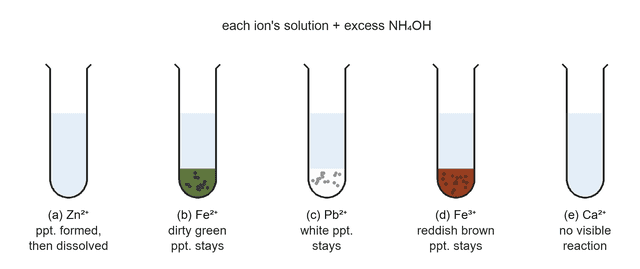
Watch out: Zn²⁺ and Pb²⁺ both give WHITE precipitates; with NH₄OH only the zinc one dissolves in excess.
Therefore, (a) → 3, (b) → 5, (c) → 2, (d) → 6, (e) → 1.
- 321 mark
Question 32
Harsh performed the following experiments in the laboratory. State one significant observation made by Harsh when:
sodium hydroxide solution was added to solution by him.
Solve with AIWritten solution
Solution:
Concept: When an alkali is added to a salt solution, its hydroxide ions () join the metal ions and form the metal hydroxide. Most metal hydroxides are insoluble in water, so they appear as a precipitate. The colour of the precipitate, and whether it dissolves when more alkali is added, tell us which metal ion is present.
Step 1 — Name the precipitate.
Copper sulphate contains copper (II) ions, so sodium hydroxide precipitates pale blue copper (II) hydroxide:
Step 2 — Say what happens in excess.
Unlike ammonium hydroxide, sodium hydroxide forms no soluble complex with copper, so the pale blue precipitate does not dissolve in excess NaOH.
Watch out: The deep blue solution appears only with excess NH₄OH, not with NaOH.
Therefore, a pale blue precipitate of copper (II) hydroxide forms, which is insoluble in excess sodium hydroxide.
- 331 mark
Question 33
Identify the following terms / compounds:
A reddish-brown precipitate formed when ferric chloride solution reacts with an alkali.
Solve with AIWritten solution
Solution:
Concept: When an alkali is added to a salt solution, its hydroxide ions () join the metal ions and form the metal hydroxide. Most metal hydroxides are insoluble in water, so they appear as a precipitate. The colour of the precipitate, and whether it dissolves when more alkali is added, tell us which metal ion is present.
Step 1 — Find the ion in ferric chloride.
Ferric chloride, , contains the iron (III) ion, .
Step 2 — Name the precipitate.
An alkali such as NaOH precipitates it as iron (III) hydroxide (ferric hydroxide), which is reddish brown and does not dissolve in excess alkali:
Watch out: Ferric means iron (III), so the hydroxide has three OH groups: Fe(OH)₃.
Therefore, the reddish-brown precipitate is ferric hydroxide (iron (III) hydroxide), Fe(OH)₃.
- 341 mark
Question 34
Complete the following sentences by choosing the correct option from the brackets:
The oxide that dissolves in caustic potash () is ............... . [ / ]
Solve with AIWritten solution
Solution:
Concept: An amphoteric substance reacts with both acids and alkalis, giving a salt and water in each case. The oxides and hydroxides of zinc, aluminium and lead are amphoteric, so they dissolve in excess of a strong alkali such as NaOH or KOH. Copper (II) oxide is a basic oxide.
Step 1 — Test zinc oxide.
Zinc oxide is amphoteric, so it reacts with caustic potash and dissolves, forming colourless, soluble potassium zincate and water:
Step 2 — Test copper (II) oxide.
Copper (II) oxide is basic: it reacts with acids but not with alkalis, so it does not dissolve in KOH.
Watch out: Caustic potash is KOH, so the salt formed is POTASSIUM zincate, not sodium zincate.
Therefore, the oxide that dissolves in caustic potash (KOH) is ZnO.
- 353 marks
Question 35
Give one relevant observation for the following:
(a) Sodium hydroxide is added dropwise to Calcium nitrate solution.
(b) Dilute Hydrochloric acid is added to Iron (II) sulphide.
(c) An amphoteric metal is added to hot concentrated alkali.
Solve with AIWritten solution
Solution:
Concept: Calcium hydroxide is a white, sparingly soluble precipitate. A metal sulphide with a dilute acid gives hydrogen sulphide gas. Amphoteric metals (zinc, aluminium, lead) react with hot, concentrated alkali, giving a soluble salt and hydrogen.
Step 1 — (a) Sodium hydroxide added dropwise to calcium nitrate.
A white precipitate of calcium hydroxide forms; it does not dissolve in excess NaOH:
Step 2 — (b) Dilute hydrochloric acid added to iron (II) sulphide.
There is effervescence: a colourless gas with a rotten-egg smell (hydrogen sulphide) is given off, and it turns moist lead acetate paper silvery black:
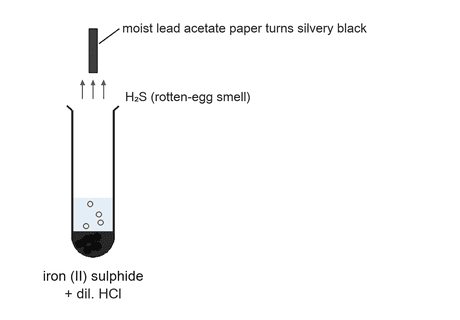
Step 3 — (c) An amphoteric metal added to hot concentrated alkali.
The metal dissolves with effervescence, giving off a colourless gas, hydrogen, which burns with a pop sound when a burning splint is brought near. With zinc:
Aluminium behaves the same way, giving sodium meta-aluminate and hydrogen:
Watch out: In (c) the gas is hydrogen, not oxygen: test it with a BURNING splint (pop), not a glowing one.
Therefore, (a) a white precipitate forms (insoluble in excess); (b) effervescence of a rotten-egg-smelling gas (H₂S) that turns lead acetate paper silvery black; (c) the metal dissolves with effervescence, giving hydrogen, which burns with a pop sound.
- 361 mark
Question 36
What do you observe when ammonium hydroxide solution is added first dropwise and then in excess to a solution of copper sulphate?
Solve with AIAnswer
(A) A pale blue precipitate that is insoluble in excess of ammonium hydroxide is seen.
(B) A curdy white precipitate that is soluble in excess of ammonium hydroxide is seen.
- Correct
(C) A pale blue precipitate is formed that dissolves in excess of ammonium hydroxide to form a deep blue solution.
(D) A curdy white precipitate that is insoluble in excess of ammonium hydroxide is seen.
Answer: (C) A pale blue precipitate is formed that dissolves in excess of ammonium hydroxide to form a deep blue solution.
Concept: Copper (II) hydroxide is pale blue. Copper (II) hydroxide and zinc hydroxide dissolve in excess ammonium hydroxide because they form soluble ammine complexes: tetraammine copper (II) ions, which are deep (inky) blue, and tetraammine zinc (II) ions, which are colourless.
Step 1 — Add NH₄OH dropwise.
The first drops give a pale blue precipitate of copper (II) hydroxide:
Step 2 — Add excess NH₄OH.
The precipitate dissolves, giving a deep (inky) blue solution of tetraammine copper (II) sulphate. This is the special test for the copper (II) ion:
Watch out: A pale blue precipitate that STAYS in excess is what copper sulphate gives with sodium hydroxide, not with ammonium hydroxide.
Why the other options are wrong:
- (A) A pale blue precipitate that is insoluble in excess of ammonium hydroxide is seen: the precipitate is pale blue, but it does dissolve in excess .
- (B) A curdy white precipitate that is soluble in excess of ammonium hydroxide is seen: copper (II) hydroxide is pale blue, not curdy white. A curdy white precipitate that dissolves in is silver chloride.
- (D) A curdy white precipitate that is insoluble in excess of ammonium hydroxide is seen: copper (II) hydroxide is pale blue, not white, and it dissolves in excess .
Therefore, the observation is a pale blue precipitate that dissolves in excess to a deep blue solution, option (C).
- 371 mark
Question 37
Name the following:
An alkali in which both copper hydroxide and zinc hydroxide can be dissolved.
Solve with AIWritten solution
Solution:
Concept: Copper (II) hydroxide and zinc hydroxide dissolve in excess ammonium hydroxide because they form soluble ammine complexes: tetraammine copper (II) ions, which are deep (inky) blue, and tetraammine zinc (II) ions, which are colourless. Sodium hydroxide dissolves zinc hydroxide (as sodium zincate) but not copper (II) hydroxide.
Step 1 — Test both hydroxides with ammonium hydroxide.
Both dissolve in excess : copper (II) hydroxide to a deep blue solution and zinc hydroxide to a colourless solution:
Step 2 — Test both with sodium hydroxide.
Zinc hydroxide dissolves in excess NaOH, but copper (II) hydroxide stays as a pale blue precipitate, so sodium hydroxide does not fit.
Watch out: The alkali must dissolve BOTH hydroxides; NaOH dissolves only the zinc one.
Therefore, the alkali is ammonium hydroxide (ammonia solution), NH₄OH.
- 381 mark
Question 38
Name the following:
The cation that forms a reddish brown precipitate when its salt solution reacts with a strong alkali.
Solve with AIWritten solution
Solution:
Concept: When an alkali is added to a salt solution, its hydroxide ions () join the metal ions and form the metal hydroxide. Most metal hydroxides are insoluble in water, so they appear as a precipitate. The colour of the precipitate, and whether it dissolves when more alkali is added, tell us which metal ion is present.
Step 1 — Identify the precipitate.
A reddish brown hydroxide precipitate is iron (III) hydroxide, .
Step 2 — Name the cation.
So the salt solution must contain the iron (III) (ferric) ion, which a strong alkali such as NaOH precipitates:
The precipitate does not dissolve in excess alkali.
Watch out: The iron (II) ion gives a DIRTY GREEN precipitate, not a reddish brown one.
Therefore, the cation is the iron (III) ion (ferric ion), Fe³⁺.
- 391 mark
Question 39
Choose the answer from the list of compounds given below:
sodium bisulphite, ferric oxide, iron (II) chloride, sodium sulphate, aluminium oxide
The compound which will form a dirty green precipitate with .
Solve with AIWritten solution
Solution:
Concept: When an alkali is added to a salt solution, its hydroxide ions () join the metal ions and form the metal hydroxide. Most metal hydroxides are insoluble in water, so they appear as a precipitate. The colour of the precipitate, and whether it dissolves when more alkali is added, tell us which metal ion is present.
Step 1 — Identify the precipitate.
A dirty green precipitate with NaOH is iron (II) hydroxide, so the compound must contain the iron (II) ion and dissolve in water.
Step 2 — Pick it from the list.
Iron (II) chloride, , is the soluble iron (II) compound in the list:
Ferric oxide contains iron (III) and is insoluble in water; aluminium oxide gives no coloured precipitate; the sodium salts give no precipitate with NaOH.
Watch out: Ferric oxide also contains iron, but iron (III), which would give a reddish brown hydroxide.
Therefore, the compound is iron (II) chloride (FeCl₂).