Solution:
Concept: The colour of the precipitate with ammonium hydroxide identifies the cation. A precipitate with silver nitrate identifies a halide anion by its colour: white for chloride, pale yellow for bromide, yellow for iodide.
Step 1 — (a) Find the cation from the first part.
A reddish brown precipitate with NH4OH is iron (III) hydroxide, so the cation is the iron (III) (ferric) ion:
Fe3++3OH−→Fe(OH)3↓
Step 2 — (b) Find the anion from the second part.
A white precipitate with silver nitrate is silver chloride, so the anion is the chloride ion:
Ag++Cl−→AgCl↓
Step 3 — Put the two ions together.
The salt contains Fe3+ and Cl− ions, so it is iron (III) chloride, FeCl3. Both tests written as full equations:
FeCl3+3NH4OH→Fe(OH)3↓+3NH4Cl
FeCl3+3AgNO3→3AgCl↓+Fe(NO3)3
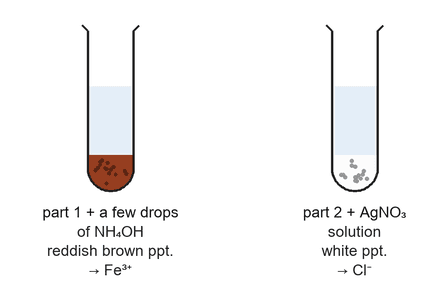
Watch out: The reddish brown precipitate is iron (III), not iron (II), which would be dirty green.
Therefore, (a) the cation is Fe³⁺ (iron (III) or ferric ion); (b) the anion is Cl⁻ (chloride ion), so the salt is iron (III) chloride, FeCl₃.
