
Question 124 marksAsked 2018Medium
Give a chemical test to distinguish between the following pairs of chemicals:
(i) Lead nitrate solution and Zinc nitrate solution
(ii) Sodium chloride solution and Sodium nitrate solution
Confirming your payment
Sign up now and get 250 free tokens.
Previous Year Questions · Question 12 of 39
Give a chemical test to distinguish between the following pairs of chemicals:
(i) Lead nitrate solution and Zinc nitrate solution
(ii) Sodium chloride solution and Sodium nitrate solution
Solution:
Concept: For a distinguishing test, choose a reagent that gives a different, visible result with each member of the pair. Copper (II) hydroxide and zinc hydroxide dissolve in excess ammonium hydroxide because they form soluble ammine complexes: tetraammine copper (II) ions, which are deep (inky) blue, and tetraammine zinc (II) ions, which are colourless.
Step 1 — (i) Choose the reagent for lead and zinc.
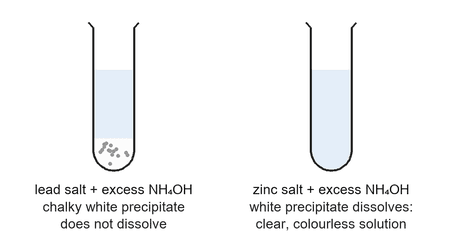
Lead and zinc hydroxides are both white, and both dissolve in excess NaOH, so NaOH cannot tell them apart. In excess ammonium hydroxide, however, zinc hydroxide dissolves and lead hydroxide does not. So we add drop by drop, then in excess, to each solution.
Step 2 — (i) Lead nitrate.
A chalky white precipitate of lead hydroxide forms, which is insoluble in excess :
Step 3 — (i) Zinc nitrate.
A white gelatinous precipitate of zinc hydroxide forms, which dissolves in excess , giving a clear, colourless solution:
Step 4 — (ii) Choose the reagent for chloride and nitrate.
Both salts are sodium salts, so the difference is in the anion. Chloride ions give a white precipitate with silver nitrate solution (acidified with dilute nitric acid); nitrate ions give none. We add a few drops to each solution.
Step 5 — (ii) Sodium chloride and sodium nitrate.
Sodium chloride gives a curdy white precipitate of silver chloride, which does not dissolve in dilute nitric acid:
Sodium nitrate gives no precipitate: the solution stays clear, because all nitrates are soluble.

Watch out: For (i), sodium hydroxide is the wrong reagent: BOTH white precipitates dissolve in excess NaOH.
Therefore, (i) with excess NH₄OH, lead nitrate gives a white precipitate that stays, while zinc nitrate gives a white precipitate that dissolves; (ii) with silver nitrate, sodium chloride gives a curdy white precipitate, while sodium nitrate gives none.