
Question 81 markMCQAsked 2018Easy
The salt solution which does not react with ammonium hydroxide is:
Confirming your payment
Sign up now and get 250 free tokens.
Previous Year Questions · Question 8 of 39
The salt solution which does not react with ammonium hydroxide is:
(A) Calcium Nitrate
(B) Zinc Nitrate
(C) Lead Nitrate
(D) Copper Nitrate
Answer: (A) Calcium Nitrate
Concept: Ammonium hydroxide is a weak alkali: it is only slightly ionised, so it gives only a few ions. Sodium hydroxide is a strong alkali and gives many ions. Its ion concentration is enough to precipitate the hydroxides of zinc, lead and copper, but too low to precipitate calcium hydroxide.
Step 1 — Test calcium nitrate.
Calcium nitrate solution shows no visible change, even with excess : no precipitate forms, so it does not react.
Step 2 — Test the other three.
Zinc nitrate, lead nitrate and copper nitrate each give a precipitate with a few drops of , so each of them does react.
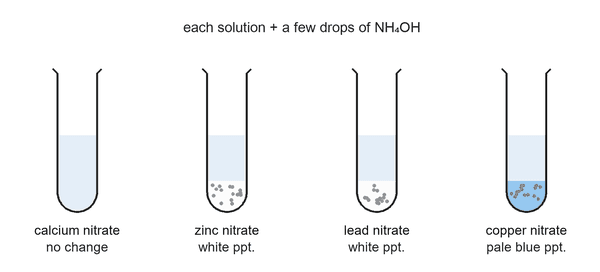
Watch out: A precipitate that later dissolves in excess (zinc, copper) still means the salt REACTED with NH₄OH.
Why the other options are wrong:
Therefore, the salt solution that does not react with ammonium hydroxide is calcium nitrate, option (A).