Solution:
Concept: Copper (II) hydroxide and zinc hydroxide dissolve in excess ammonium hydroxide because they form soluble ammine complexes: tetraammine copper (II) ions, which are deep (inky) blue, and tetraammine zinc (II) ions, which are colourless. Lead chloride dissolves in hot water, but lead sulphate does not.
Step 1 — (i) Add each alkali to copper sulphate solution.
Add each alkali drop by drop, then in excess, to separate samples of copper sulphate solution. With a few drops, both alkalis give the same pale blue precipitate of copper (II) hydroxide:
CuSO4+2NH4OH→Cu(OH)2↓+(NH4)2SO4
CuSO4+2NaOH→Cu(OH)2↓+Na2SO4
Step 2 — (i) Watch what happens in excess.
The two alkalis now behave differently, which tells them apart:
- Ammonium hydroxide: the precipitate dissolves, giving a deep (inky) blue solution of tetraammine copper (II) sulphate.
- Sodium hydroxide: the pale blue precipitate does not dissolve in excess.
Cu(OH)2+(NH4)2SO4+2NH4OH→[Cu(NH3)4]SO4+4H2O

Step 3 — Add lead nitrate solution to each acid.
Lead nitrate gives a white precipitate with both acids, because lead chloride and lead sulphate are both only slightly soluble in cold water.
Pb(NO3)2+2HCl→PbCl2↓+2HNO3
Pb(NO3)2+H2SO4→PbSO4↓+2HNO3
Step 4 — Heat both test tubes.
Since both precipitates are white, their colour cannot tell the acids apart. We use their solubility in hot water instead:
- Dilute hydrochloric acid: the white precipitate of lead chloride dissolves on heating, because lead chloride is soluble in hot water. It reappears as crystals when the solution cools.
- Dilute sulphuric acid: the white precipitate of lead sulphate does not dissolve even on heating, because lead sulphate is insoluble in hot water too.
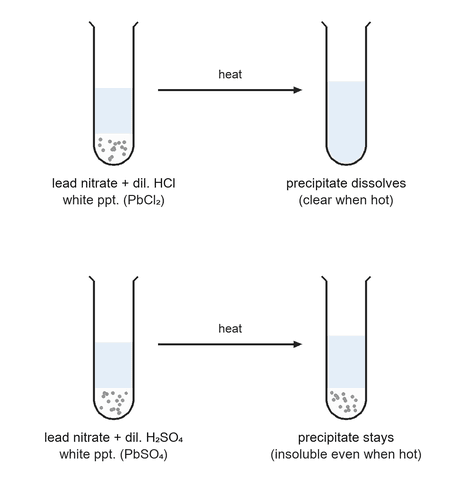
Watch out: In (ii) both acids give a WHITE precipitate, so you must say what happens on heating; naming the colour alone scores nothing.
Therefore, (i) excess NH₄OH dissolves the pale blue precipitate to a deep blue solution, while excess NaOH leaves it undissolved; (ii) the white precipitate with dilute HCl (PbCl₂) dissolves on heating, while the white precipitate with dilute H₂SO₄ (PbSO₄) does not.
