Solution:
Concept: When an alkali is added to a salt solution, its hydroxide ions (OH−) join the metal ions and form the metal hydroxide. Most metal hydroxides are insoluble in water, so they appear as a precipitate. The colour of the precipitate, and whether it dissolves when more alkali is added, tell us which metal ion is present. Ammonium hydroxide is a weak alkali: it is only slightly ionised, so it gives only a few OH− ions. Sodium hydroxide is a strong alkali and gives many OH− ions. So calcium is the exception: NH4OH gives too few OH− ions to precipitate it.
Step 1 — (a) Zn²⁺.
White gelatinous zinc hydroxide forms, then dissolves in excess as the soluble, colourless tetraammine zinc (II) ion, so Zn²⁺ matches 3. With zinc sulphate, for example:
Zn2++2OH−→Zn(OH)2↓
Zn(OH)2+(NH4)2SO4+2NH4OH→[Zn(NH3)4]SO4+4H2O
Step 2 — (b) Fe²⁺.
Dirty green iron (II) hydroxide forms and stays in excess, so Fe²⁺ matches 5:
Fe2++2OH−→Fe(OH)2↓
Step 3 — (c) Pb²⁺.
Chalky white lead hydroxide forms and stays in excess NH4OH, so Pb²⁺ matches 2:
Pb2++2OH−→Pb(OH)2↓
Step 4 — (d) Fe³⁺.
Reddish brown iron (III) hydroxide forms and stays in excess, so Fe³⁺ matches 6:
Fe3++3OH−→Fe(OH)3↓
Step 5 — (e) Ca²⁺.
No precipitate forms, even in excess, because the OH− concentration from NH4OH is too low to precipitate calcium hydroxide, so Ca²⁺ matches 1.
Step 6 — Collect the matches.
Entry 4 (blue precipitate soluble in excess) is left over: it describes the copper (II) ion, which is not in List X.
| List X | List Y |
|---|
| (a) Zn2+ | 3. Gelatinous white precipitate soluble in excess |
| (b) Fe2+ | 5. Dirty green precipitate insoluble in excess |
| (c) Pb2+ | 2. White precipitate insoluble in excess |
| (d) Fe3+ | 6. Reddish brown precipitate insoluble in excess |
| (e) Ca2+ | 1. No visible reaction |
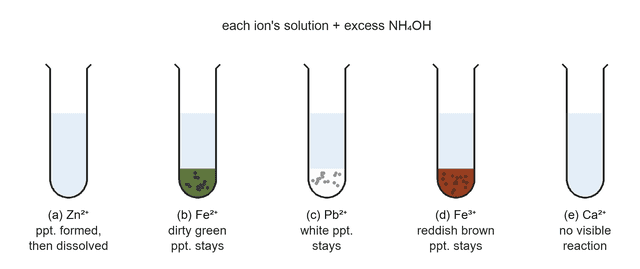
Watch out: Zn²⁺ and Pb²⁺ both give WHITE precipitates; with NH₄OH only the zinc one dissolves in excess.
Therefore, (a) → 3, (b) → 5, (c) → 2, (d) → 6, (e) → 1.
