
Question 301 markMCQAsked 2025Easy
A salt solution which gives a reddish-brown precipitate with and a white precipitate with solution is:
Confirming your payment
Sign up now and get 250 free tokens.
Previous Year Questions · Question 30 of 39
A salt solution which gives a reddish-brown precipitate with and a white precipitate with solution is:
(A)
(B)
(C)
(D)
Answer: (C)
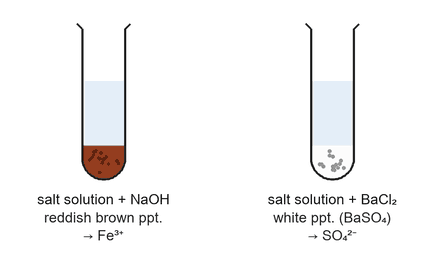
Concept: Use the two tests one at a time. A reddish brown precipitate with NaOH shows the cation is . A white precipitate with barium chloride, from the salts offered, shows the anion is sulphate, .
Step 1 — Find the cation.
Iron (III) hydroxide is reddish brown, so the salt must contain :
Step 2 — Find the anion.
Barium sulphate is a white precipitate, so the salt must contain :
Step 3 — Combine the two results.
The only salt offered that has both and is iron (III) sulphate.
Watch out: Each test identifies only ONE ion; an option must pass both tests.
Why the other options are wrong:
Therefore, the salt is iron (III) sulphate, option (C).