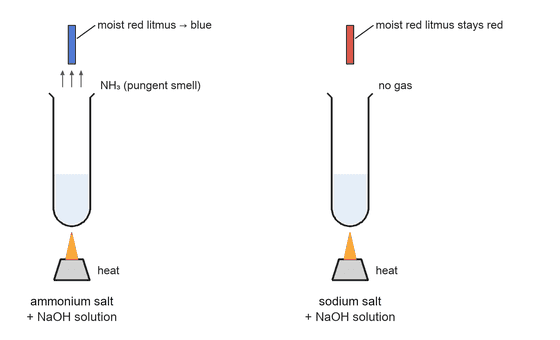
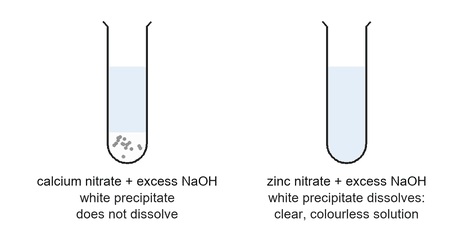
Concept: Ammonium salts give ammonia gas when warmed with an alkali; sodium salts do not. Zinc hydroxide dissolves in excess NaOH (it is amphoteric), but calcium hydroxide does not.
Step 1 — (a) Warm each salt with sodium hydroxide.
Ammonium chloride gives ammonia gas, which has a pungent smell and turns moist red litmus paper blue:
NH4Cl+NaOHΔNaCl+H2O+NH3↑
Sodium chloride gives no gas and no change.
Step 2 — (b) Add NaOH to each nitrate, then excess.
Zinc nitrate gives a white gelatinous precipitate which dissolves in excess NaOH, giving a clear, colourless solution of sodium zincate:
Calcium nitrate gives a white precipitate which does not dissolve in excess NaOH:
Ca(NO3)2+2NaOH→Ca(OH)2↓+2NaNO3
Watch out: In (a) the mixture must be WARMED, and the ammonia is tested with MOIST red litmus.
Therefore, (a) ammonium chloride gives ammonia (moist red litmus turns blue) with an alkali, while sodium chloride gives no gas; (b) with excess NaOH the zinc nitrate precipitate dissolves, while the calcium nitrate precipitate stays.