
Question 361 markMCQAsked 2026Easy
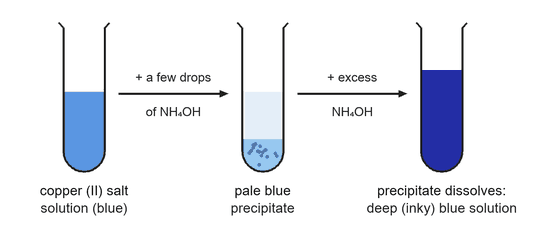
What do you observe when ammonium hydroxide solution is added first dropwise and then in excess to a solution of copper sulphate?
Confirming your payment
Sign up now and get 250 free tokens.
Previous Year Questions · Question 36 of 39
What do you observe when ammonium hydroxide solution is added first dropwise and then in excess to a solution of copper sulphate?
(A) A pale blue precipitate that is insoluble in excess of ammonium hydroxide is seen.
(B) A curdy white precipitate that is soluble in excess of ammonium hydroxide is seen.
(C) A pale blue precipitate is formed that dissolves in excess of ammonium hydroxide to form a deep blue solution.
(D) A curdy white precipitate that is insoluble in excess of ammonium hydroxide is seen.
Answer: (C) A pale blue precipitate is formed that dissolves in excess of ammonium hydroxide to form a deep blue solution.
Concept: Copper (II) hydroxide is pale blue. Copper (II) hydroxide and zinc hydroxide dissolve in excess ammonium hydroxide because they form soluble ammine complexes: tetraammine copper (II) ions, which are deep (inky) blue, and tetraammine zinc (II) ions, which are colourless.
Step 1 — Add NH₄OH dropwise.
The first drops give a pale blue precipitate of copper (II) hydroxide:
Step 2 — Add excess NH₄OH.
The precipitate dissolves, giving a deep (inky) blue solution of tetraammine copper (II) sulphate. This is the special test for the copper (II) ion:
Watch out: A pale blue precipitate that STAYS in excess is what copper sulphate gives with sodium hydroxide, not with ammonium hydroxide.
Why the other options are wrong:
Therefore, the observation is a pale blue precipitate that dissolves in excess to a deep blue solution, option (C).