Solution:
Concept: Calcium hydroxide is a white, sparingly soluble precipitate. A metal sulphide with a dilute acid gives hydrogen sulphide gas. Amphoteric metals (zinc, aluminium, lead) react with hot, concentrated alkali, giving a soluble salt and hydrogen.
Step 1 — (a) Sodium hydroxide added dropwise to calcium nitrate.
A white precipitate of calcium hydroxide forms; it does not dissolve in excess NaOH:
Ca(NO3)2+2NaOH→Ca(OH)2↓+2NaNO3

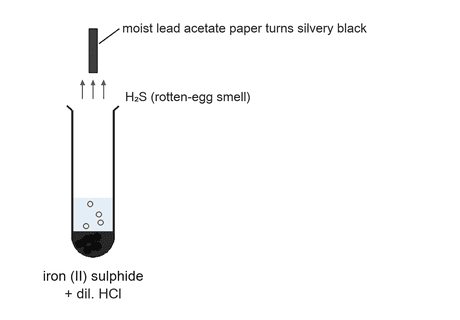
Step 2 — (b) Dilute hydrochloric acid added to iron (II) sulphide.
There is effervescence: a colourless gas with a rotten-egg smell (hydrogen sulphide) is given off, and it turns moist lead acetate paper silvery black:
FeS+2HCl→FeCl2+H2S↑
Step 3 — (c) An amphoteric metal added to hot concentrated alkali.
The metal dissolves with effervescence, giving off a colourless gas, hydrogen, which burns with a pop sound when a burning splint is brought near. With zinc:
Zn+2NaOH→Na2ZnO2+H2↑
Aluminium behaves the same way, giving sodium meta-aluminate and hydrogen:
2Al+2NaOH+2H2O→2NaAlO2+3H2↑

Watch out: In (c) the gas is hydrogen, not oxygen: test it with a BURNING splint (pop), not a glowing one.
Therefore, (a) a white precipitate forms (insoluble in excess); (b) effervescence of a rotten-egg-smelling gas (H₂S) that turns lead acetate paper silvery black; (c) the metal dissolves with effervescence, giving hydrogen, which burns with a pop sound.
